The home of architecture and design in the Asia-Pacific
Get the latest design news direct to your inbox!

Get the latest design news direct to your inbox!
Rather than relegating learning to only classrooms, Henning Larsen’s Hong Kong studio has designed the entire French International School of Hong Kong as a playground for exploration, education and eco-friendliness.

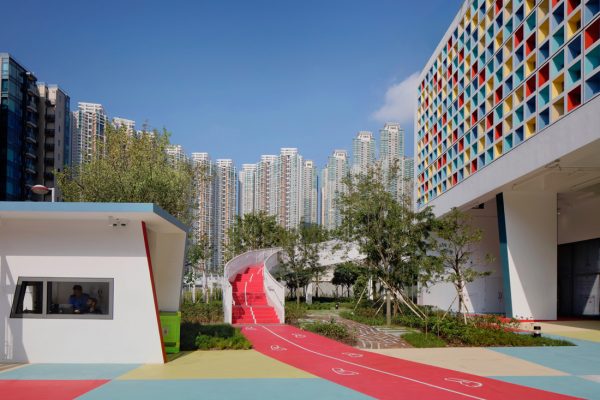
Hong Kong’s concrete landscape has been blessed with a burst of colour in the form of the French International School of Hong Kong’s Tseung Kwan O campus. Designed by the Hong Kong studio of Danish architecture firm Henning Larsen, the campus is an invitation to play with a rainbow palette running up and down and across the school’s walls and floors.
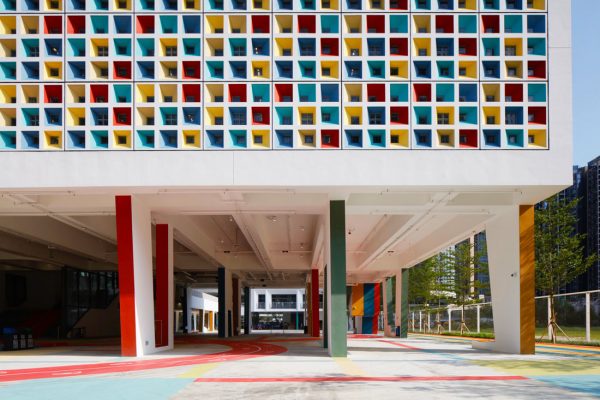
The institution comprises a Primary School and College for 1,100 students, divided into two blocks arranged perpendicularly. From afar, the most intriguing component is the Primary School’s facade – a blockish composition of deep-set brise-soleil built with 715 concrete and glass bricks that subtly reflect coloured light inward.
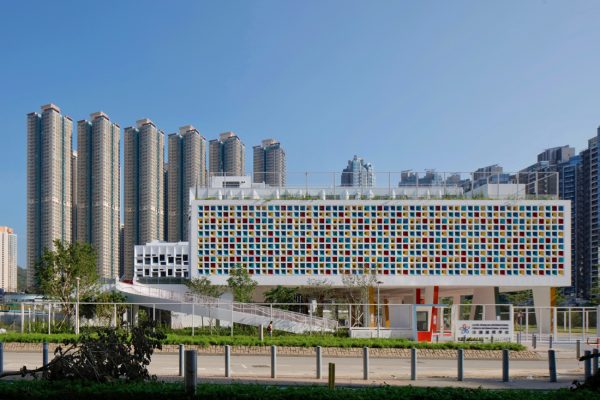
The college block has a different facade design that also has brise-soleil as well as balconies that mitigate Hong Kong’s subtropical climate. These gestures protect classrooms from indirect sunlight and increase thermal comfort while maximising daylight entry, thus removing any need for blinds. Additionally, all classrooms face north or south to mitigate the low, harsh sun from the east and west from October to March, so there is no need for mechanical ventilation and cooling during this period.
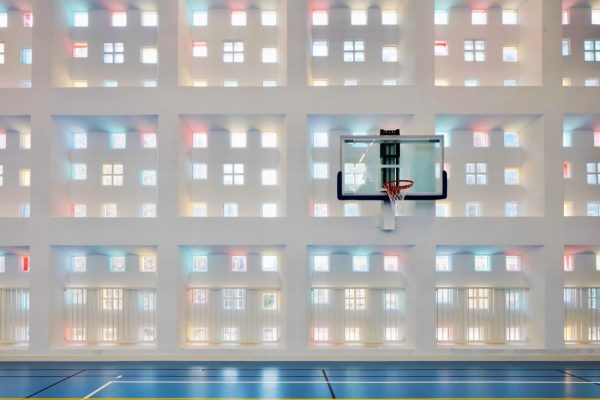
Other features add up to make the school an impressive case study for sustainability. Eco-friendly materials include bamboo sourced from renewable forests, non-toxic paints and pure woollen fabrics. A total of 42 trees spread over the campus, a plant-covered perimeter fence, multi-storey hanging gardens and a 550-square-metre botanical garden planted with South Chinese vegetation all contribute to a 20-per-cent green plot ratio. At the same time, the greenery offers respite among the structures and improves the overall air quality of the campus.
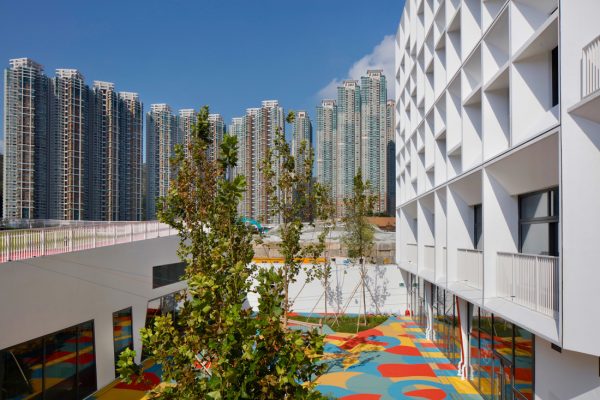
The prevalent use of colour is particularly apt for the typology. Its articulation on the facade is reminiscent of Le Corbusier’s Unite d’Habitation – optimistic, sophisticated and iconic. “Five carefully selected colours are applied in different locations within the project and are contrasted with the building’s overall white aspect, giving it a strong identity,” shares Claude Bojer Godefroy, Partner and Design Director at Henning Larsen Architects Hong Kong Ltd.
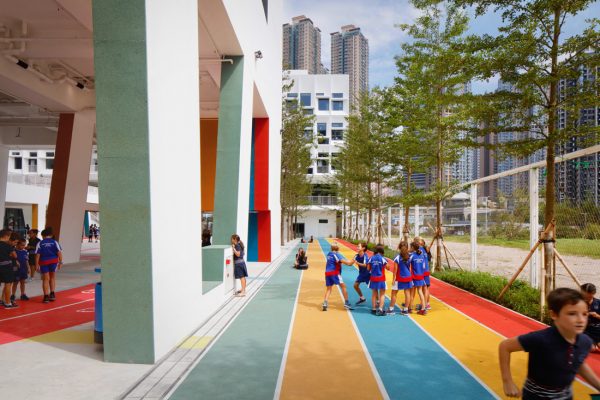
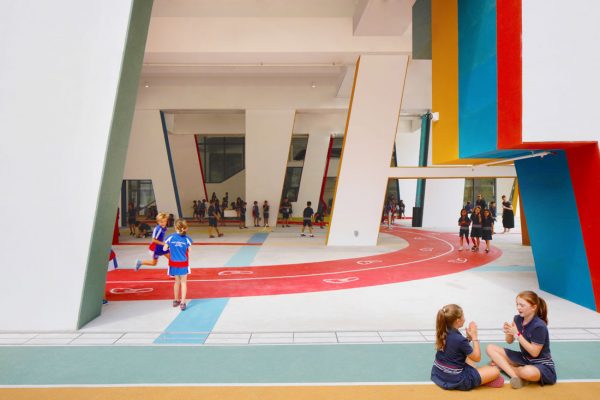
A 400-metre-long track nicknamed ‘The Loop’ winds its way through the school, uniting the different spaces. Its psychedelic shades runs up stairs and bends under the Primacy School volume, which is raised on pilotis to highlight the main entrance and form a sheltered playground beneath.
Here, gaps and extruded parts in the angled columns become sculpted play furniture called ‘playstations’ and are specially designed for uses and activities as expansive as the imagination can think up, explains Bojer Godefroy.
Another inventive spatial feature is found indoors. Instead of conventional, isolated classrooms linked to a corridor that purely functions as transition space, each cluster of five open-plan classrooms (termed a ‘villa’) merge into a centralised common space called the ‘agora’.
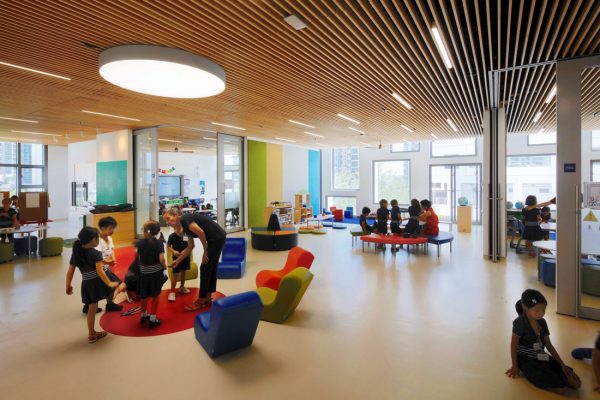
“Sliding and acoustic glass doors allow much spatial flexibility while accommodating different teaching methods. Thus, exchange and cooperation between classrooms is promoted, which is beneficial to learning and the development of multi-lingual skills,” says Bojer Godefroy, highlighting the school’s international make up.
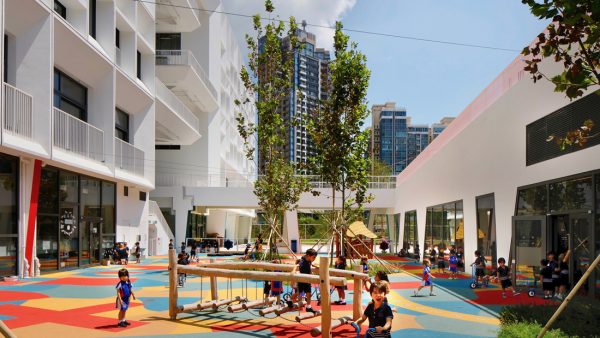
Cohesiveness, community and connectivity are all qualities intrinsic to learning and growth. These qualities are found not only in the school’s design. They are also expressed in the opening up of facilities, such as the playground and assembly ground, for public use on weekends and during cultural events to a neighbouring cluster of residential high-rises that forms part of this new district on reclaimed land.
Architect: Henning Larsen
Architecture Project Team: Elva Tang, Claude Godefroy (Partners), Thomas Bormann, Ka Tam
Executive Architect: AGC Design
Engineer: Henning Larsen (sustainability), WSP (structure, MEP, BEAM), Inhabit (facade)
Landscape Architect: Bassinet Turquin Paysage, Aecom
Contractor: Paul Y Builders
Acoustics Consultant: Marshall Day
Lighting Consultant: Lichtvision
Total Land Area: 8,200 square metres
Area: 20,000 square metres
Fixtures and Fittings: Dorma
Interior Floor and Wall Materials: Nora Plan, Keim Colour, Agrob-Buchtal, Bamboo International, Gerflor, Clestra, Kvadrat
Joinery: Clestra, Formica
Decorative Lighting: Lucibel, Zumtobel
Interior Furniture: Steelcase, Ascender
INDESIGN is on instagram
Follow @indesignlive
A searchable and comprehensive guide for specifying leading products and their suppliers
Keep up to date with the latest and greatest from our industry BFF's!
The internet never sleeps! Here's the stuff you might have missed