The home of architecture and design in the Asia-Pacific
Get the latest design news direct to your inbox!

Get the latest design news direct to your inbox!
Elegantly designed for refined dining, Gradini Ristorante Italiano is a refreshing change to the ultra modern, industrial-style restaurants that have become ubiquitous in Hong Kong, writes Martine Beale.

October 27th, 2014
Gradini Ristorante Italiano resides in the recently opened Pottinger Hotel on Pottinger Street in Central (see our story here). In Italian, the word ‘gradini’ means steps, which directly correlates to the fact that Pottinger Street, one of the Island’s oldest streets, is formed from granite slab steps.
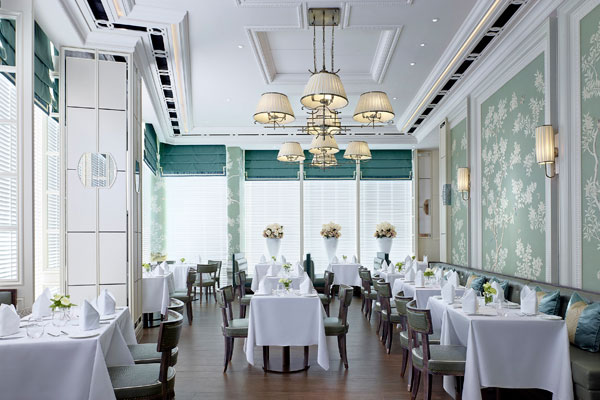
Just like the Hotel itself, Gradini’s design is based on the history of Pottinger Street and surrounding streets, and has an Oriental meets Colonial sensibility whilst managing to resist the temptation of being kitsch. In fact, it’s fair to say that Gradini exudes a respectful air of timeless elegance.
“The design had to encapsulate and embody many qualities,” says Rudolf Leong, Director of LCL Architects, the architectural firm behind the project.
“And, this was somewhat challenging. The restaurant’s cuisine was Italian yet the restaurant was located in a hotel celebrating Hong Kong’s heritage and the meeting of east and west. It also had to embody a sophistication befitting the Head Chef, Giovanni Greggio.
Our brief included chinoiserie inspired elements, and thus inspiration had to be drawn from chinoiserie’s decorative influence on Italian royal courts of the 17th and 18th century,” Leong explains.
Gradini is graced with fabulously high ceilings and floor to ceiling windows that during the day cast an abundance of natural light over its crisp white tablecloths and sage green wallpaper.
“The custom designed wallpaper was specially commissioned in a colourway to suit the overall palette of materials for Gradini’s interiors, and depicts a typical chinoiserie scene of flowers, birds and insects hand painted in a western style,” Leong says.
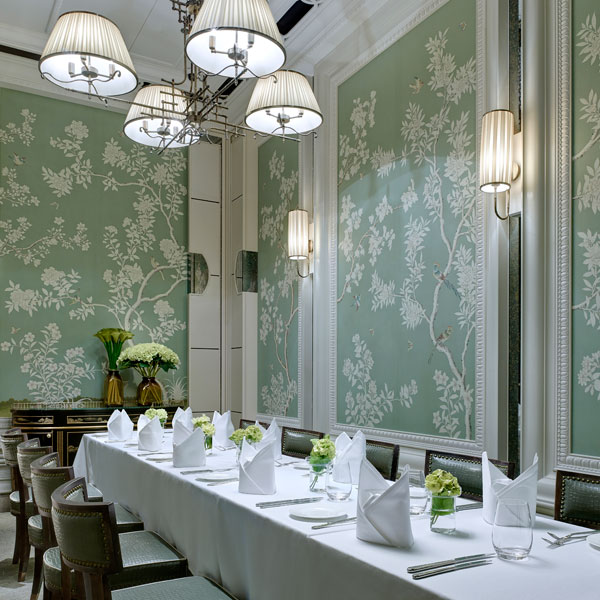
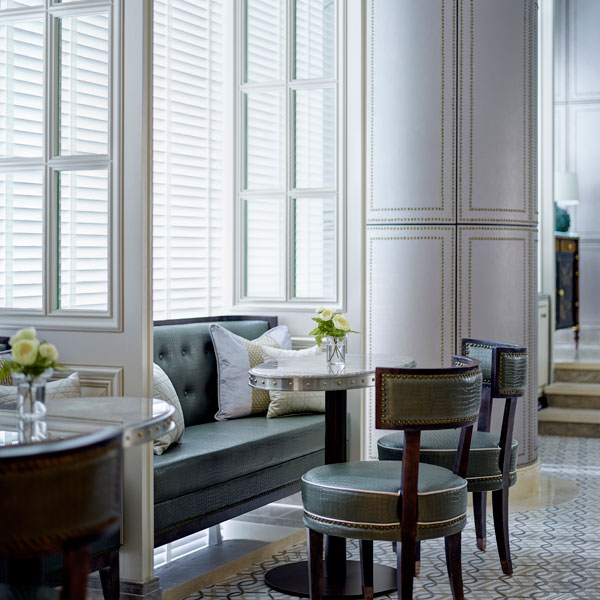
Green was used as a signature colour against a cream and taupe backdrop to evoke a harmonious ambience, and carries across onto window dressing, as well as custom-designed banquettes and chairs that feature meticulous stud work.
“Brass studs or tacks have been used in furniture construction for centuries,” Leong points out. “Before the advent of machinery and adhesives, this would have been a common method of ‘tacking’ down a seat or back cover onto a frame.”
The brass studs are also employed decoratively on large round columns and along the front of the bar, where they juxtapose nicely with the green and white patterned floor tiles that extend from the Hotel’s main lobby.
“The tiles evoke a casual, chic ambience, while the floor in the restaurant’s dining hall is finished in timber to evoke a more formal, traditional dining setting. The private dining room floor is also finished in timber, however, it has an area rug to create a cosier, more intimate setting.”
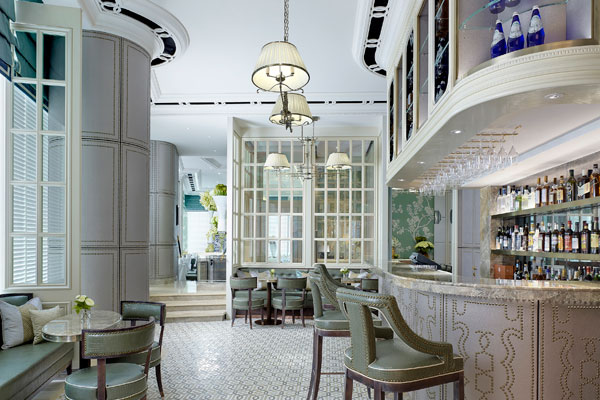
Additional ambience is generated by a variety of lights. “Lighting creates mood and is a critical element in restaurant design,” says Leong.
The lighting here comprises a mix of custom made, matching ceiling and wall fixtures. “The ceiling hung lamps are inspired by classical billiard pendants and are constructed of a metal frame with an antique brass finish. The metal frame is cast to mimic bamboo twigs, which lend further to the decor’s chinoiserie flavour.”
LCL also turned what could have been a problem area into an advantage, namely, the restaurant’s exit stairwell, which sits in the middle of the restaurant and divides the bar from the main dining hall.
“If solid fire-rated walls had been used to enclose the stairwell, it would have been an eyesore,” says Leong.
“Instead, we created a fire rated enclosure out of glass and timber, and designed it in the same vein as the glass pane doors in the Hotel’s lobby and other parts of the restaurant. The result is a light and airy atrium enclosure that still affords a visual connection between the dining hall and bar area.”
Says Gina Tam, Hotel Manager of The Pottinger, “Guests regularly remark about the restaurant’s classic and contemporary design and the spectacular high ceilings.
“As well as how refreshing it is to see a restaurant and bar with such a classic and heritage inspired design, it’s rare to find new establishments opening that have the elegance and timeless class of Gradini.”
LCL Architects
lclarchitects.com
INDESIGN is on instagram
Follow @indesignlive
A searchable and comprehensive guide for specifying leading products and their suppliers
Keep up to date with the latest and greatest from our industry BFF's!
The internet never sleeps! Here's the stuff you might have missed