The home of architecture and design in the Asia-Pacific
Get the latest design news direct to your inbox!

Get the latest design news direct to your inbox!
The skin, hair and body care brand talks about the design process behind Aesop Fashion Walk and Aesop Galaxy.

June 16th, 2016
Founded in Melbourne in 1987, Aesop has always been about creating beautiful skin and hair care products using plant-based materials and laboratory-made ingredients. Its scents are distinctive and recognised all over Asia, as are its brown bottles. Something Aesop is also known for is its approach to the design of its stores; authenticity is key, particularly with respect to the culture and craftsmanship of the environment each of their stores sits in. Here, the brand’s design team gives us the inside scoop on what it takes to create an authentic Aesop store. They talk us through the process behind Aesop Fashion Walk in Hong Kong’s Causeway Bay, and Aesop Galaxy at Galaxy Macau’s shopping mall.
How does the design process usually start at Aesop?
Usually the architect on each store project will receive a document from Dennis Paphitis, Aesop’s Founder. Mostly it’s about two literature readings. The first is In Praise of Shadows, by Junichiro Tanizaki.
The second is by Dennis himself, he writes about what he thinks good design means. There are three key terms here: being sincere, being authentic, and being timeless. Timelessness is mostly about looking at the culture of a place in a broader sense. Materials that have come from the region that store is located in, and a culture of technique that has been cultivated in that region. It’s about craftsmanship.
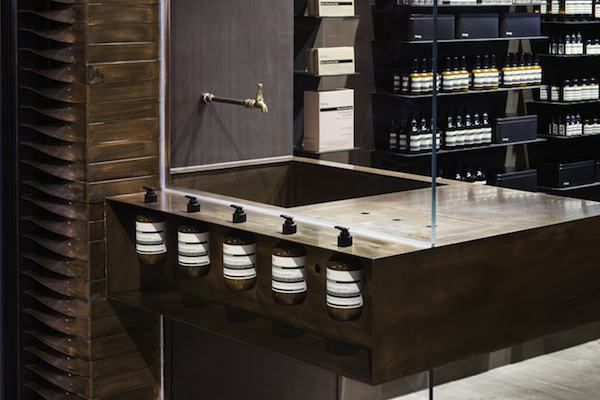
A hand-made copper basin at Aesop Fashion Walk
How did this happen with the Aesop Fashion Walk store?
Our store at Fashion Walk has been there since 2014. We were thinking we should give new life to it. We knew that we had a very large facade, and that the facade needed to be ventilated, as our shop is right under the shopping mall’s exhaust fan. If we wanted to have a cool façade, we had to make it as porous as possible so that the mall would allow us to place something over the exhaust fan. We also had to do lots of technical drawings to show the mall how it would look and function.
The team of contractors was thinking about using metal. These days, people use metal that has been pre-fabricated in factories. These talented young contractors felt it didn’t really showcase what they could do – they can really bend metal!
They bend it by hand using a crank. If you want to put a 90-degree turn in the metal, you have to turn it one full crank. Of course, you can’t control the curve; metal is very lively, especially brass and copper. This is where the whole idea for the facade started.
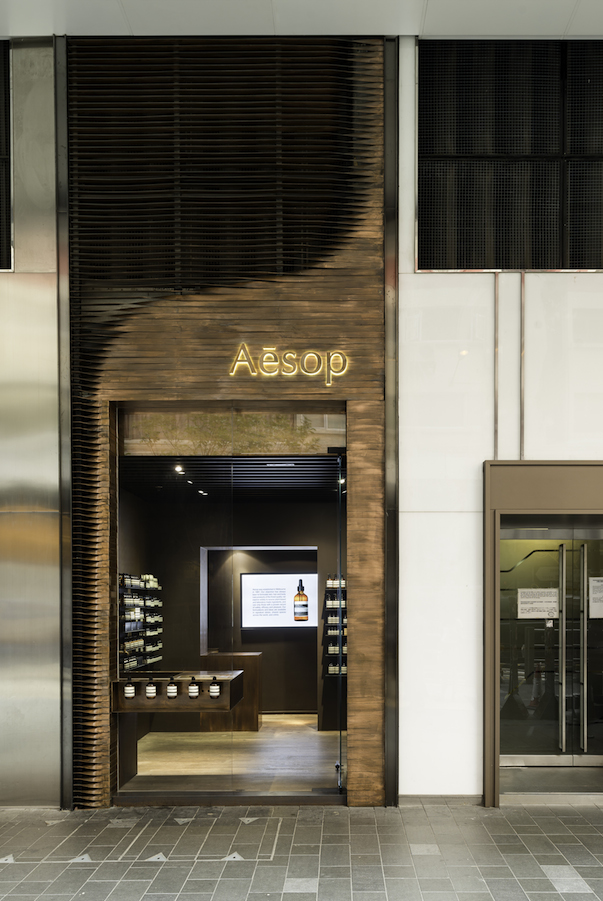
The curving metal facade at Aesop Fashion Walk
What inspired the design for Aesop Galaxy?
Galaxy Macau a nice shopping mall, but the context is not very relevant to Aesop. We like wine, but gambling is not really on-brand. So from the beginning, we wanted to make ourselves disappear but more aggressively. We wanted to “aggressively disappear”!
We looked at the work of Doug Wheeler, [among others]. He’s a very well-known installation artist, who knows how to make things disappear by manipulating light.
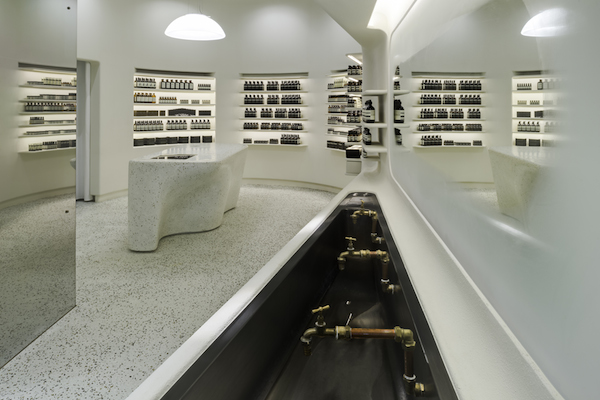
Manipulating light at Aesop Galaxy
How did you apply these ideas to Aesop Galaxy, and what was the build process like?
We started exploring materials once the concept was confirmed. We knew we would have this white plaster wall with a mirror that disappears, but this is quite standard. What was different was that we invented our own terrazzo. We needed something unique at Aesop Galaxy, but also something safe and polished, given the high traffic coming through the store.
In Guangzhou, a lot of the architecture features terrazzo, but the people there no longer make it. We wanted our efforts at Aesop Galaxy to be the most traditional execution, using on-site plastering.
We wanted to have our own unique composition, one that is relevant to Aesop. Our thought process was, If terrazzo is just concrete, then can we put our own Aesop bottles in it? We crushed Aesop’s brown bottles, testing the terrazzo with big, small and large pieces from the bottles.
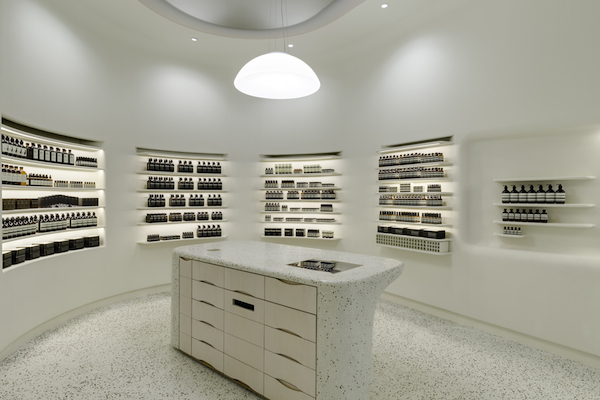
The terrazzo-covered bench at Aesop Galaxy
We worked very closely with the contractors, and we failed a lot of times. We started to understand the techniques behind terrazzo. And finally we achieved a good result that was very promising, so we deployed it on the site.
The easy part was doing the floor in terrazzo. It was our ambition to make a complex geometric shape using the terrazzo, so we created cardboard models of the shape we had in mind. We then coated the final form on-site in our terrazzo mix.
Aesop
aesop.com
INDESIGN is on instagram
Follow @indesignlive
A searchable and comprehensive guide for specifying leading products and their suppliers
Keep up to date with the latest and greatest from our industry BFF's!
The internet never sleeps! Here's the stuff you might have missed