The home of architecture and design in the Asia-Pacific
Get the latest design news direct to your inbox!

Get the latest design news direct to your inbox!
The Japanese architect spoke about Architecture as the Embodiment of an Opera at the University of Hong Kong. Marta Catalán Erato reports.

May 4th, 2016
Pictured above is the National Taichung Theater, courtesy of Huang, Ming-Qing
Only a few architects around the world are truly changing the way architecture is conceived, and Toyo Ito is certainly one of them. On 23 April 2016, he gave a lecture at the University of Hong Kong (HKU) that was so popular there wasn’t room for everyone – despite the considerable size of the theatre. Part of the Department of Architecture’s Spring 2016 Public Lecture Series, Ito’s talk attracted a long queue of people; one that formed several hours beforehand, speaking to the huge success the Japanese architect has been enjoying for some time now.
Ito-san gave an inspiring lecture on the meeting point of architecture and nature. He kicked off his talk by showing an illustration of characteristic Japanese social gatherings during sakura – or cherry blossom – season. This image portrayed the use of simple fabric that defined the space within nature, with Ito saying, “People come together and dance under the trees; unfortunately in modern society, it’s very hard to achieve this feeling in architecture.”
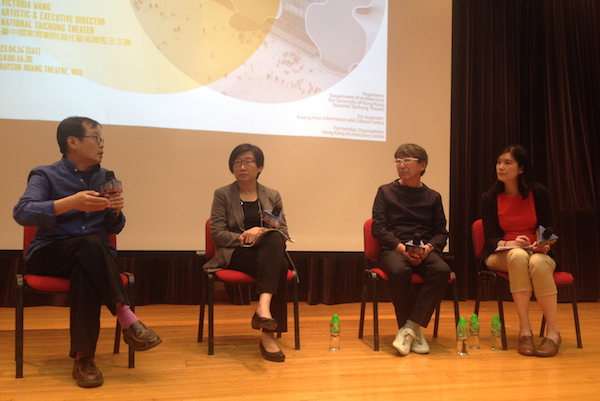
A Q&A session with Ito at the end of the lecture at HKU
He then went on to share several of his own projects that challenged this statement: Matsumoto Performing Arts Centre and Za-Koenji Public Theatre are two examples that show how the flow of public and artists has been carefully designed to make everyone feel like they are “all performers.” The boundary between stage and audience is blurred, said Ito, and “the idea is to allow the streets to slowly enter into the architecture.”
The main project and core of the talk was the National Taichung Theater, which will open in Taichung, Taiwan, at the end of the year. Ito showed an aerial view of the building, which possesses distinctive organic forms. “It looks like computer generated but it’s a real photo,” he joked.
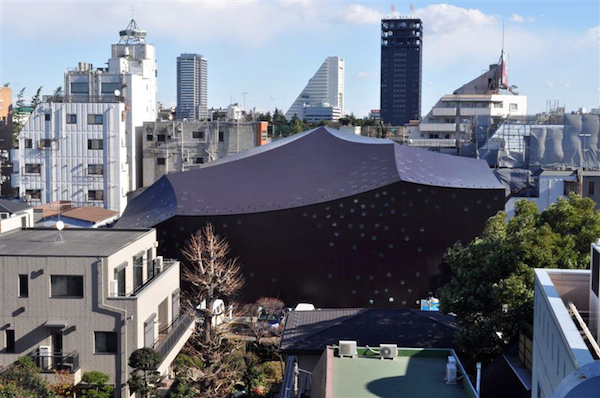
Za-koenji Public Theatre
The theatre is located in the middle of a park, and it is being build around the concept that you can be strolling through the park, and, without realising it, you suddenly enter the building. Ito defined it this way: “The building performs like a human body, where eyes, nose and various tubes connect interior and exterior.”
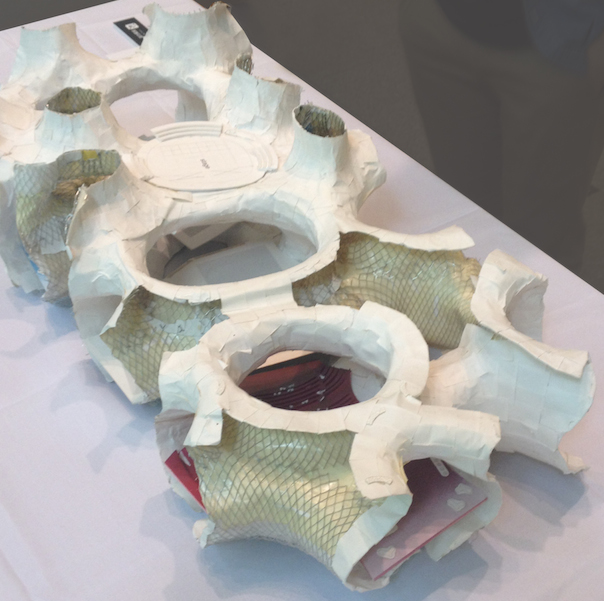
A model of the National Taichung Theater
Ito and his team created the floorplans using an algorithm with different types of polygons. And the construction, done by a local firm, involves an irregular, trussed wall system that needed to be carefully handcrafted. According to Ito, building the National Taichung Theater is a complex process involving a number of consultants. It’s a process he believes brings a human, maker element back to the architectural production experience.
Victoria Wang, the artistic and executive director of the National Taichung Theater, also made an appearance at Ito’s lecture: she came on stage to act as moderator between Ito and the audience in a discussion of everyday architectural practices.
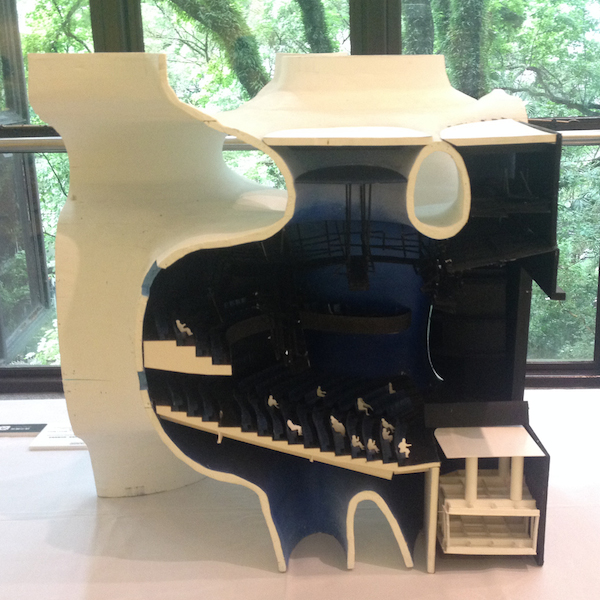
A model showing the interiors of the National Taichung Theater
Ito concluded his lecture by telling the audience “The boundary between interior and exterior is something yet to be achieved. I hope to still live 10 more years and be able to continue working on it.” IDLHK hopes so too.
Toyo Ito & Associates, Architects
toyo-ito.co.jp
Faculty of Architecture, HKU
arch.hku.hk
INDESIGN is on instagram
Follow @indesignlive
A searchable and comprehensive guide for specifying leading products and their suppliers
Keep up to date with the latest and greatest from our industry BFF's!
The internet never sleeps! Here's the stuff you might have missed