Above: the Olivetti Valentine typewriter, designed by Ettore Sottsass and Perry King, made by Olivetti, Italy, 1969. Photo: Powerhouse Museum.
It’s hard to say whether Campbell Bickerstaff is a techno-geek or not. On the one hand he has spent several years collecting objects for the Sydney Powerhouse Museum’s design and technology collection. And on the other hand, he doesn’t even own a mobile phone. Ask for his number and he’ll give you two landlines: Home and work. “I’m holding out for as long as possible,” he says. “I don’t want to end up glued to a mobile like everyone else.”

Campbell Bickerstaff with 2+7 Telephone. Designed by Marcello Nizzoli, made by SAFNAT, Italy, 1958. Photo: Powerhouse Museum.
It’s a strange sentiment for the curator of the Powerhouse Museum’s latest exhibition: Interface: People, Machines, Design.
Drawing on the museum’s extensive collection, Interface explores how a handful of companies, designers and industrial visionaries transformed clunky machines of a century ago and created the uber-cool, must-have items that we can’t live without today.

Apple I personal computer. Designed by Steve Wozniak, made by Apple Computer, USA, 1976. Photo: Powerhouse Museum
Design visionaries whose work is explored in the exhibition include: Dieter Rams, the German industrial designer who was Braun’s design visionary; Steve Jobsand Steve Wozniakco-founders of Apple; Doug Engelbarta seminal figure of computer interface design; Olivetti designers Marcello Nizzoli, Ettore Sottsassand Mario Bellini; the early Apple designs from Hartmut Esslingerwho helped shape Apple’s transformation into a global brand and current designer Sir Jonathan Ive.

the Blickensderfer 6 portable typewriter. Designed by George Canfield Blickendsderfer, USA, 1906. Photo: Powerhouse Museum.
Highlight objects include a rare Apple I computer, one of Steve Jobs and Steve Wozniak’s Blue Box phones from the early 1970s, and a Xerox Alto computer that Steve Jobs saw working in the Xerox labs in the late 1970s which transformed his and Apple’s vision of how people could use computers in the future.
Bickerstaff, who has been working on Interface for almost two years, says it is essentially an exhibition about ideas and design. “We’ve got iPads and iPhones and they are incredibly complex machines, but they are really easy to use. I wanted to see what designers contributed along the way to make that interface so simple.”
ICO MP1 (Modello Portatile 1) Typewriter. Designed by Aldo Magnelli and Riccardo Levi, made by Olivetti, Italy, 1932. Photo: Powerhouse Museum.
There are 65 objects featured in the exhibition. Bickerstaff says among his favourites are the Bauhaus telephone designed by Marcel Breuer in the 1920s for a housing project called New Frankfurt; and the super rare Apple 1 computer. “I acquired the Apple 1 in 2010. We’re very lucky to have it because there were only ever a couple of hundred made and there are just 50 of them surviving. And no, I’ve never plugged it in,” he says.

iMAC G3 Bondi Blue, designed by Jonathan Ive, made by Apple Computer Inc, USA, 1998. Photo: Powerhouse Museum.
He’s also proud of the Olivetti P101 he discovered in the University of Sydney’s engineering department. “They asked me if I wanted it, and I didn’t hesitate. This was the same machine that NASA used to work out the ballistic trajectory of its Apollo vehicles in the mid-1960s.”
When it comes to the designers whose work is showcased in Interface, Bickerstaff admires Mario Bellini, and the way he was able to invest Olivetti’s designs with an extra element to provide the consumer with a palpable sense of satisfaction. “In 1973 Bellini designed a little pocket calculator; the Divisumma 18, in bright orange plastic and neoprene. It’s really tactile; the buttons have an audible ‘click’ when you press them’. It’s this attention to detail and the consumer interface that has rubbed off on modern designers such as Sir Jonathan Ive.”

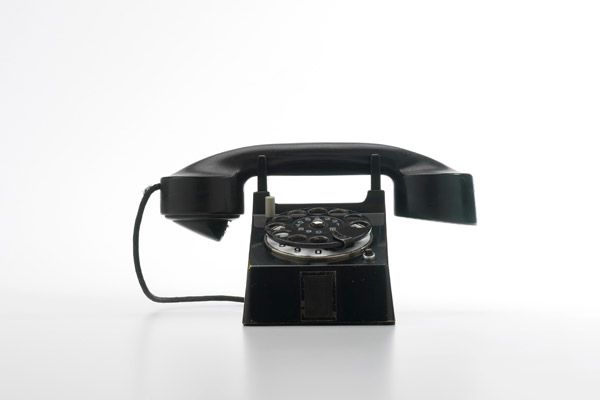
‘Bauhaus’ Telephone. Designed by Marcel Breuer and Richard Schadewell, made by Fuld & Co / Telephonbau & Normazeit GmbH, Germany, 1928. Photo: Powerhouse Museum.
There is an extensive interview with Bellini (now in his late 70s) in the Interface exhibition catalogue. The catalogue also includes essays by Bickerstaff himself, design academic Jesse Adams Stein and technology journalist Seamus Byrne. The catalogue will be available through the Powerhouse Museum Shop and online as well as selected bookstores.
Interface: People, Machines, Design will be showing at the Powerhouse Museum Sydney from August 15 2014 to 11 October 2015
sydneydesign.com.au/2014/event/interface-people-machines-design