The home of architecture and design in the Asia-Pacific
Get the latest design news direct to your inbox!

Get the latest design news direct to your inbox!
The humble street vendor cart and shelter that lines the streets of many Asian cities and is a key driver of local economies will get a design makeover by Australian and Indonesian architecture students this month.
February 22nd, 2016
Students from the University of Sydney and Bandung Institute of Technology (Institut Teknologi Bandung – ITB) in Indonesia are taking part in a two-week international exchange to redesign the temporary structures street vendors commonly use in Indonesia.
Indonesian native Dr Rizal Muslimin, one of the organisers of the exchange who lectures in architecture at the University of Sydney, says that while street vendors provide goods and services to the local community and are a vibrant part of the local culture, “their temporary carts and shelters often become permanent fixtures that cause major congestion and cleanliness problems.”
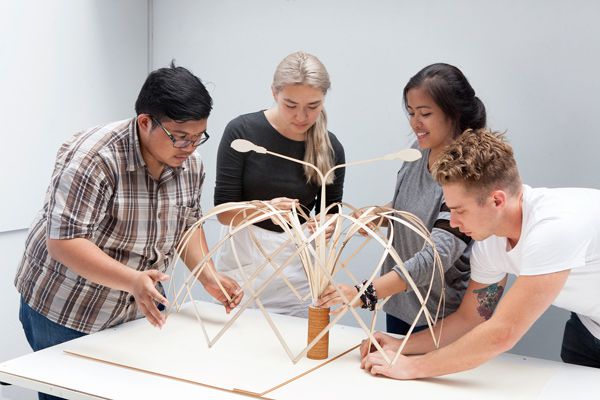
Eight architecture students from Indonesia are spending one week in Sydney working with six students from the University of Sydney’s Faculty of Architecture, Design and Planning. The group are using the university’s advanced digital fabrication labs to develop prototype designs for a deployable, lightweight shelter.
“Students are asked to come up with portable, low-cost structure that is quick and simple to erect and dismantle. They must also consider materials that are widely available in Indonesia, which they will use to build their structure,” said Dr Muslimin.
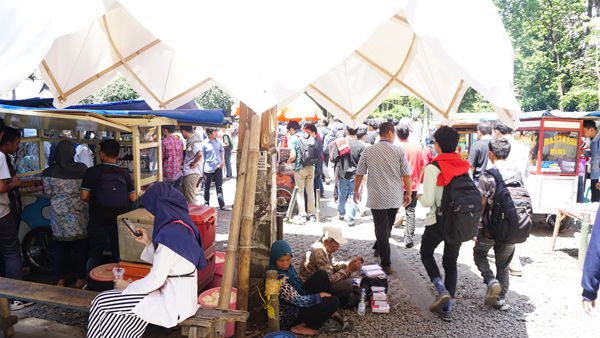
Above: The prototype shelter Bunga Bandung designed by architecture students from the University of Sydney and Bandung Institute of Technology gets a test run with street vendors in Bandung, Indonesia. Photo: Fauzan Alfi A.
After developing the designs in Sydney, the student group will return to Bandung in Indonesia to spend a week building their prototypes and test driving the new shelters on the streets of Indonesia.
“The students will be involved in seeing if their design holds up in the local environment and getting feedback from local vendors on whether it meets their needs. It is a great opportunity for our architecture students to collaborate on a real-life problem with likeminded students from Australia’s closest neighbour,” Dr Muslimin shares.
Muslimin believes that the prototype shelters may also have the potential for use in local community markets in Australia. “The needs of stallholders in Australia’s own community markets are not dissimilar to the Indonesians. They both need something that is easy to transport and set up and pull down in a short space of time,” said Dr Muslimin.
The University of Sydney
sydney.edu.au
Hero Photograph: Architecture students from the University of Sydney and Bandung Institute of Technology finalise their design concept Bunga Bandung (translation: flower). L-R: Fauzan Alfi A (ITB), Stephanie Cheung (USyd), Laras Winarso (ITB) and Matthew Hunter (USyd). Photo: Sarah Rhodes.
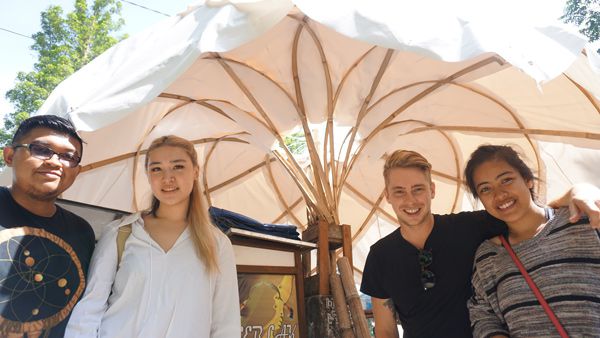
Above: Architecture students from the University of Sydney and Bandung Institute of Technology with their prototype shelter Bunga Bandung (translation: flower) on the streets of Indonesia. L-R: Fauzan Alfi A (ITB), Stephanie Cheung (USyd), Matthew Hunter (USyd) and Laras Winarso (ITB). Photo: Fauzan Alfi A.
INDESIGN is on instagram
Follow @indesignlive
A searchable and comprehensive guide for specifying leading products and their suppliers
Keep up to date with the latest and greatest from our industry BFF's!
The internet never sleeps! Here's the stuff you might have missed