The home of architecture and design in the Asia-Pacific
Get the latest design news direct to your inbox!

Get the latest design news direct to your inbox!
UNStudio is known as an innovator of digital technology with architecture. A recently completed shopping mall in Shanghai by the Dutch studio, Lane 189, offers an opportunity to explore formal complexity and a deep integration of façade and interior space – all inspired by art and science.

The character of the interior is derived from a central void, capped by a skylight art installation.

UNStudio describes Lane 189, which is located in the Putuo district of Shanghai, as a destination for shopping, strolling, eating, gathering and relaxing.

The void is punctuated by a series of rounded plateaus for individually themed programmes, positioned in a rotational manner.
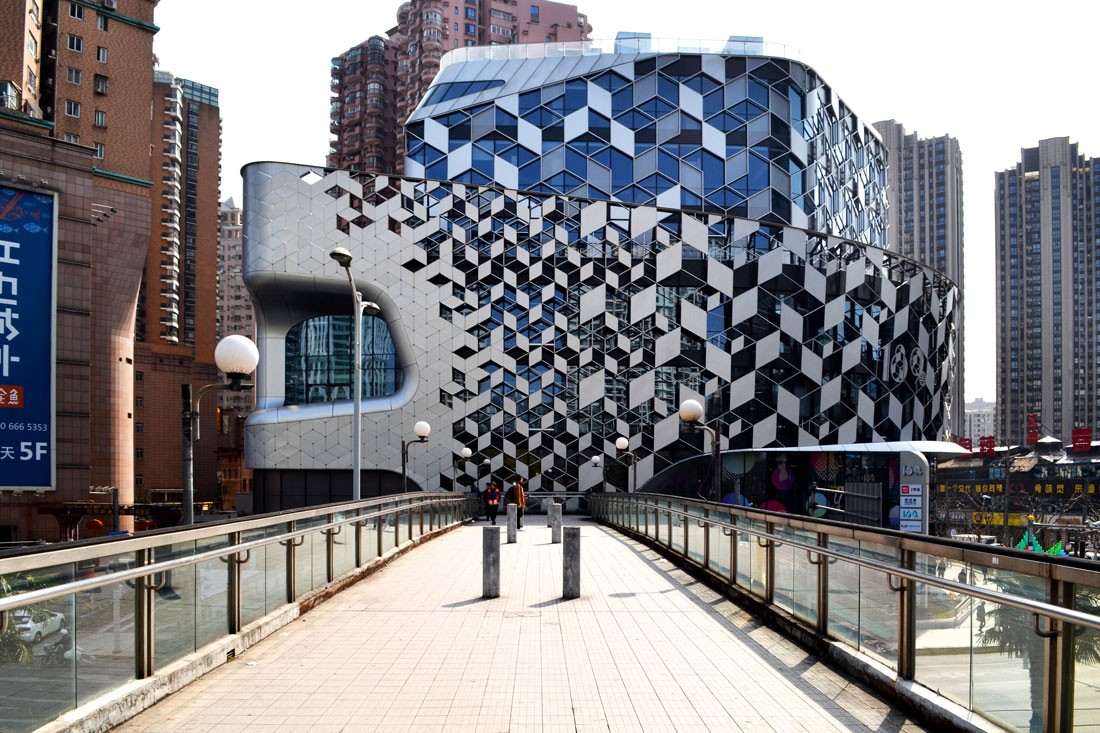
The varied facade components follow the building’s articulated geometry and provide constantly changing perspectives as well as a complex optical effect. Photo © Eric Jap (courtesy of UNStudio).

On the lower facade, diamond-shaped panels are tied between pins forming a tensioned cladding system with a depth of 400mm.

The design incorporates elements of ‘old Shanghai’ through geometry, pattern and materialisation, and combines these with a contemporary urban experience.

Large double-height façade openings, dubbed ‘urban eyes’, present the interior programme to the outside world.
When Lane 189, a new shopping mall designed by UNStudio, opened in Shanghai, its visitors were welcomed by a unique acoustically enhanced shopping experience where 3D sound systems created a surreal aural environment. The project exemplifies the challenge shopping malls face in this era of digital upheaval: innovate or succumb to the onslaught of online retail.
UNStudio would know about this; the practice has done research on the issue in collaboration with several Dutch universities. One of the studies looked at how to transform shopping spaces into social places to prevent them from dying out. In fact, Ben Van Berkel (founder and Principal Architect at UNStudio) does not see Lane 189 as a place to merely buy things. Rather, the building was designed as a vertical public square. “The idea of a vertical square where people meet is perhaps the first idea I think of when we design these malls. I am often inspired by art, and in this case, artists like Rauschenberg and Warhol, who were fascinated with the culture of shopping and the things one finds along the way,” says Van Berkel.

A vertical marketplace.
The social spaces at Lane 189 manifest in various forms and are dispersed throughout the building. These, along with the other programmes in the building, are encapsulated within a complex-looking three-dimensional skin. Besides creating an attractive public destination in the city of Shanghai, the façade gives Lane 189 its urban character through a calculated play on visual porosity. While the spatial layout of Lane 189’s design was inspired by art, its aesthetic can be traced to Van Berkel’s interest in science. This can be seen in the beautiful glass patterns that form the skylight above the central void. “It plays with this idea of patterns you don’t recognise immediately but are influenced by images of science… It could easily be seen as a pattern coming out of nature. Like in the façade, it is a beautifully controlled chaos,” he explains. Van Berkel continues, “The pattern-making on the façade can also be found in the internal balconies and the void space, and because they have the visual refinement common to patterns, the building appears to be woven into one holistic visual effect.”
Lane 189 is yet another demonstration of architecture’s mastery at delivering ‘hardware’ – architectural interventions. However, Van Berkel is of the view that architecture is still quite behind in providing the ‘software’ solutions increasingly needed in this age. Big data, automation, artificial intelligence, virtual reality – there are endless challenges that the profession (which Van Berkel jokingly critiques as the Walkman in an iPhone world) must contend with today.
How will architecture evolve in this brave new digital age? “This requires a whole new approach towards architectural design. Yet, that is not how architects are trained. We are not data analysts or programmers, and that will be something that we will have to slowly pull into the profession over the coming years. We also need to update ourselves with the technology that so many other companies are already using,” he says.

UNStudio describes Lane 189, which is located in the Putuo district of Shanghai, as a destination for shopping, strolling, eating, gathering and relaxing.
Updating the practice is a subject that Van Berkel and UNStudio have been grappling with for some time. In 2013, UNStudio relaunched as a knowledge-sharing office. The fundamental idea is to leverage on the sharing of knowledge to enrich and increase efficiency in the studio’s projects. Four years on, that experiment is progressing on to a new stage of evolution and Van Berkel shares some of the lessons they have learned: “When we started talking about this idea, we were only halfway through setting it up in the studio. The system of sharing knowledge that we produce internally and how we organise external knowledge is still not active enough. We are still working on improving this.”
More importantly, Van Berkel gives an optimistic view of the profession’s future: “We are also now planning to expand these ideas even further, into areas that require knowledge beyond the production of architecture, and incorporate digital technologies. But I can’t say too much about that just yet, as we are still in the process of setting it up.”
This originally appeared in issue #87 of CUBES. Interested for more on the convergence of digital and architecture? We chat to Yelena Smetannikov of SYSTEMarchitects about digital pre-fabrication.
INDESIGN is on instagram
Follow @indesignlive
A searchable and comprehensive guide for specifying leading products and their suppliers
Keep up to date with the latest and greatest from our industry BFF's!
The internet never sleeps! Here's the stuff you might have missed