The home of architecture and design in the Asia-Pacific
Get the latest design news direct to your inbox!

Get the latest design news direct to your inbox!
Indesign celebrates the career of luminary Philip Cox, whose distinctive style is seen throughout Australia as well as internationally.
March 1st, 2012
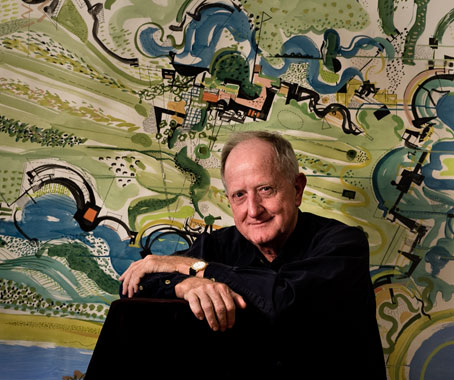
Founding principal of one of the largest and most successful architectural firms in Australia, architect Philip Cox has devoted his professional life – a career spanning 50 years – to developing his own visionary brand of Australian architecture and exploring the potential of structure.
Characteristically, he has designed lightweight buildings with arcing volumes and overtly expressed structures of white steel. His distinctive structuralist style, in particular his landmark exhibition centres and sporting stadia, has been highly influential both here and internationally.
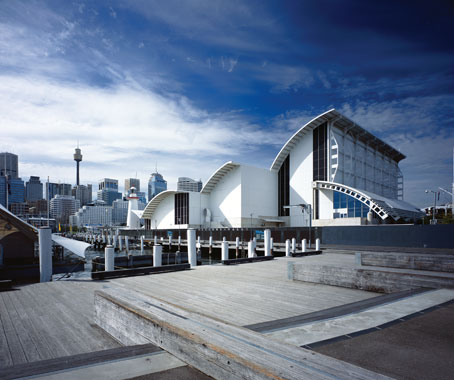
National Maritime Museum, Darling Harbour, Sydney (1988).
He has also been extremely prolific, and his many ’big-statement’ buildings have made a major impression on our capital cities, on the development of architecture in Australia, and – since architecture provides us with a reflection of ourselves – on our national identity.
Cox established his architectural practice with Ian Mackay in 1962, and has subsequently worked in partnership with other architects through the years, including Peter Storey, Philip Taylor, John Richardson, Michael Rayner, and Ian McGilvray.
Since its inception, Cox Architects and Planners (COX) has produced buildings in virtually every design category: from commercial offices to civic buildings, sporting, and educational facilities, bridges, convention centres, residential schemes, hotels and resorts.
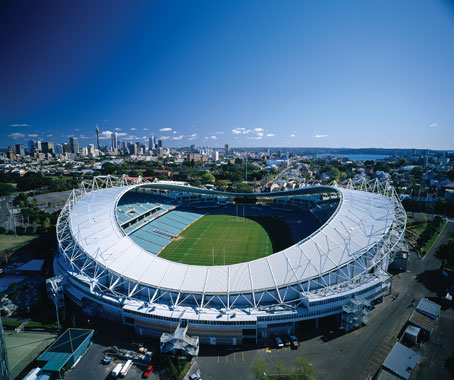
Sydney Football Stadium (1988).
In the 1980s, with a succession of these high-profile projects designed to commemorate the Bicentennial and then built for the Sydney 2000 Olympics, COX grew considerably. After 2000, the firm expanded again, this time into the international arena.
Today, the company has a staff of around 400 and offices in Sydney, Melbourne, Brisbane, Perth and Canberra, although many of its projects are built in China, South East Asia and the Middle East.
While COX continues to pursue structure for its aesthetic expression, new technologies provide much of the impetus for exploration, and the firm’s responses to different regional and cultural circumstances have led to greater stylistic diversity.
Throughout his career, Cox has also been involved in urban planning as much as architecture, and through the company’s many re-development schemes, COX has influenced the regeneration of public spaces and urban waterfronts in Sydney, Brisbane, Melbourne, Townsville, Cairns and Perth, along with those in Singapore, Shanghai and other cities in China.
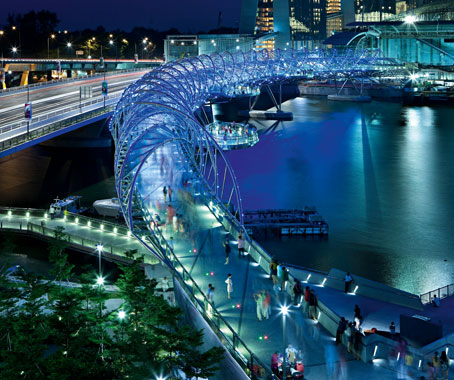
Marina Bay Pedestrian Bridge, Singapore (2010).
Cox is also a Professor of Architecture at the University of New South Wales, and has been an active architectural commentator, lecturing widely, particularly in Asia. He has held positions on numerous design boards and industry committees over many years, and has, in addition, written nine books on Australian architecture and his particular interest related to vernacular forms.
For his substantial contribution to Australian architecture Cox has been recognised by his peers and his country. In 1983, he was presented with the Commonwealth Association of Architects’ Sir Robert Matthew Award.
In 1985, he received the RAIA Gold Medal, and in 1988, he was made an Officer of the Order of Australia.
In 1987, he became a Life Fellow of the Australian Institute of Architects and of the American Institute of Architects, and in 2000 he received an Honorary Doctorate of Science from the University of New South Wales.
These personal honours are distinct from the many awards the firm continues to attract.
Portrait by Anthony Browell. Project photography courtesy of Cox Architecture.
Philip Cox was featured as a Luminary in issue #48 of Indesign, this is an abridged version.
INDESIGN is on instagram
Follow @indesignlive
A searchable and comprehensive guide for specifying leading products and their suppliers
Keep up to date with the latest and greatest from our industry BFF's!
The internet never sleeps! Here's the stuff you might have missed