The home of architecture and design in the Asia-Pacific
Get the latest design news direct to your inbox!

Get the latest design news direct to your inbox!
The rise of biophilic design is seeing A+D reconnect the ‘designed world’ with the ‘non-designed world’.

As our population continues to grow and our economy relies less on the land, the urbanisation of our natural landscape shows no sign of abating. The world is becoming ever more constructed, with natural environments giving way to built environments time after time, and we very rarely see the reverse occur; where a residential block or office tower is pulled down to make way for a new park or green space.
Thankfully though, many firms in the A+D sector are beginning to embrace and encourage biophilic design. Biophilia is the love of ‘love of life or living systems’ and, by extension, biophilic design endeavours to consciously include nature in architectural or interior design; reconnecting us to nature by bringing the great outdoors in to our constructed world.
One company that is a huge advocate of biophilic design and recognises how critical it is to human health to incorporate nature into our buildings, is Interface. The brand even launched its own Human Spaces Report, along with psychologist Professor Sir Cary Cooper, on the topic. The results concurred with over 50 other worldwide studies to prove the positive effects that nature (or environments that mimic nature) have on our overall health and wellbeing. This was particularly apparent in the workplace, which showed a direct correlation between clever workspace design and improved performance. Even just simple changes to incorporate nature into the workplace had a huge impact on how happy, creative and productive employees felt whilst working.
Of course, not every space can be designed to incorporate all the principles of biophilic design but there are many contributory elements that will enhance the interior and wellbeing of those within it. For example, natural light, vegetation, natural textures and materials, living walls and nature views all provide a positive impact. As such, Interface is now on a one-company crusade to elevate a biophilic approach to workplace design higher on to the global corporate agenda. It also continues to explore the power of biophilic inspired design through its own collections of carpet tiles, which directly mimic natural surfaces and textures.
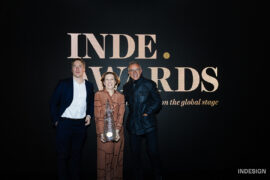
With such a passion for the impact of design on our region at large, Interface has proved the perfect partner for The Influencer award at our upcoming INDE.Awards: Particularly so because, among our shortlist of nominees, are several projects that embrace this concept of biophilic design.


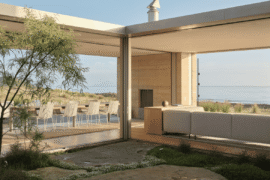
88 Angel Street by Steele Associates is one of these. Indeed, this development of three terraced houses smack bang in the middle of Newtown, sets a new benchmark for urban living! Each of the three-bedroom properties is made from recycled concrete and feature open-plan kitchen-dining-living areas that spill onto entertaining decks and gardens. They also all include native green roofs for thermal and acoustic insulation, internal reflection pools, retractable glass roofs (to provide enhanced space, light and ventilation), natural stone benchtops, hardwood timber floors and permaculture gardens. As Steele Associates says, “these dwellings epitomise well-appointed sustainable living for Sydney in the 21st century while bridging the gap between nature and the ever-expanding urban environment.”
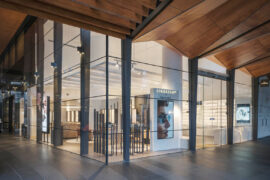
Another nominee for The Influencer award shows biophilic design used in the hospitality sector. When Foolscap Studio was asked to design the Noma Australia pop-up restaurant in Barangaroo, working together with the Lendlease design team, their brief was for something ‘uniquely Australian – an interior that reflected Noma’s intent to source ingredients from coastal and surrounding regions’.
The result was a stunning, fundamentally materials-driven experience where the concept of land was represented by solid mass, weight, charred textures and earth. Water, meanwhile, was depicted through the use of light, shadow, glass and spatial volume. Through a clever use of colour and materials, the design beautifully encapsulated the elemental quality of our landscape – rugged oxidised earth, sweeping coastlines, open sky and the regeneration of native bushland through fire.
Hopefully projects such as these will inspire more of us in the A+D industry to take a biophilic approach to our work. Not only does it instil in us a better sense of wellbeing and happiness, it allows us to enjoy the great outdoors – traditionally one of Australia’s biggest assets – whilst we have to be indoors. Besides which, if we keep on building and developing our natural environment at such a rapid pace, then we will need to get our nature-fix from somewhere!
INDESIGN is on instagram
Follow @indesignlive
A searchable and comprehensive guide for specifying leading products and their suppliers
Keep up to date with the latest and greatest from our industry BFF's!
The internet never sleeps! Here's the stuff you might have missed