The home of architecture and design in the Asia-Pacific
Get the latest design news direct to your inbox!

Get the latest design news direct to your inbox!
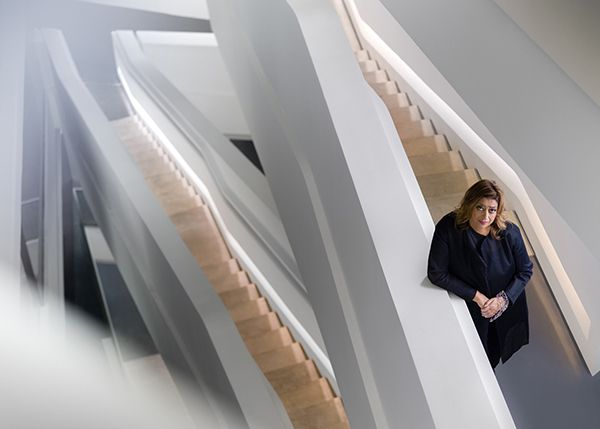
Celebrated architect Dame Zaha Hadid has passed away at age 65. Despite her young age, the Iraqi-born, British designer leaves behind a magnificent legacy and portfolio that includes the London Aquatic Centre for the 2012 Olympic Games, MAXXI Italian National Museum of 21st Century Arts in Rome, and a stadium for the 2022 FIFA World Cup in Qatar.
April 1st, 2016
Brazen, highly experimental, impactful and inspirational – Zaha Hadid regularly ventured where few would dare. Earlier this year she was the first woman to receive the Royal Institute of British Architects (RIBA) Gold Medal in its 180 year history. She was the first woman to win the Pritzker prize in 2004, placing her amongst the company of artistic visionaries like Gehry and Utzon.
Born in Baghdad in 1950, Hadid studied mathematics at the American University in Beirut, and relocated to London in 1972 where she studied at the Architectural Association, a centre for experimental design and the oldest independent school of architecture in the UK. She established her own practice in 1979, and from there began to receive recognition for her futuristic, fantastical unrealised drawings and paintings, such as the Peak Leisure Club in Hong Kong (1983) and Kurfürstendamm 70 in Berlin (1986).
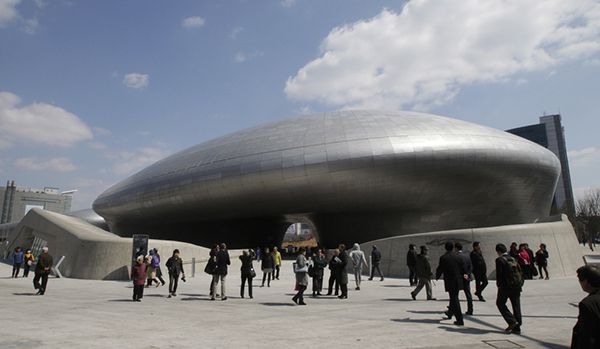
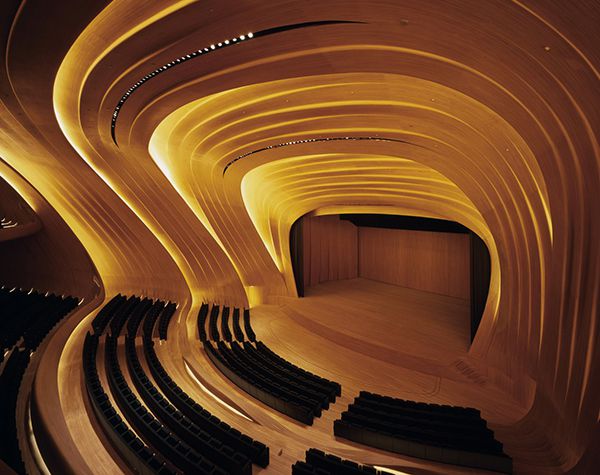
Despite some controversies surrounding construction, Hadid’s designs have captured the imagination of people the world over. Often featuring undulating folds, feminine bows and mind-bending curvatures – her life’s work is made up of a collection of ambitious, emotive and future-focused projects. The Dongdaemun Design Plaza in Seoul is a floating silver aluminium orb, and earned the city the title of World Design Capital in 2010. Hadid’s Heydar Aliyev Centre in Azerbaijan is made up of a series of almost calligraphic flicks and waves in brilliant, glowing white. The building was a technological masterpiece – a combination of geometry, structure and materiality, brought together and controlled by advanced computer algorithms. Her design work crossed disciplines, and included furniture, jewellery, footwear, cars and the fittingly titled ‘Z.Boat’.
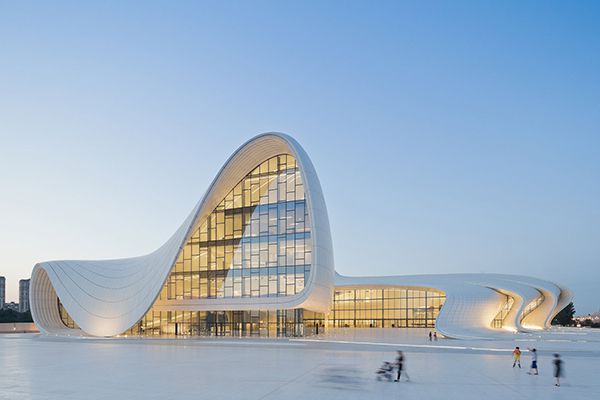
Other notable Hadid inventions include the Riverside Museum of Transport in Glasgow, the Vitra fire station in Weil Am Rhein in Germany and the Guangzhou Opera House in China. See our compilation of just a few of Hadid’s most inspired projects here.
Hadid was an iconic leader, who refused to be slowed down by her background or her gender. “I am non-European, I don’t do conventional and I am a woman,” she once said in an interview. Her influence is spread across disciplines and across all walks of life – within the very art of architecture, for women, and in evolving future cities all over the world.
Hadid suffered a heart attack while being treated for bronchitis at a hospital in Miami on March 31, 2016.
INDESIGN is on instagram
Follow @indesignlive
A searchable and comprehensive guide for specifying leading products and their suppliers
Keep up to date with the latest and greatest from our industry BFF's!
The internet never sleeps! Here's the stuff you might have missed







![Re[MARK]able Jewellery](https://www.indesignlive.com/wp-content/uploads/../../media/SEPTEMBER-08/SUSTAINABILITY/mark_hero.jpg "Re[MARK]able Jewellery")