The home of architecture and design in the Asia-Pacific
Get the latest design news direct to your inbox!

Get the latest design news direct to your inbox!
Editor of DQ magazine, Alice Blackwood, talks with jeweller Phoebe Porter.
May 7th, 2009
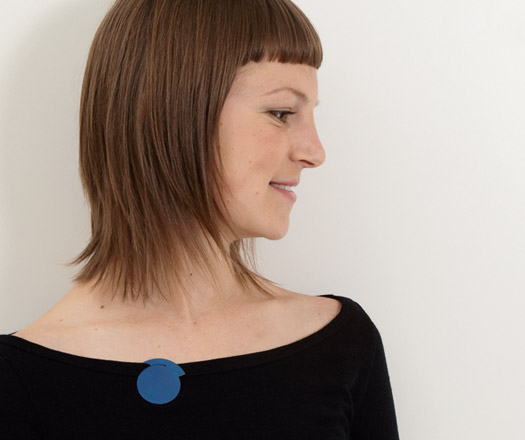
Phoebe Porter is another of Design Quaterly’s ’2009 Top Ten Forces and Faces in Australian and New Zealand Design’. Porter will be exhibiting her latest work at the Metalab gallery in Surry Hills Sydney from 7 – 31 May 2009.
Alice Blackwood, DQ Editor caught up with Phoebe recently.
Alice Blackwood: How would you describe your work?
Phoebe Porter: I’m definitely interested in industrial design and engineering. I aim to refine each piece to its necessary elements, often starting with the fastening mechanism which then becomes an integral part of the design. The question of what makes crafted objects different from mass-produced objects, when they may be of the same materials or processes is essential to my work.
AB: You trained at the ANU School of Art. What impact and influence has art school had on your work?
PP: Art school exposed me to a range of influences: conceptual ideas, the traditions of gold and silver smithing and newer approaches such as product design and CAD. I didn’t gain the sort of widespread technical training that a trade jeweller needs. It was more about developing an individual way of working and the freedom to apply whatever methods and materials will best express an idea.
AB: You had your first solo show, Location Devices, at e.g.etal last year. Could you explain the premise behind the collection for us and how your jewellery illustrated this?
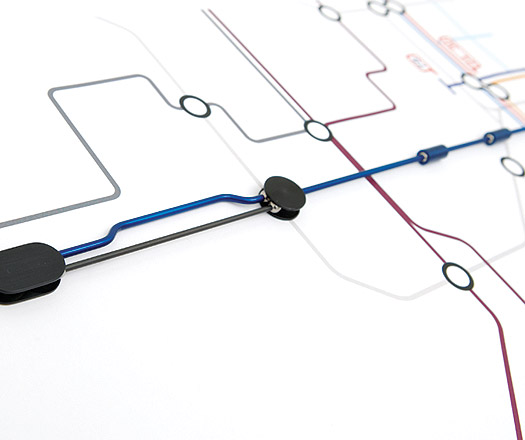
PP: The work was generated by my experience of relocating from Canberra to live and work in Melbourne. It is about connectedness and the invisible networks within a city. Having experienced the discovery of Melbourne through street maps and transport networks, I decided to use schematic maps as a metaphor for social networks, direction and belonging – for developing a personal route through life.
A scene from William Kentridge’s Stereoscope, was an initial source of inspiration. Kentridge drew lines of communication in cobalt blue, shooting from a telephone switchboard across the city. Referencing this image, the centrepiece of Location Devices is a large schematic map made from cobalt blue sheet metal. Locations are marked by a series of wearable metal clips designed to adorn clothing. Visitors to the exhibition can purchase a clip and wear it as a tiny personal Location Device, becoming a part of this particular creative network.
AB: Who would you say have been the main influences/supports in your career so far?
PP: My Family, Blanche Tilden (co-founder of Studio Hacienda and General Assembly) e.g.etal and Thomas Caddaye (my very patient partner and industrial designer).
AB: What do you feel sets you apart from other contemporary jewellery makers, as well as your peers?
PP: My Less is More approach and commitment to using industrial materials and processes.
AB: You have a few exhibitions and exciting things coming up, one of which is in Sydney. Can you fill us in a little more?
PP: 2009 is already looking pretty full. The most exciting news is that I’ll be showing Location Devices at Metalab in Surry Hills, opening mid-year.
INDESIGN is on instagram
Follow @indesignlive
A searchable and comprehensive guide for specifying leading products and their suppliers
Keep up to date with the latest and greatest from our industry BFF's!
The internet never sleeps! Here's the stuff you might have missed