Sydney Olympic Park and adjoining parklands enjoy a facelift on the twelfth anniversary of the 2000 Olympic Games, with the latest stage putting a strong emphasis on fun
July 16th, 2012
The opening of the Blaxland Common Regional Playspace, comes twelve years since Hargreaves Associates established the site as an extension of the Sydney Olympic Parklands in time for the 27th Olympiad.

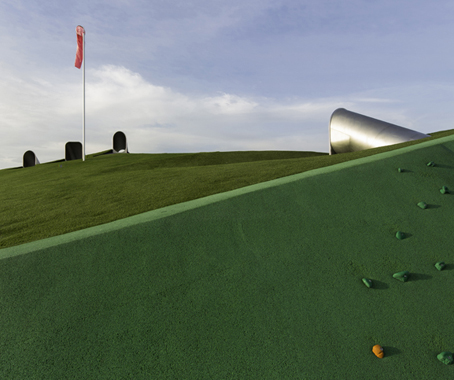
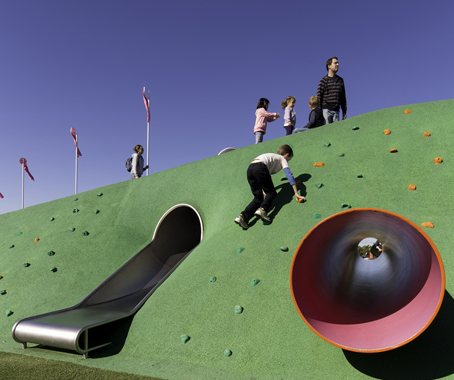
The existing design for the sprawling hilltop site was comprised of considerable over-sized earthforms and excavations that JMD Design have since embellished and built upon in creating an environment that caters lavishly to youth and families.
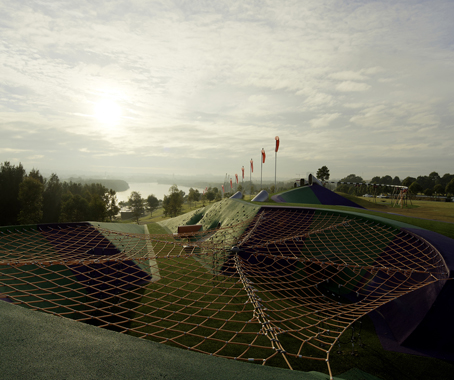
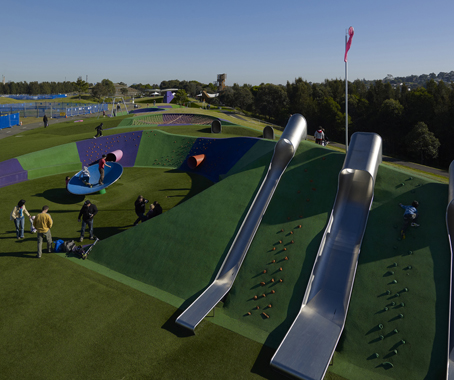
Designed around and into the dominant earthforms are interactive play elements such as slides, tunnels, flying foxes and climbing nets all customised to suit the pronounced topography.
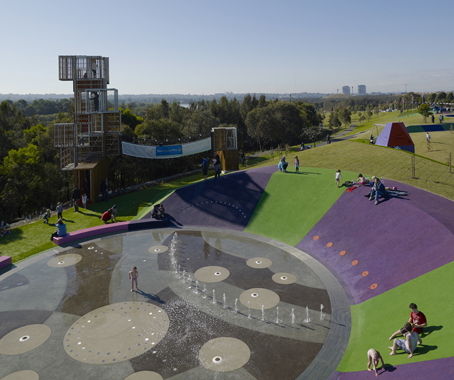
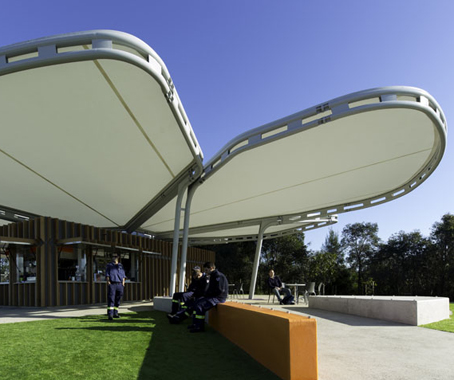
Structurally, a twelve metre high ’tree-house’ offers views across treetops to the integrated sand pits and a water plaza serviced by 170 programmable jets, all adjacent to a Tonkin Zulaikha Greer (TZG) designed kiosk.
A riot of colour, the distinct new design has already proven a considerable success.
INDESIGN is on instagram
Follow @indesignlive
A searchable and comprehensive guide for specifying leading products and their suppliers
Keep up to date with the latest and greatest from our industry BFF's!
Stepping into Intuit’s Sydney workplace certainly doesn’t feel like walking into an office. Why? In this film, we discover that, when joy takes precedence as a design driver, even a high-performing commercial CBD headquarters can feel like an intuitive wonderland that invites employees to choose their own adventure.
In the second instalment of our performance seating three-parter, we turn to DKO’s Michael Drescher and Jacob Olsen to peek behind Sayl’s confident architectural form and explore the ideas of inclusivity, adaptability and freedom to move as hallmarks of what sitting your best actually means.
In the last instalment of our three-part performance seating series, Alex Bain from Architectus explains why sitting well shouldn’t feel like sitting at all and explores an unexpected success metric of the hybrid workplace: the grounding power of emotional support.
In the first instalment of our three-part series exploring what it means to sit your best, we pose the question to Gray Puksand’s Dale O’Brien, who discusses the importance of ease and majority rule when it comes to sitting and reveals why specifying a task chair is not unlike choosing a Volvo.
The combination of elegant designs and the highest quality finish of stainless steel components, is what makes A2F a leader in their field.
Super Design and Great Dane bring you an exclusive behind-the-scenes tour of some of the oldest furniture houses from one of the world’s most iconic design movements.
Australian student, Rodrigo Capati, is the only Aussie to be selected in the Top 100 of the global 2014 Electrolux Design Lab competition. This is an outstanding result for Rodrigo, with more than 1,700 innovative ideas submitted this year by students from 43 different countries.
The internet never sleeps! Here's the stuff you might have missed

The decision isn’t really about budget. It comes down to who designs the kitchen, who builds it, and whether those are the same people installing it in your home.
The Geelong College’s Sport and Wellbeing Centre ‘Belerren’ designed by Wardle is designed around bringing in natural light. But Shade Factor’s job was to help modulate and precisely control it for the most important competitive moments.
As part of our ongoing series of intimate editorial dinners with Signature Appliances, we recently gathered a group of architects, designers and industry voices in Sydney for a private conversation around one of design’s most persistent questions: can everyone have access to great design and beautiful spaces?
Melbourne-based architect and object maker Adam Markowitz blurs the line between design and craft, bringing a deeply considered, material-led approach to his work. As both a practising architect and furniture designer, Markowitz explores how objects can respond to space, light and human use.