The home of architecture and design in the Asia-Pacific
Get the latest design news direct to your inbox!

Get the latest design news direct to your inbox!
For Ingrid Richards and Adrian Spence, Brisbane is more than just the city they call home – it’s a wellspring of inspiration. The pair reflects on lessons learnt in over a decade spent reshaping the civic identity of the Queensland capital.

August 30th, 2019
The first thing that strikes you about Brisbane is the atmosphere. Here, sunny optimism meanders into laid-back languor, all in the space of a day. The sonorous sound of crickets after a lush rainstorm clings to the imagination like honey. For Ingrid Richards and Adrian Spence, the pair behind Brisbane-based architecture practice Richards & Spence, the influence is a potent one. “Climate is the single most defining factor to our character and sense of place,” says Richards.

Cornerstone Stores’ Highway Entrance. Photo by Andy Macpherson
Indeed, in a region in which weather has shaped an entire architectural vernacular – the heritage Queenslander home – Richards’ sentiment has historical resonance. But with the rise of homogenous skyscrapers that tower over the banks of the Brisbane River, the city’s identity is in flux. “Rather than rely on associations with international cities like New York, our ambition is to find our own civic identity,” Richards says.

The Calile Hotel. Photo by Sean Fennessy
At just 11 years old, the practice has already carved a reputation for creating civically-minded spaces that are distinguished by their minimalist material palette and nods to Brutalist form. Raw, unpolished concrete, brick and breeze blocks are stacked en masse to create buildings that feel unpretentious, dependable, even nostalgic. “A limited material palette makes the experience more potent,” points out Spence.

The Calile Hotel. Photo by Sean Fennessy
But the momentum behind the success of the practice is not solely derived from its stylistic sensibilities. If anything, aesthetic elements are merely a means to a more intangible end. “We are more interested in experience than style. We look for circumstantial opportunities to create charm without being self-conscious,” Richards explains. “We are seeking a reductive outcome: as much as necessary, but as little as possible.”
With this deft simplicity and focus on experience, Richards & Spence has quietly transformed pockets of Brisbane’s public realm. The practice’s impressive résumé includes the redevelopment of the Gasworks Market, the international terminal at Brisbane Airport, and the James Street precinct, which has since emerged as a benchmark-setting locality for Brisbane’s retail and hospitality offering. And with last year’s opening of the practice’s most significant project to date – The Calile Hotel – Richards & Spence has firmly established itself as a pivotal player in the city’s design evolution.

Calile Hotel’s James Street arcade entrance. Photo by: Yaseera Moosa
“The Calile Hotel embodies the collective thinking of our work within the James Street precinct,” explains Spence. The jewel in the crown, the hotel is symbolic of the practice’s commitment to process. “Each project is a prototype for the next. We see ourselves as custodians of our built environment, and aim for well-mannered and dignified outcomes.”

Christie Nicolaides. Photo by Yaseera Moosa
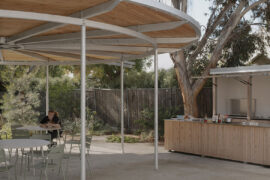
When it comes to Richards & Spence’s retail and hospitality projects, this ambition has been realised through commissions that play on the interaction between public and private realms. Concept retail store Museum of Small Things and the flagship store of Australian jewellery brand Christie Nicolaides are dimly lit, cavernous spaces that encourage intimate experiences. By contrast, the airy Cornerstone retail and dining precinct south of Brisbane shows how a building can encourage flowing, public engagement.

The Calile Lobby Bar. Photo by Sean Fennessy
The importance of experience is abundantly clear at The Calile Hotel’s Lobby Bar, where pink marble and brass fixtures are surprisingly luxurious elements, dramatically juxtaposing the hotel’s Brutalist, concrete exterior. “Quiet contrasts of high and low, large and small, light and dark, crude and refined are employed to curate a spatial experience,” offers Spence.

The Calile Hotel. Photo by Sean Fennessy
Explaining the practice’s rationale, Spence points out that creating site-specific solutions is crucial to avoid any notions of ‘theming’ – a particularly important reminder when the aim is to create something of lasting value. “We look for opportunities inherent in the site and context to form the identity of a venue. A non-prescriptive plan allows for different tenures throughout the life of the building – a passive sustainability of sorts. We consider our work to be part of the evolution of our city, not a full stop in time. Our ambition is to make buildings that feel like they have always been there,” he says. A simple intention, but one with lasting value.
This profile originally appeared in issue #78 of Indesign – the ‘Customer Experience’ issue. And for more digital design inspiration, join our mailing list.
INDESIGN is on instagram
Follow @indesignlive
A searchable and comprehensive guide for specifying leading products and their suppliers
Keep up to date with the latest and greatest from our industry BFF's!
The internet never sleeps! Here's the stuff you might have missed