The home of architecture and design in the Asia-Pacific
Get the latest design news direct to your inbox!

Get the latest design news direct to your inbox!
This year’s Pritzker Architecture Prize winner tells us why he chooses to take on less. Ola Bednarczuk has this story.
June 8th, 2012
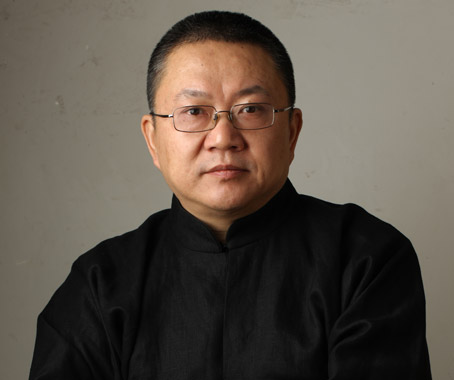
In Brisbane recently to present a keynote speech at the Australian Institute of Architects’ 2012 National Conference, Chinese architect Wang Shu spoke about his reaction to the announcement that he was the winner of this year’s Pritzker Prize.
“Of course for me it’s a big surprise, because in fact I am a special architect,” says Wang.
“I do my work very independently. In China this means working on the fringe of society. It’s [outside] of the system.”

5 Scattered Houses, Ningbo, China. Photo by Lang Shuilong
In a country that’s urbanising at a rapid rate, Wang’s Amateur Architecture Studio – which he founded in 1998 with partner Lu Wenyu – has set its own pace by taking on just one project per year.
It’s a reaction against the mediocre, quantity-over-quality approach to the built environment seen in cities across the world, but particularly in the megacities and industrial sprawl of China.

Xiangshan Campus, China Academy of Art, Phase II, Hangzhou, China. Photo by Lv Hengzhong
“In China, everything is fast. [Architects are given] a short time to design and a very short time [for] construction. It’s very difficult to do good work… This is why my work becomes special.
“My way is not just about profession. My way is about life, about memory, about future.”

Ceramic House, Jinhua, China. Photo by Lv Hengzhong
Wang’s work places emphasis on tradition and cultural continuity, acknowledging Chinese history, employing traditional methods and materials as much as modern ones, and looking to life and the natural world for inspiration.
“A lot of architects… start [a] design from an abstract concept. But in reality [design] comes from life; from feeling, from the habits of your life. [When you] really focus on life itself, your working way is more relaxed, more sensitive… hard work but pleasure.”

Library of Wenzheng College, Suzhou, China. Photo by Lu Wenyu
Although his work is in high demand, Wang remains fixed in his decision to keep his output low.
“I want to do interesting things. Every year my studio [takes on] one new project. That’s my principle. And now – maybe I [will] have two. Because so many want [my designs], I design for them. It’s difficult to refuse. But I have to refuse.
“If [the work has] no meaning for me, I don’t do it. I don’t care if it’s big or small. [It has to] interest me; it has to have some meaning to culture and society.”
Amateur Architecture Studio
chinese-architects.com/en/amateur/en/
INDESIGN is on instagram
Follow @indesignlive
A searchable and comprehensive guide for specifying leading products and their suppliers
Keep up to date with the latest and greatest from our industry BFF's!
The internet never sleeps! Here's the stuff you might have missed