The home of architecture and design in the Asia-Pacific
Get the latest design news direct to your inbox!

Get the latest design news direct to your inbox!
New Bridge by Cox Rayner Architects paves the way for the future.
December 1st, 2008
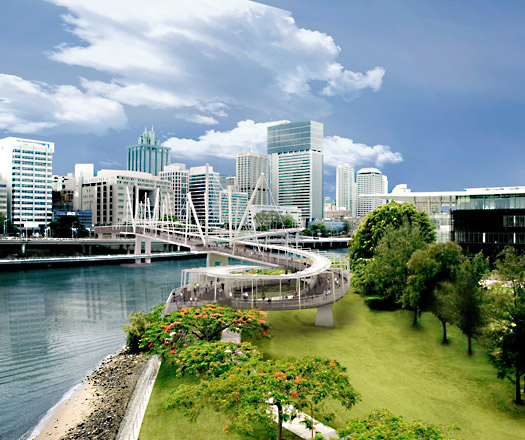
The world’s first tensegrity pedestrian bridge, designed by Cox Rayner Architects, is due to be completed later this year on the banks of the Brisbane River.
The Kurilpa Bridge, commissioned as part of Premier Anna Bligh’s commitment to providing better access for pedestrians and cyclists, and has already been singled out for its innovative approach to design.
Taking the unique principle of tensegrity – which allows a structure to be concurrently strong, yet incredibly light – the bridge will link the city’s legal precinct to its cultural hub and provide a 425 metre pathway for users.
Baulderstone Kurilpa Bridge Project Manager Paul Stathis says that it was a combination of the engineers wanting the challenge of building something very lightweight and efficient and the architects wanting to build something that wasn’t just a ‘run-of-the-mill’ concrete bridge. “It’s not just unique in appearance, it’s unique in design and engineering,’’ Stathis says.
He says that while each of the 12.8m bridge deck segments are uniform, the cables that support the bridge differ in length, angle and load, creating engineering challenges.
“We are building the bridge deck piece by piece, night by night. Every element that’s installed is random, with the exception of the deck and the crossbeams – but the work is definitely not speculative or random,” Stathis says.
Check out the project progress here
INDESIGN is on instagram
Follow @indesignlive
A searchable and comprehensive guide for specifying leading products and their suppliers
Keep up to date with the latest and greatest from our industry BFF's!
The internet never sleeps! Here's the stuff you might have missed