The home of architecture and design in the Asia-Pacific
Get the latest design news direct to your inbox!

Get the latest design news direct to your inbox!
How does ergonomics affect economics? Humanscale shows us how improved ergonomic behaviours can improve business performance and individual wellbeing.
It’s a known fact that today’s agile working behaviours are affecting productivity for the better. According to the Economic Policy Institute, between 1973 and 2013, worker productivity in the US increased by 74.4 per cent; new data from the Bureau of Labour Statistics (BLS) suggests that in the third quarter of 2017 alone, workplace productivity in the US increased by 3.8 per cent. But what is the toll of all of this productivity on our bodies?
Much has been made of the impact of the contemporary workplace on worker health and wellbeing. Chairs have come under particular scrutiny: in 2014, The Huffington Post made waves when it declared that ‘Sitting is the New Smoking’. Though the claim has been roundly refuted as an exaggeration, the gist of the article holds some truth. As workers spend upward of seven sedentary hours in desk chairs, rates of low back pain and discomfort are increasing. The average worker who passes the majority of their day seated also places themselves at risk of poor circulation and, potentially, premature spinal disc degeneration. To further complicate matters, workers are no longer spending their 9 to 5 in the same place, with many instead choosing to work remotely or away from the standard cubicle.
The ergonomics industry has responded to these new challenges in kind, shifting their research and design focus toward encouraging health and activity within the workplace. Leading the charge is Humanscale Ergonomics Consulting, who have championed ergonomic comfort and a strong user focus as drivers for workplace furniture design since 1983. Drawing from the expertise of an in-house team of ergonomists, Humanscale understands that using ergonomics to create a comfortable, healthy workplace is not a question of simply purchasing a single product. Rather, building the groundwork for a healthy working life is achieved by incorporating a number of ergonomic measures working in concert with one another.
By reframing workplace ergonomics as a strategic vision rather than simply a problem to be solved, Humanscale has developed a suite of simple, beautiful, and durable products tailored to today’s agile work habits. Humanscale’s products focus on incorporating movement into the workday through design of ‘The Active Workspace’, in which adjustability and flexibility prevail.
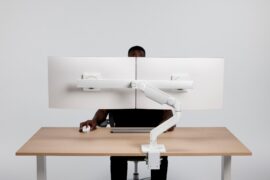
Humanscale are driven by a desire to formulate new answers to old questions, as seen in their sit/stand products. Designed to allow effortless changing of postures, the adjustable products respond to growing concerns surrounding the sedentary nature of today’s technology-driven workplaces. Humanscale takes this technology and improves it, applying it not only to desks but also to monitor arms, computer stands, and worktops. Workers are given the ability to move as much as – and how – they need to, regardless of whether they are working in the office or remotely.
This nuanced understanding of today’s workforce is also reflected in Humanscale’s adjustable desk chairs. Responding to hot-desking and flexible work arrangement trends, the chairs offer maximum adjustability without complicated levers or buttons. Instead, they respond intuitively to the user’s body weight to provide a comfortable recline with the correct tension for every individual. Every aspect of the chairs is carefully considered as an opportunity for ergonomic comfort, from armrests that move with the backrest as one unit to pioneering gel seat cushions that resist compression and support the sitter’s body consistently throughout the day.
Humanscale’s catalogue of ergonomic office furniture is bolstered by the success of Humanscale Consulting, the company’s in-house ergonomics service. Formed in 2002 in response to a gap in the market in terms of effective ergonomics programs implementation, the consultancy has since improved work efficiency for more than 2000 organisations, including Fortune 500 companies and government agencies.
INDESIGN is on instagram
Follow @indesignlive
A searchable and comprehensive guide for specifying leading products and their suppliers
Keep up to date with the latest and greatest from our industry BFF's!
The internet never sleeps! Here's the stuff you might have missed