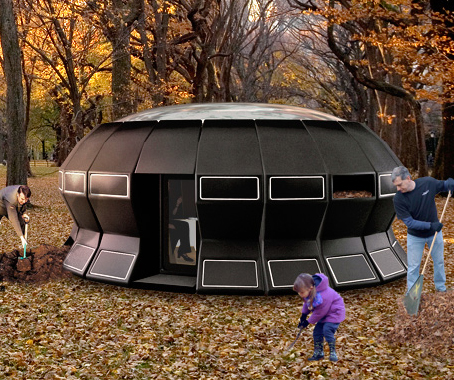
Heating things up in Japan with decaying compost.
August 25th, 2010
When compost meets an igloo, the result is Comploo.
Conceived by Tokyo-based architects Bakoko, the Comploo is an energy-saving experiment, which aims to heat small spaces with decaying compost.
Japanese households produce 400 million tons of waste per year,” Alastair Townsend, one half of Bakoko, told Indesignlive.com. “In Tokyo food accounts for 30 percent of all household waste.”
“Much is made of wind and solar energy sources these days”, said architect Alastair. “Having experimented with composting ourselves, we wondered if could compost also be part of the solution to global warming?”
Composting can generate heat in excess of 50ºC as the organic material decomposes.
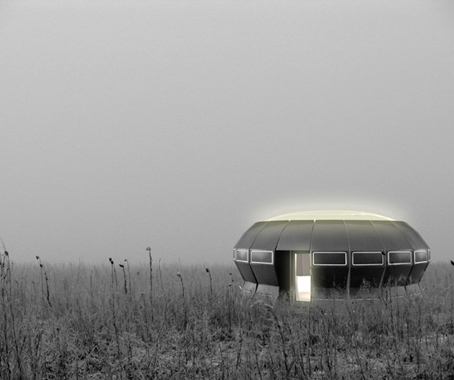
Bakoko architects wanted to explore the possibility of heating small spaces – such as teahouses – with this energy, while at the same time engaging the imagination of the public.
“Comploo was originally designed as a way to raise community awareness about composting in a fun and interactive way. That’s why it is intended for public parks, community farms, etc.”
Shaped like an igloo and covered with an ETFE dome to allow natural light to filter through, the internal space is surrounded by bins.
Garden waste, food scraps or other compostable materials are inserted through a door at the top of each bin.
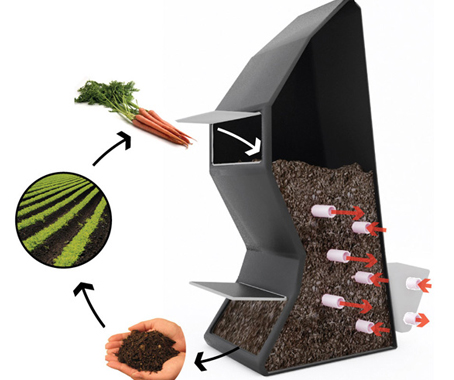
Air is circulated through sealed ducts passing between the bins, which warm the inside by emitting air into the interior.
Occupants sit upon a circular bench surrounding the heat source.
The rich organic compost can later be extracted from a door at the bottom of each bin, providing fertiliser for new vegetation, which will eventually fuel to Comploo once more.
“The concept will is suited to large urban parks, community garden, or even serving as an outdoor cafe – anywhere that generates a continuous supply of organic waste for fuel.”
Bakoko Architects
bakoko.jp
INDESIGN is on instagram
Follow @indesignlive
A searchable and comprehensive guide for specifying leading products and their suppliers
Keep up to date with the latest and greatest from our industry BFF's!
The Geelong College’s Sport and Wellbeing Centre ‘Belerren’ designed by Wardle is designed around bringing in natural light. But Shade Factor’s job was to help modulate and precisely control it for the most important competitive moments.
Aeron Chair’s new shades, Nightfall and Jasper, arrive with a sense of quiet cohesion – no bells and whistles, no loud technicolour; just two timeless, perfectly versatile near-neutrals. But the new hues aren’t just about colour – and their significance is much more profound than their surface-level subtlety might suggest.
At 3daysofdesign 2026, AHEC’s immersive exhibition traced the journey of American hardwood from forest to finished product.
As Woven Image celebrates 40 years, it introduces a new collection developed in collaboration with Australian artist Ben Goss, inspired by his original artwork Where the Kookaburra Sits into a vibrant collection of digitally printed EchoPanel® murals and patterns.
Adam Goodrum is kicking the design goals this year. The latest in his growing line of achievements is the Rigg Design Prize 2015 – now on show at the NGV, Melbourne. Barbara Bo Chung visits the show and shares her insights.
Promotions, new appointments, and the shifts of the design and architecture world – it’s a fast-changing landscape. Find out who is where with our September On The Move column.
The internet never sleeps! Here's the stuff you might have missed
The latest print magazine is about to arrive! In this issue, Guest Editor Andrew Tu’inukuafe & Barrington Gohns of Warren and Mahoney push us to think, consider and collaborate.
The Art Gallery of New South Wales has reopened the Brett Whiteley Studio in Sydney’s Surry Hills following a major renovation by TZG that upgrades the building while preserving the character of the artist’s former home and workplace.