The home of architecture and design in the Asia-Pacific
Get the latest design news direct to your inbox!

Get the latest design news direct to your inbox!
Freight Architects offer new possibilities for government childcare centres in Singapore. Is this INDE.Awards 2018 Shortlisted project the start of another chapter in Singapore’s ‘city in a garden’ story?

May 24th, 2018
Government childcare centres in Singapore used to be primarily associated with modestly sized spaces in the void decks of HDB blocks. Convenient and affordable, these centres have been the saviours of parents, but most have a limited capacity.
The Early Childhood Development Agency (ECDA) has been tackling the capacity issue by building more and building larger. The ‘large childcare centre’, defined as one that can provide care for 300 to 500 children, is now an established term in Singapore’s planning lexicon. And it is gradually changing the image and perception of government childcare services, one project at a time.
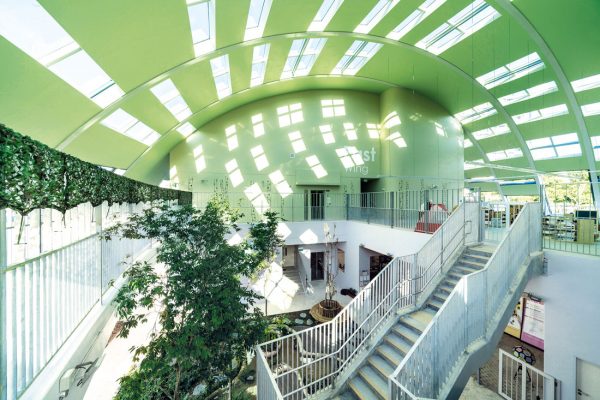
The latest of these began operating in February. Managed by operator Skool4Kidz (a consortium formed by Kinderland Educare Service and Dr Jane Ching-Kwan) and designed by Freight Architects, this Campus @ Sengkang Riverside Park spans 4,000 square metres and accommodates 460 children. It is the first large childcare centre to be situated within a public park, and the first collaboration between ECDA and the National Parks Board (NParks).
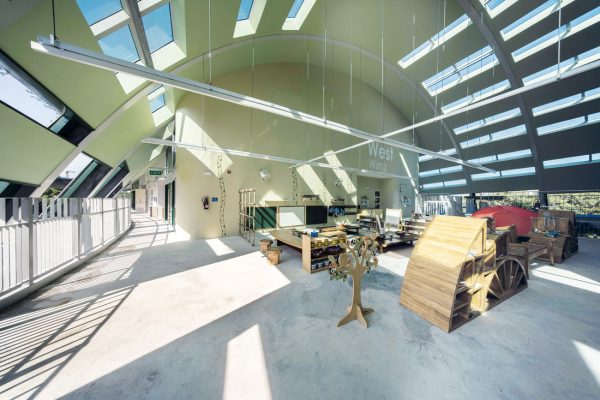
“Studies have shown that being closer to nature and participating in outdoor activities can enhance children’s wellbeing and nurture their appreciation for the environment,” says Kee Jing Zhi, Director at Freight Architects. Designed like a rolling hill that blends with its context, the two-storey childcare centre blurs the notions of indoor and outdoor using its ‘cocoon’ – a curving green roof structure. The roof is perforated by skylights and left open on the ground and second levels, providing fresh air and dappled natural light for the indoor areas as well as a replacement green area for the outdoors.
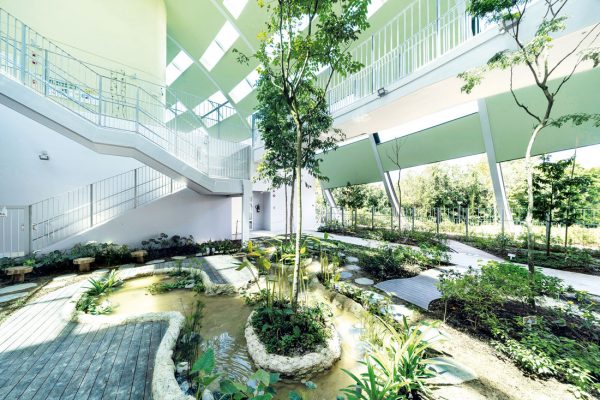
The campus features a garden atrium populated by trees and shrubs, an eco pond, and a sky bridge on the second level. “The idea is to teach biodiversity to the children… They can feel the running water, see the fish, smell the herbs and touch the trees’ leaves from the sky bridge,” says Kee. And there are plenty of open spaces for the children to explore.
ECDA tapped on NParks’ expertise for the incorporation of educational materials on Singapore’s biodiversity – for example, composting and the farm-to-table concept. The school makes its own compost and plans to incorporate vegetables and herbs harvested from the school garden and the adjacent community garden (part of NParks’ Community in Bloom initiative) into its lunch menu.
According to Kee, aside from the tight budget and short timeframe, the biggest challenge in realising the project was the inter-agency collaboration process. This also happens to be the project’s biggest accomplishment. The boundaries of various jurisdictions between government agencies, he said, could benefit from a higher degree of permeability, as this project demonstrates.
Photography by Darren Soh (courtesy of Freight Architects).
Read the complete article in Cubes 91, Out now!
INDESIGN is on instagram
Follow @indesignlive
A searchable and comprehensive guide for specifying leading products and their suppliers
Keep up to date with the latest and greatest from our industry BFF's!
The internet never sleeps! Here's the stuff you might have missed