The home of architecture and design in the Asia-Pacific
Get the latest design news direct to your inbox!

Get the latest design news direct to your inbox!
INDE.Awards 2018 shortlisted project Mobile Lotus by WY-TO sets an example of how the experience of hands-on community-based projects could help to build resilient modes of practice among tomorrow’s design professionals.

Rendering by WY-TO.
June 8th, 2018
“The contemporary social impact design movement.” Those words jumped off the screen as I read them at publicarchitecture.org – the website of a San Francisco-based group of the same name. Public Architecture connects non-profits with providers of pro bono design services, its intent being the creation of social gain (for those priced out of a traditional client-architect arrangement) through the design of the built environment. It asks design firms in the US to pledge one per cent or more of their working hours to pro bono service. Although it has the ring of an ‘add-on’ to ‘normal’ client-driven practice, it seems a noble mission – albeit one that many may only find feasible in economically buoyant times.
But if social-impact design is thought of as a “movement”, are there not associated parameters of time and circumstance? After all, movements by nature tend to decline and dissolve. Will there still be the impetus for architects and designers to ‘help’ if there’s less discourse – less of a movement encouraging it to happen?
The answer to that question is of course heavily context specific. Positive outcomes and resilience for people in need, as well as their environments, will mean very different things in San Fransisco, Singapore, rural Cambodia or suburban Australia. If appropriateness to context is a key ingredient of design that promotes resilience, then deep understanding of the home grounds on which practitioners work – or are likely to work – is essential.
In the Asia Pacific region, where firms in the most developed countries have seized on opportunities in their developing counterparts, context can take a broad and rather daunting definition. How can the prospect of design for positive impact be encouraged in this region in a way that will have deep roots, real meaning and longevity? How could a mindset of openness to the needs of people in the contexts in which we work be encouraged – with, hopefully, the ripple effect of design solutions (paid or pro bono) that maximise positive outcomes?
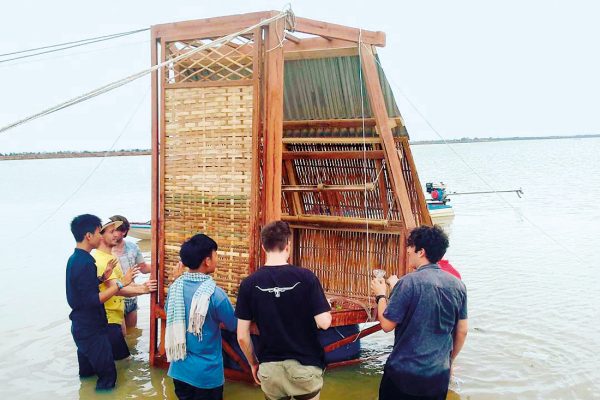
Photo by Adam Jack.
A project being undertaken by the Singapore studio of France and Singapore-based practice WY-TO provides a lens through which to consider the potential impact that the education experience might have on the priorities, knowledge and considerations of tomorrow’s practitioners. With various partners, WY-TO conducted a workshop in Cambodia for students from Phnom Penh, Singapore and Adelaide in which a segment of a floating clinic was built and tested on Tonlé Sap Lake.
This freshwater lake is a UNESCO Biosphere Reserve that’s under ecological pressure from over-exploitation of its natural resources. Mobile Lotus is a proposal by WY-TO for a floating ‘eco clinic’ that would provide information to the residents of the lake’s floating villages about the various causes of, and remedies for, the compromised water quality. Healthcare services and information for children and adults would also be integrated into the programming for this mobile community space.
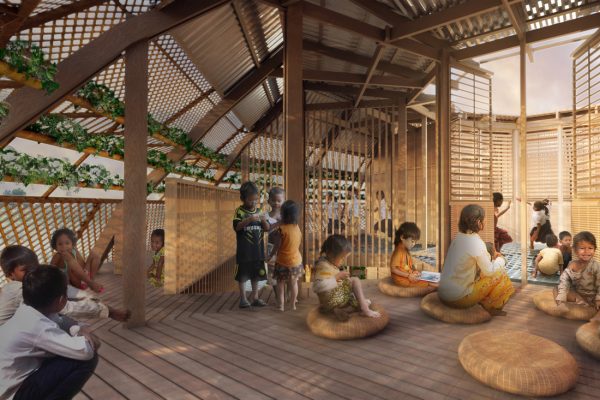
Rendering by WY-TO.
The project began as an entry to a 2015 competition held by UK-based Eleven magazine for designs for a floating medical, research and educational structure to serve the 1.2 million people living on the lake. Mobile Lotus didn’t win, but WY-TO’s Managing Director and Head of Design Yann Follain was keen to take the project further.
“I felt it was important to collaborate with universities and schools, and to do things not just with the community in Cambodia but also with foreign students,” he explains. The workshop was developed with the Royal University of Fine Arts in Phnom Penh, Glasgow School of Art in Singapore (where Follain has been teaching interior design) and the University of South Australia as a way to test the idea, prove the floating concept and raise awareness. “If students could participate in this kind of workshop, they would go home and start to spread awareness of the very difficult situation that Tonlé Sap Lake is in,” he says.
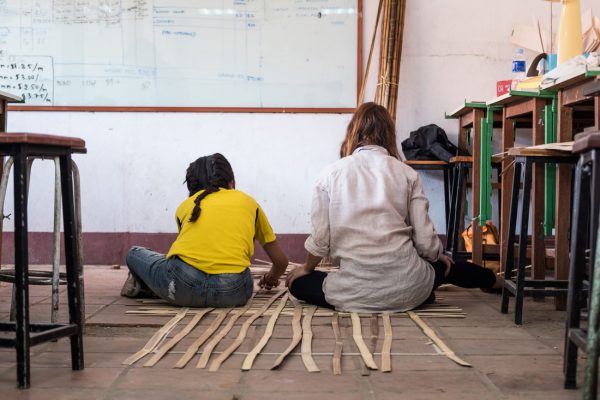
Photo by Nick Frayne.
But aside from the ecological story, there’s also the awareness-building possibility of what designers could do to address such issues – not to mention awareness of the contexts in which design professionals may find themselves working around the region. For the Singaporean and Australian students, vernacular Cambodian modes of construction were eye-opening. “It reminded the students that architecture can be very active. When you build by hand, even the simplest system for opening a window becomes something you need to develop,” says Follain.
Photography courtesy of WY-TO, GSA and UniSA.
Read the complete article in Cubes 91, Out now!
INDESIGN is on instagram
Follow @indesignlive
A searchable and comprehensive guide for specifying leading products and their suppliers
Keep up to date with the latest and greatest from our industry BFF's!
The internet never sleeps! Here's the stuff you might have missed