The home of architecture and design in the Asia-Pacific
Get the latest design news direct to your inbox!

Get the latest design news direct to your inbox!
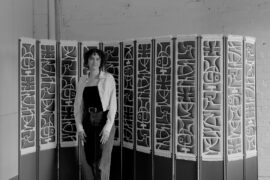
A pioneer in glass making in Singapore, Florence Ng transforms spaces and environments through innovative uses of the material. Olha Romaniuk writes.

August 4th, 2016
They say, practice makes perfect, and the saying still rings true for glass artist Florence Ng who, for over three decades, has been perfecting her craft and pioneering innovative glass making techniques in the Southeast Asia region. One of the first in Singapore to break into the glass art scene, Ng continues to bring her expertise in glass making to small- and large-scale projects for renowned clients like St. Regis Hotel Singapore and Taj Gurgaon @ Vivanta by Taj, India, with a continuous tenacity to create one-of-a-kind solutions and installations, and a desire to push the limits of glass making as an art form.

Origami-inspired design at Scotts Square, Singapore
With a background in illustration and graphics, Ng always saw potential in glass as a canvas for her art and design. The range and versatility of the material’s applications – from interior and furniture to lifestyle accessories and jewellery – was what initially attracted the artist to the craft as an outlet for her creativity and prompted her to explore glass making in more depth.
“I always thought that there was more to glass than using it just for functional purposes,” affirms Ng. “I saw it as the perfect material for the synergy and combination of art and function, one that could be applied in all sorts of ways.”

Glass art in Taipei
Having started her own glass studio, Synergraphic Design, in the late 1980s, when glass art was relatively unknown in Singapore, Ng was determined to learn more about the craft and glass fabrication techniques and treatments. It was this sense of determination that led Ng to travel to Seattle, USA, 30 years ago to study under American artists, Roger Nachman and Carmen. Studying under Nachman, Ng perfected the technical basics of glass making and began to experiment with the various techniques that she learned. Additionally, after visiting Dusseldorf in 1990, the artist brought back her first kiln to Singapore and started experimenting with glass fusing and kilnforming.

The creative process
For Ng, growing and evolving as a studio meant keeping up with the latest trends and technological developments. As the company expanded over the years, Ng and her team began to develop ranges of standard glass products that often combined unique glass making techniques with artistic flair and creativity. LamiArt (glass laminated with various substrates) and SynAxo (glass with metallic finishes), as well as many others, became widely used among architects and interior designers, exemplifying the creative innovation of Ng and her team.

Glass making process – Hotworking
“What has always set our works apart was, firstly, our design. Secondly, it was the way that we mixed and matched our techniques and, thirdly, it was our attempts to continually find synergies between glass and other materials to create something wonderful and beautiful,” says Ng. “This is because while glass is in itself versatile, it is still limited as a material and often presents something extraordinary when combined with other materials such as stone, wood, acrylic, metal.”

Glass making process – warmworking
Ng’s creativity and willingness to explore the possibilities of glass led to collaborations with other designers on works that demanded bespoke solutions, out-of-the-box ideas and technical expertise. While, initially, the works were limited to small, very intricate and detailed designs, Synergraphic Design eventually began to take on larger interior projects, looking at different ways of how glass art could harmonise with the surrounding environment, create an atmosphere and shape a space.

Glass installation at Singapore Garden Festival 2016
Despite the variations in scales and settings that have come with some of the bigger projects, Ng and her team’s approach of exploring different treatments and techniques for an impactful result has remained consistent throughout the years. “We always attempt to go beyond the two-dimensional drawings to bring the renderings to life in three-dimensional form, often employing multiple techniques to create those special finishes and effects,” Ng explains. “We always desire to create works of enduring beauty that wow the audiences.”

Glass installation at Singapore Garden Festival 2016
Today, Ng’s pursuit of innovation continues to lend her company a steady stream of creative projects for clients in Singapore and in the region. Synergraphic Design recently completed a sizeable commission, totalling close to 1,000 pieces with 24 designs, for illuminated wall artworks for a large hotel in Asia. The company also completed an installation of blown glass dragonflies and origami-style bees in collaboration with Ann Teo from COEN Design International for the recently concluded Singapore Garden Festival 2016 at Gardens by the Bay.
As for the future goals for her company, Ng hopes to continue sharing her passion for glass making through her projects and collaborations, bringing awareness to the versatile material that inspired her to start Synergraphic Design in the first place. She says, “I hope to produce unique designs in glass in synergy with other materials and art forms, distilled in furniture, lighting, and lifestyle accessories and perhaps even in fashion, that people will come to appreciate. I hope they will find that these works bring value to their lives and spaces.”
Synergraphic Design
synergraphic.com.sg
INDESIGN is on instagram
Follow @indesignlive
A searchable and comprehensive guide for specifying leading products and their suppliers
Keep up to date with the latest and greatest from our industry BFF's!
The internet never sleeps! Here's the stuff you might have missed