In coping with a manpower crux across industries, the Singapore government has been actively pushing the workforce to adopt smart and productive measures – favoured over manpower-reliant processes. The building and construction industry is not exempted, especially since the use of modular construction techniques can propel Singapore’s building industry to build faster and better with lesser.
A case in point, the new wing of Crowne Plaza Changi Airport – designed by esteemed architectural firm WOHA – is the first private and public building constructed using Prefabricated Prefinished Volumetric Construction (PPVC), a method whereby free-standing modules complete with wall, floors and ceiling finishes are built in an accredited fabrication facility before being installed in a building.
For Crowne Plaza Changi Airport’s new 10-storey extension, modules were prefabricated offsite in Shanghai, China, complete with interior finishings before shipment to Singapore to be assembled onsite. The method was proposed by the hotel’s developer, OUE Limited, who was keen to utilise more cutting-edge techniques to raise productivity in architectural construction.
According to Sunshine Wong, the General Manager of Crowne Plaza Changi Airport, PPVC enabled onsite construction manpower to be reduced by 40 per cent. And in comparison to traditional methods, the time required for onsite works was shortened by three months, enabling the hotel to offer 75 per cent of its new capacity to guests sooner. It also resulted in “a much higher quality end product,” he adds.
Richard Hassell, Founding Director of WOHA, explains that the extension building, composed solely of guest rooms and back of house facilities, was suited for PPVC as it called for the high repetition of modular and uniform rooms. “In the adoption of the PPVC method, priorities were given to achieve [a] high repetition, efficient layout and modular system within [a] structural grid,” he adds. This is WOHA’s first PPVC project.
When asked about the feasibility of PPVC in other projects, Hassell says, “For other projects requiring a greater range of atypical areas, the challenge will be to achieve the desired variety with the least number of different modules, in order to reap the maximum benefit of PPVC.” Most definitely, the design must also be able to be sliced up into smaller, transportable blocks.
Explaining the other design challenges faced by the team, Hassell shares that the small 2600-square-metre plot and location on a traffic island called for a framework that would “mitigate the limited footprint below the guest room block, yet allow for some usable space.” At the same time, the building had to be architecturally engaging, in relevance to the airport context. As a result, a geometrical, multi-layered and translucent architectural skin was created, complementing the existing, iconic floral facade of its old wing, while possessing an identity of its own.
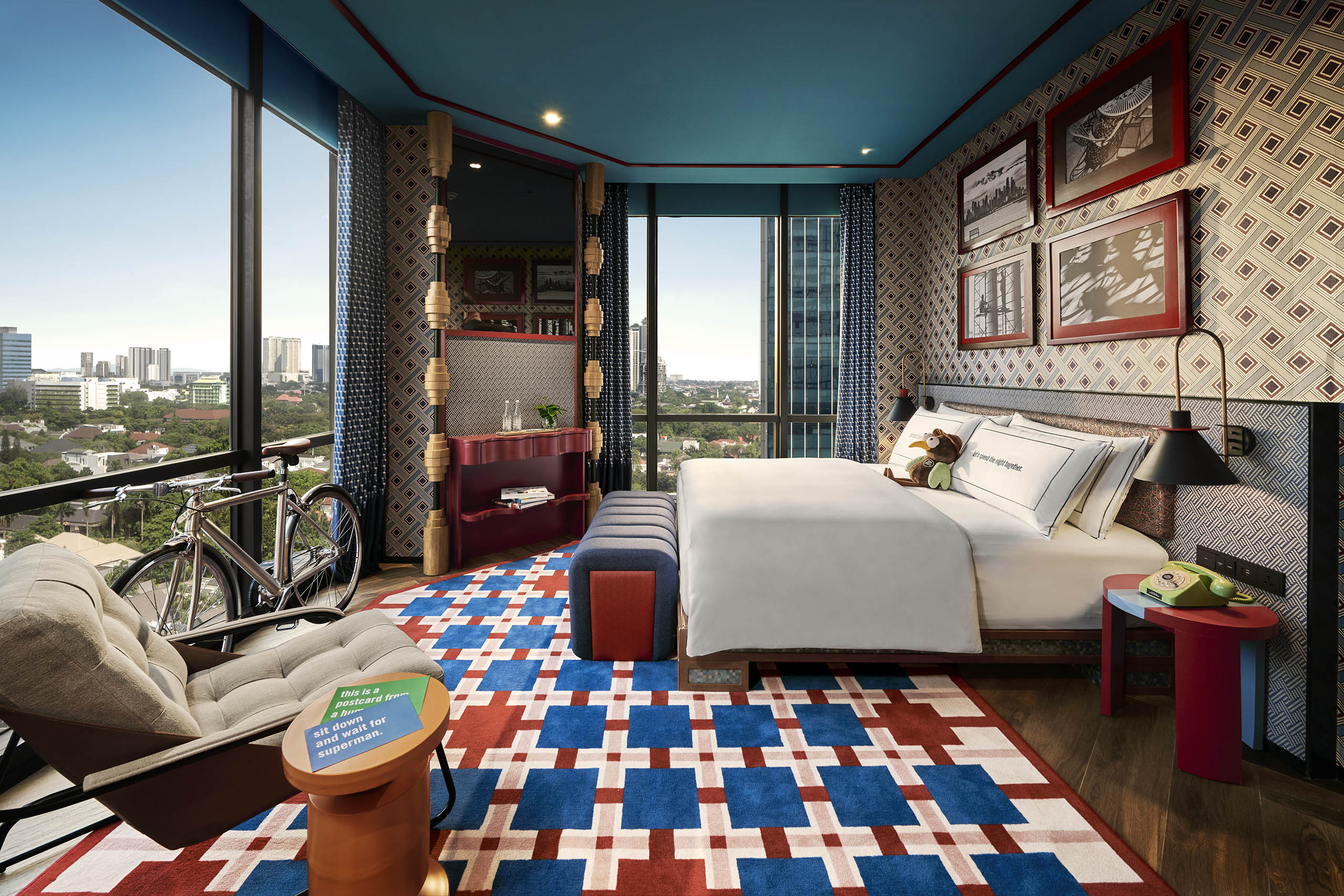
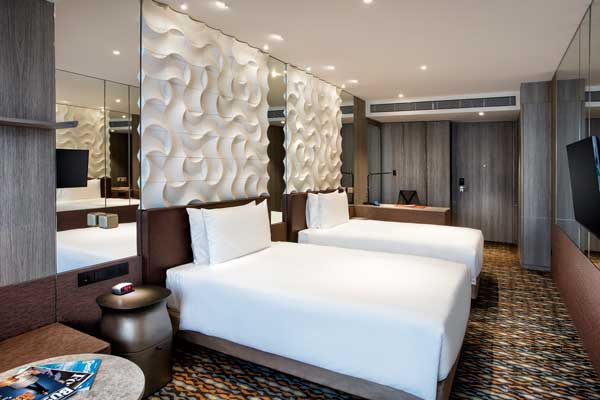
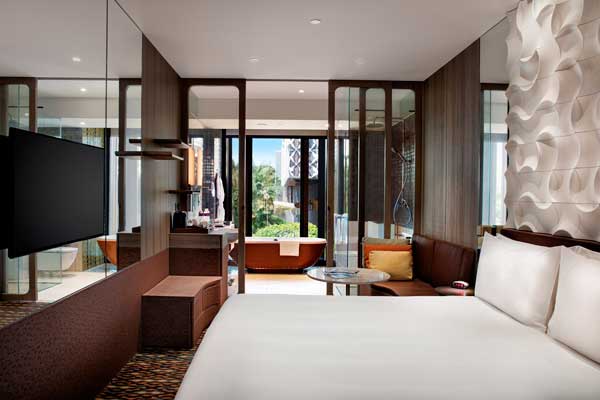
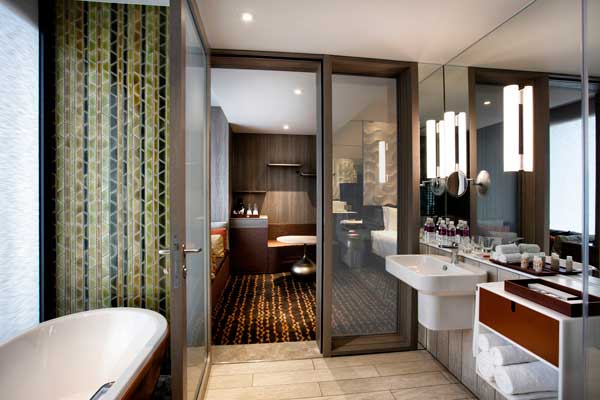
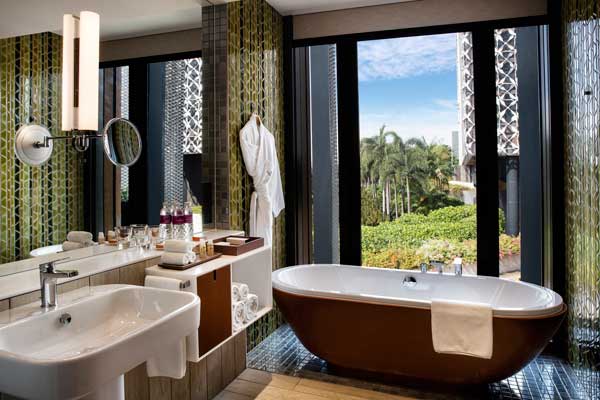
The interiors of the 243 Business Rooms have been designed for the modern business traveller. Using colours and mirrors, the rooms are cosy, comfortable, conducive and multifunctional, be it for work or a restful stay. The material palette continues the hotel’s ‘urban resort theme’, reflecting the characteristics of Singapore: tropical, Asian, multicultural, cosmopolitan, efficient and stylish. Each room comes with a generous writing desk and a Herman Miller ergonomic swivel chair. With floor-to-ceiling glass windows, guests can enjoy the view of Jewel Changi Airport when it completes in 2019.
As exemplified in the new wing of Crowne Plaza Changi Airport, the shift from constructing a building onsite to offsite manufacturing and assembling can improve quality control, shorten construction time, reduce manpower onsite, and is less disruptive, making it a game-changer for the construction industry here.
WOHA
woha.net