The home of architecture and design in the Asia-Pacific
Get the latest design news direct to your inbox!

Get the latest design news direct to your inbox!
The new Kuala Lumpur outlet of Common Man Coffee Roasters shuns the typical hipster café concept in favour of a welcoming space, where everyone and anyone can come to enjoy really good coffee.

December 16th, 2016
Photography: Darren Soh
Hipster cafés are a dime a dozen in Singapore. You don’t have to walk long to find one, and their oft hard-edged, industrial interiors can frequently be spotted from afar. Common Man Coffee Roasters (CMCR for short) is a Singaporean brand that’s aiming to change the game. The company wants to make really good coffee accessible to everyone, which is why, with their very first café in Kuala Lumpur, Malaysia they put Viewport Studio to the task of designing a coffee house that would be welcoming to a much more varied audience.
According to Ian Macready, Communications Director at UK- and Singapore-based Viewport Studio, the client wanted to “avoid the clichés of the typical hipster coffee house.” CMCR wanted the project to contain reference to the 1930s, the time of the Great Depression, and along with that, the idea of bringing great brew to everyone.
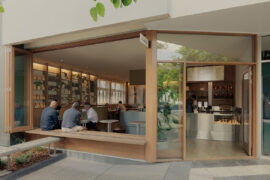
A café with classic leanings and references to the Southeast Asia context became the design starting point for Viewport Studio. Crucial to the experience of the café was the need to provide a variety of seating arrangements for customers. “Our design attempts to create a series of options for enjoying the space: drink at the bar, or sit in a booth, or [grab] a quick coffee on a perch by the door. Each area is configured with different seating options, which allows the patron to enjoy the café and the coffee (and food of course) in a different way each time they drop by,” Macready explains.
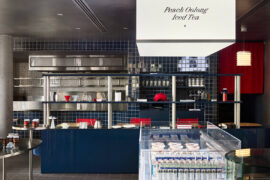
The different seating zones comprise booths with curved banquettes and rattan chairs; two-person café tables; oval group tables surrounded by upholstered stools; booth seating by the windows; and taking pride of place at the centre of the space, a large oval bar with an Art Deco style lighting feature.
All the furniture are bespoke, and the material palette of oak, rattan, cane, green marble, tiles and patterned fabric all come together to create a warm and convivial space with a subtle Asian influence. That’s not to say that CMCR KL is without the industrial touch. “We have used typical 1930s motifs of perforated mesh steel (the lighting), tubular steel (the booth seating) and a grid of steel rod, in the space, which are all industrial by origin,” says Macready. When combined with the other design elements, however, the result is a far softer and approachable space.
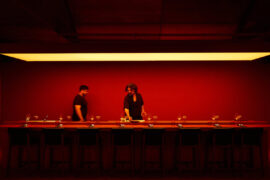
More than just a café, CMCR KL wants to offer a holistic experience with coffee. The new outlet houses a retail wall at the entrance, and an Academy where one can join in on coffee tasting sessions and learn the art of coffee making.
INDESIGN is on instagram
Follow @indesignlive
A searchable and comprehensive guide for specifying leading products and their suppliers
Keep up to date with the latest and greatest from our industry BFF's!
The internet never sleeps! Here's the stuff you might have missed