The home of architecture and design in the Asia-Pacific
Get the latest design news direct to your inbox!

Get the latest design news direct to your inbox!
When was the last time you drew with a pencil rather than a mouse? The World Architecture Festival has announced that a hand-drawn and digitally conceived hybrid has won its inaugural Architecture Drawing Prize.

Overall and Hybrid Category Winner, ‘Momento Mori: A Peckham Hospice Care Home’ by Jerome Xin Hao Ng (detail)
October 27th, 2017
“A great drawing is the first step from beauty to immortality,” say artists Ben Langlands and Nikki Bell, two of the judges for the World Architecture Festival’s (WAF’s) Architecture Drawing Prize. “The importance of drawing can’t be exaggerated because it evidences aesthetic and conceptual perception at the most fundamental level,” they add.
But can a computer-generated drawing hold the same resonance as one that has emerged directly from the mind-pencil-paper connection?
The Architecture Drawing prize was created in recognition of the continuing importance of hand drawing, while also embracing the creative use of digitally produced renderings. The new prize is curated by Make Architects, Sir John Soane’s Museum and WAF.
This year’s inaugural award received 166 entries across three categories: Hybrid, Digital, and Hand-Drawn. Of these, 38 entries from architects, designers and students from 15 countries were shortlisted. And despite what you may expect about the dominance of digital techniques, sixty per cent of the shortlisted entries were submitted by entrants aged 30 and under.
The overall winner was Jerome Xin Hao Ng, a student at The Bartlett School of Architecture, University College London. His drawing titled Momento Mori: A Peckham Hospice Care Home also won the Hybrid category.
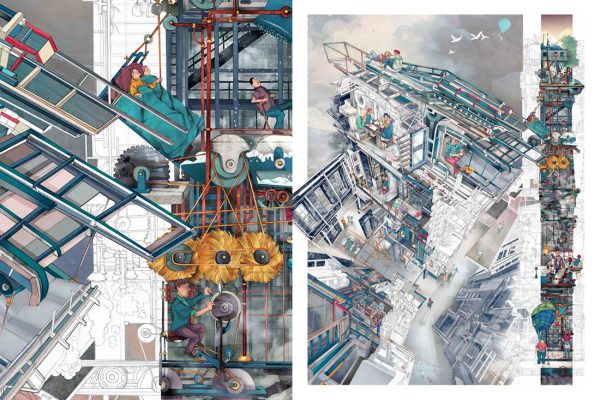
Above: Overall and Hybrid Category Winner, ‘Momento Mori: A Peckham Hospice Care Home’ by Jerome Xin Hao Ng (detail on the left).
Jeremy Melvin, Curator of WAF, described the drawing as “a superbly conceived and executed perspectival view looking down through the building from roof level, praised for its technical skill and the sensitivity with which it depicted the spaces found in such institutions as settings for multi-generation social interaction.”
The winners of the other two categories: Christopher Wijatno with Deepwater Purgatory in the Digital category; and Dimitrios Grozopoulis for Scenarios for a Post-Crisis Landscape in the Hand-Drawn category.
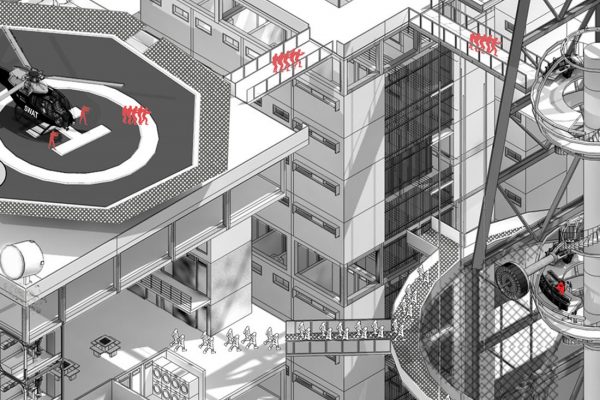
Above: Detail of Winner in Digital Category, ‘Deepwater Purgatory’ by Christopher Wijatno.
Wijatno depicted a prison moored like an oil rig in deep water, which judges felt evoked Piranesi and Dante. Grozopoulis’ drawing was commended by judges as having a haunting quality beyond that of most images of postindustrial landscapes, portrayed with an extraordinary control of line.

Above: Detail of Commended Entry to Hand-Drawn Category, ‘360 Degrees Panorama of the Dam Square’ by Elles Middeljans.
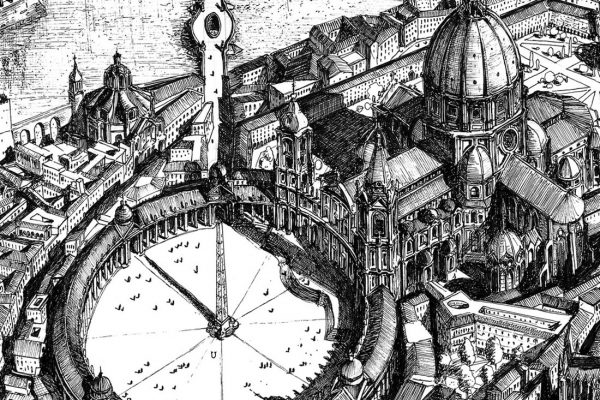
Above: Detail of Commended Entry to Hand-Drawn Category, ‘Utopia’ by Ubaldo Occhinegro.
Along with Langlands and Bell, the jury consisted of Narinder Singh Sagoo, Head of Design Communication at Foster and Partners; Ken Shuttleworth of Make Architects; Owen Hopkins of the Sir John Soane’s Museum; and Jeremy Melvin of WAF.
Commented Hopkins: “In the end, three drawings emerged which we felt demonstrated a perfect unity of subject, technique and media and these were our winners. The competition has shown that the art of architectural drawing is well and truly alive”.
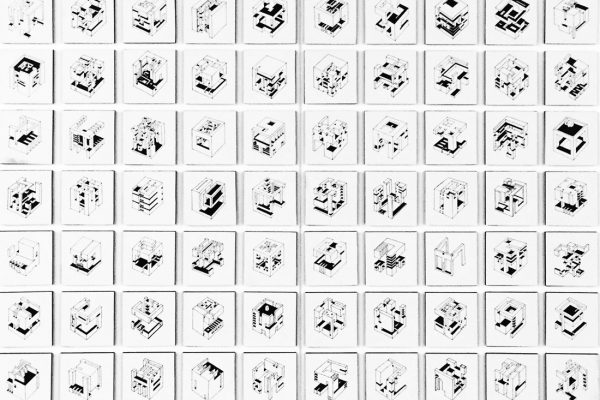
Above: Detail of Commended Entry to Hand-Drawn Category, ‘100’ by Reza Aliabadi.
The winning and commended entries will be displayed at WAF in Berlin (15-17 November). The winning and shortlisted entries will later be exhibited at Sir John Soane’s Museum in London from 21 February to 14 April 2018. Make Architects are featuring blog posts on drawing by invited contributors at makearchitects.wordpress.com
INDESIGN is on instagram
Follow @indesignlive
A searchable and comprehensive guide for specifying leading products and their suppliers
Keep up to date with the latest and greatest from our industry BFF's!
The internet never sleeps! Here's the stuff you might have missed