The home of architecture and design in the Asia-Pacific
Get the latest design news direct to your inbox!

Get the latest design news direct to your inbox!
Nendo showcased 16 delightful exhibits that play with the concept of outlines and blurred boundaries in its solo exhibition Invisible Outlines.

Photo by Takumi Ota
May 17th, 2017
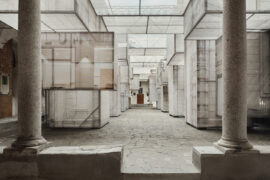
There was a long, snaking queue outside the Jill Sander showroom at Via Luca Baltrami during Milan Design Week. The culprit? Invisible Outlines, a solo exhibition by Nendo. It’s no surprise that visitors were willing to spend some time queuing to see what Oki Sato and team had come up with; Nendo’s exhibitions have always guaranteed to be delightful and photogenic. Invisible Outlines was no exception.
“We tend to perceive the existence and positioning of objects by subconsciously following outlines, and by distinguishing the inside and outside of these contours,” says the exhibition’s catalogue. “This also means that objects with obscure outlines cannot always be identified as objects, and conversely if outlines are visible, that information which is not visible can be subconsciously supplemented.”
Nendo played with this principle and presented 16 exhibits displayed in seven rooms that showcased the concept of outlines and blurred boundaries being made into objects. The 16 collections of objects were a mix of new projects specially created for the event and older projects by Nendo.
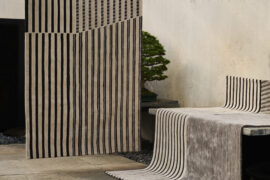
Objectextile, Nendo’s collaboration with German fashion label and host of the exhibition Jil Sander, offered five textile patterns derived from pure white objects arranged in transparent boxes. These boxes of pure white objects were photographed using a variety of lighting angles and shooting methods to create patterns in shades of grey, which were then made into textile for Jill Sander’s ready-to-wear pieces and accessories (read more about the collaboration at Indesignlive.sg).
With the Gaku lamp designed for FLOS, Nendo showed how the lamp’s frame constructed an interior space in which the user can arrange anything inside to co-exist with the light source. In another room, The Trace Collection, a series of cabinets and storage spaces created for the 2016 Collective Design fair in New York, were presented with steel outlines that trace the movements of their doors. Visitors’ eyes automatically supplemented the movements without having to see the cabinets actually being opened. The same effect was found in Unprinted Material – an installation that presented the outlines of ‘books’ in various states.
One of the crowdpleasers in the exhibition was the installation of Jellyfish Vases. Turning the conventional relationship of a vase, water and flower on its head, the installation presented 30 vases made of ultrathin, twice-dyed transparent silicon that gave the impression of a graduated silhouette of colours. These vases were placed inside an aquarium with a gentle water current that made them sway like jellyfish.
For those of you who would like to catch the exhibition, Invisible Outlines will be on display at the heritage exhibition space Grand-Hornu in Belgium from 21 May to 1 October 2017.
INDESIGN is on instagram
Follow @indesignlive
A searchable and comprehensive guide for specifying leading products and their suppliers
Keep up to date with the latest and greatest from our industry BFF's!
The internet never sleeps! Here's the stuff you might have missed