The home of architecture and design in the Asia-Pacific
Get the latest design news direct to your inbox!

Get the latest design news direct to your inbox!
Designed by WOHA, Singapore’s 1,550-sqm nett-zero energy pavilion for World Expo 2020 in Dubai aims to showcase Singapore’s innovative urban solutions and its quest to remain resilient. Get in touch with the organising team to participate in its program!

August 30th, 2019
Singapore will be participating in World Expo 2020, URA announced on Wednesday. The Expo, to be held from 20 October 2020 to 10 April 2021 in Dubai, will involve a total of 192 participating countries and is expected to attract 25 million visits during its six-month run. This participation will mark Singapore’s fourth presentation at World Expo, after participating in its 2000, 2005 and 2010 editions.
The URA will lead the participation by coordinating and collaborating with partners from both the public and private sectors to realise the Singapore Pavilion. Titled Nature. Nurture. Future, the 1,550-sqm pavilion is designed by WOHA Architects and produced by events and branding company Radius Experiential International.
Nature. Nurture. Future is envisioned as a dense, multi-layered three-dimensional greening space that embodies Singapore’s story as a small island nation that has evolved into a highly liveable city in a garden.
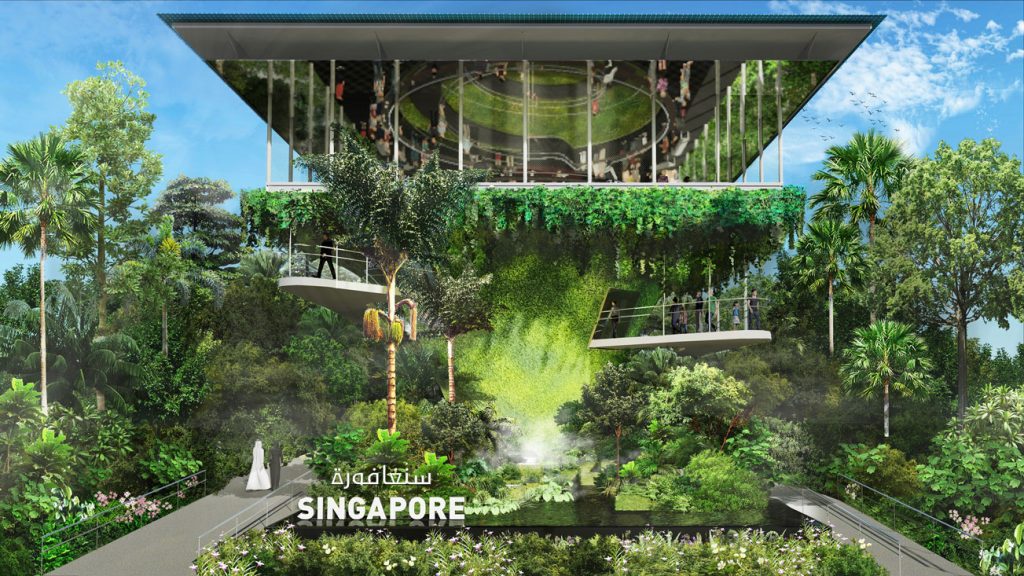
Visitors will be received in a tropical garden setting on the ground level. The centrepiece of the pavilion will be three large volumes whose surfaces are completely covered by greenery.
“With our design, we aim to show that it is possible to build a self-sufficient green oasis anywhere in the world, even in the desert,” shares Wong Mun Summ, co-founding director of WOHA.
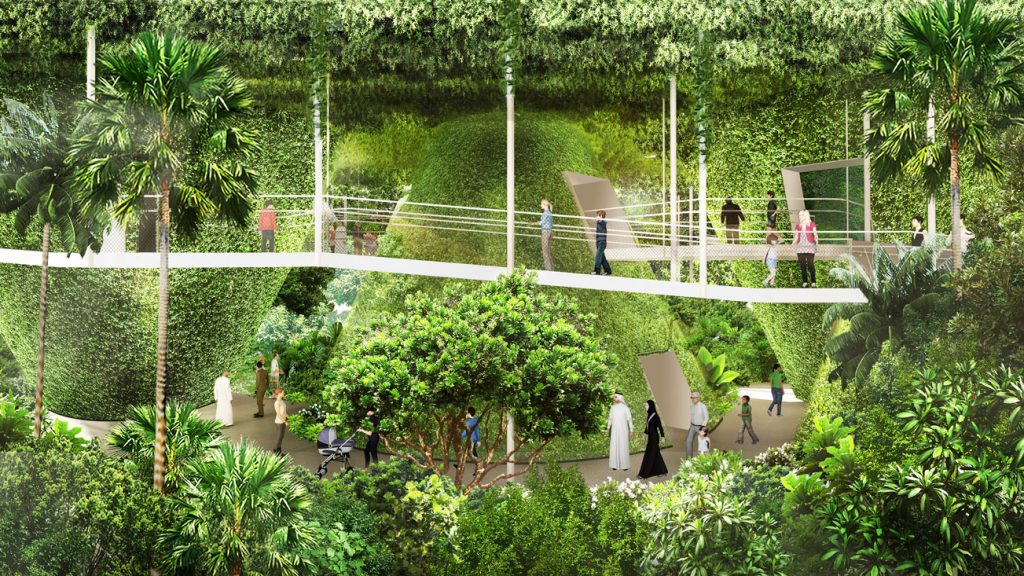
Key exhibits will be displayed inside these cones. A canopy walk will connect the three volumes and take visitors through the exhibits and up to an open platform with a full view of the Expo.
“Planting more trees and creating more green spaces is the best way to take immediate action against climate change – recent studies show it to be the most effective, cost-efficient and broadly available solution to combat global warming and it can be done now, anywhere. Singapore has been exploring many ways to become one of the greenest places in the world and we hope to share this knowledge and innovation at the World Expo,” Wong elaborates.
The pavilion is also envisioned as a net-zero energy building, featuring a water treatment system and a vast cantilevered roof that provides shade for the visitors and serves as a platform for enough solar panels to generate energy for its day to day operation. URA and WOHA are collaborating with Web Structures (structural consultant), Salad Dressing (landscape consultant), Transsolar (ESD consultant) and Light Collab (lighting consultant) to realise this vision.
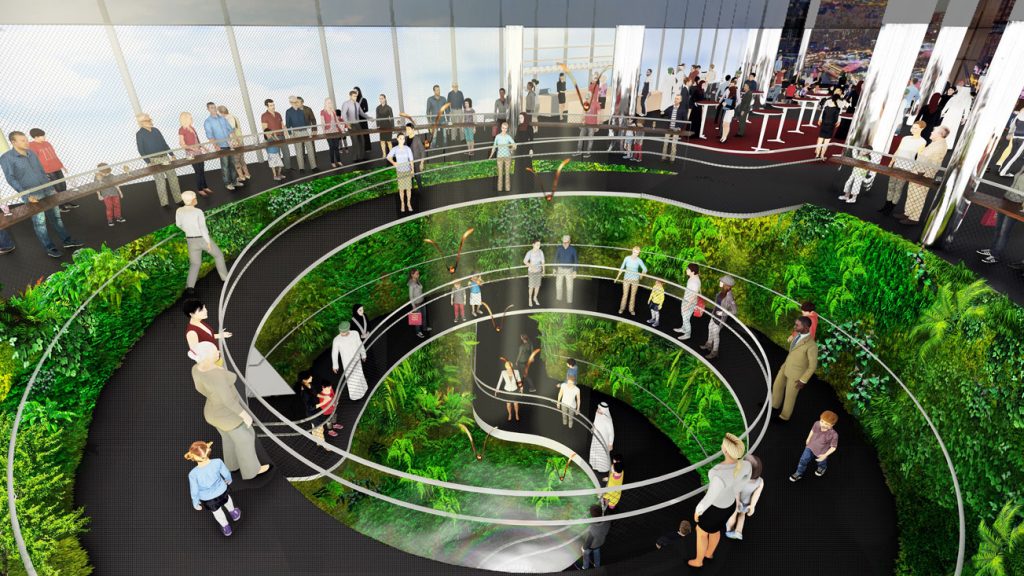
“The Singapore Pavilion is centred on our country’s guiding ethos of sustainable growth where we can have both economic growth and a high-quality living environment,” says URA CEO Lim Eng Hwee.
“Through the presentation at Expo 2020 Dubai, we hope to celebrate Singapore’s spirit of ingenuity and creativity by profiling Singapore’s innovative urban solutions, design and capabilities through programmes and activities that will take place throughout the six-month Expo. We invite Singapore businesses and organisations to play a part in realising the Singapore Pavilion and reach out to a global audience in the dynamic MEASA region,” he adds.
View the walkthrough experience in the video below:
INDESIGN is on instagram
Follow @indesignlive
A searchable and comprehensive guide for specifying leading products and their suppliers
Keep up to date with the latest and greatest from our industry BFF's!
The internet never sleeps! Here's the stuff you might have missed