The home of architecture and design in the Asia-Pacific
Get the latest design news direct to your inbox!

Get the latest design news direct to your inbox!
DP has grown from a partnership focused on post-independence nation building to an international mega firm. An exhibition at The URA Centre and a hefty book commemorate the journey so far.

August 23rd, 2017
From 15 staff in 1967, to 17 offices in 11 countries and a staff count of 1,300 in 2017 – DP Architects is the epitome of business success among Singaporean architecture practices. DP ranks tenth in BDOnline’s 2017 survey of the world’s largest architecture practices. It’s one of three Asian firms in the top ten, the others being Nikken Sekei and Aedas. (Gensler tops the list, joined by numerous other North American firms in the top ten.)
Compare the office locations of these three Asian mega firms, and you’ll see the geographic flows that are dominating architectural consultancy today. DP has expanded from Singapore to Shanghai, Beijing, Shenzhen, Guangzhou, Mumbai, Bengaluru, Jakarta, Kuala Lumpur, Johor Bahru, Yangon, Bangkok, Ho Chi Minh City, Hanoi, Istanbul, Dubai and London. Nikken Sekkei is headquartered in Tokyo with offices in Seoul, Hanoi, Ho Chi Minh, Singapore, Dubai, Moscow and Barcelona, with three affiliated offices in China and a project office in Riyadh. And Aedas is headquartered in Hong Kong with offices in Beijing, Shanghai, Chengdu, Macau, New Delhi, London, Dubai, Abu Dhabi, Los Angeles and Seattle.
DP is outpacing its Asian rival firms in terms of the expanding international footprint of its studios, and this prowess is referenced directly in the title of the firm’s fiftieth-anniversary exhibition: A Common Line | One Global Studio. The exhibition, which was a year in the making, is currently on display at The URA Centre along with a new commemorative book that spans 592 pages (all of them with gilded edges). Singapore’s Minister of National Development Lawrence Wong was present on 11 August to open the exhibition, signalling the significance of the undertaking and the importance of the firm to Singapore’s history and future.
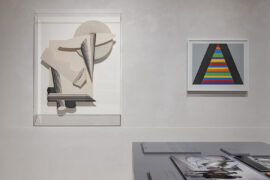
The exhibition contains 37 reconstructed models, over 2,000 previously unseen architectural drawings in chronological order (snaking around the exhibition area on a custom-made railing system), a specially commissioned wall-sized illustration titled Building Blocks by Singaporean illustrator Lee Xin Li, and an interactive visual display that allows the reimagining of Singapore’s Orchard Road and Marina Bay areas. The latter incorporates a sensor-embedded ‘giant T-square’ that can be slid across the screen to refresh the visuals.
Among the models are a large-format presentation of the Golden Mile Complex (minus its end towers), designed by Design Partnership (precursor to DP Architects) and completed in 1974; an enormous rendition of the Dubai Mall, completed in 2008 – the world’s largest covered mall; as well as iconic projects such as the Singapore Sports Hub (completed in 2014) and new ones such as Our Tampines Hub (partially completed).
Says DP Architects’ Senior Associate Director and Head of Exhibition Ng San Son, “We hope that visitors to the exhibition will not only query the function of architecture and urbanism, and rethink conventions, but also encourage conversations as they relate their memories of the spaces they have interacted with, in one way or another.”
While the exhibition will, hopefully, encourage dialogue about the built environment in Singapore, the limited-edition commemorative book should serve as a vehicle for thinking about how architecture practice in Singapore has changed over five decades and reached out to the international sphere.
Within the book, fascinating ‘Decade Wheels’ document DP’s active projects and staff strength in each decade; archival photos, drawings and letters present the atmosphere and concerns of particular eras; and a genealogical map of project collaborations and types tracked against time gives a multilayered glimpse of the ongoing presence of foreign design consultants in Singapore alongside DP Architects’ own expansion outwards.
A scaled-down version of the book (sans gilding) will be available in bookstores.
The exhibition runs till 29 September 2017, from 9am to 5pm (closed on Sundays) at The URA Centre. A half-hour architect-guided tour is offered on selected Saturdays at 11am.
INDESIGN is on instagram
Follow @indesignlive
A searchable and comprehensive guide for specifying leading products and their suppliers
Keep up to date with the latest and greatest from our industry BFF's!
The internet never sleeps! Here's the stuff you might have missed