The home of architecture and design in the Asia-Pacific
Get the latest design news direct to your inbox!

Get the latest design news direct to your inbox!
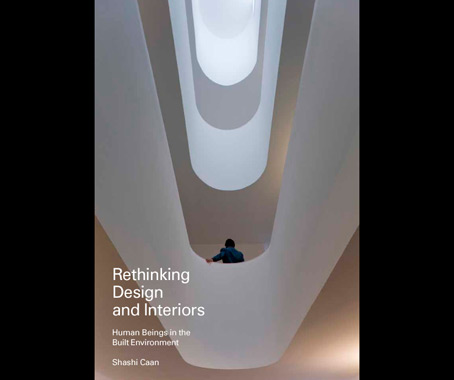
We quiz IFI president and The Collective principal Shashi Caan about her first book.
November 8th, 2012
Your book is titled “Rethinking Design and Interiors: Human beings in the built environment.” What prompted you to embark on this project?
I give a lot of lectures and do a lot of public speaking. The more I researched and thought about interiors and design, the more strongly I felt that some interpretations of our history are a bit backwards.

Shashi Caan
I had been giving provocative talks for the purpose of raising discussion. The provocation is that the notion of ’interiors’ is not recent; interior design is not a new profession, even though its professional history is short. Architecture is recognised as an older profession. As we’ve evolved, we’ve considered interiors to be more about decoration – about style and lifestyle – and architecture to be the serious profession. To me that’s just not accurate or correct.
The reality is that interiors exist for shelter. The interior was not a consequence of architecture. Architecture was invented in order to create interiors. So part of the provocation was situating the interior back in the cave days. The moment we discovered the cave and went indoors is when we started discovering self.
There was a publisher in the audience at one of my talks, and after hearing this he started talking to me about publishing a book. At first I said no. It took three years of conversation before I finally said yes to writing the book and an additional three and a half years of research.
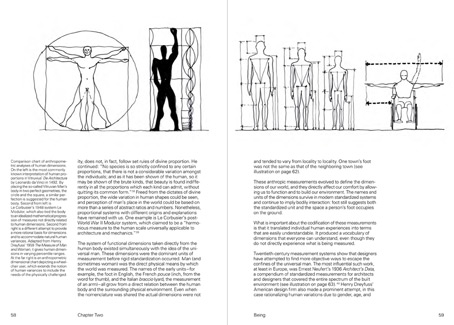
Spread from “Rethinking Design and Interiors” (chapter 2)
How are the contents of the book organised?
There are 4 chapters: Shelter, Being, Inside, and Design. There’s also an epilogue. The first chapter is a deep look into the nature and the philosophical underpinnings of shelter – the earliest thinking that subsequently shaped thousands of years of our thinking and our history.
Being (chapter 2) is all about us – who we are and who we become the moment we cross thresholds. These could be any thresholds, for example from here to the street, to a different country, and so on. The moment we do that, we become someone else. That is really what the designer shapes; it’s that quality of who we become.
The third chapter, Inside, is about the origins of the profession of interior design, but it also explores different kinds of ’insides’. It’s very broad.

Spread from “Rethinking Design and Interiors” (chapter 4)
The fourth chapter, Design, looks at the underpinnings of design knowledge – the history, the theory, the skills that are required, and then what knowledge is actually missing. It focuses on the very broad connections between all the arts.
The epilogue looks into the future. We’re fascinated with what the world might be like. One potential future is that today’s shortage of resources will result in cohabitation – farming, business, hotel, and hospital can all be co-located in one structure. Such structures are predicted to be enormous, like putting a massive roof over all of downtown Singapore. In that instance, all we will have is an inside. So what kind of knowledge do we need to be thinking about now?
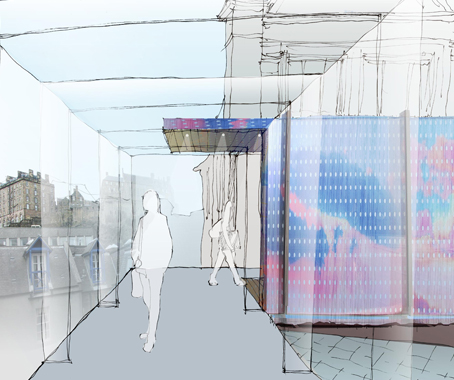
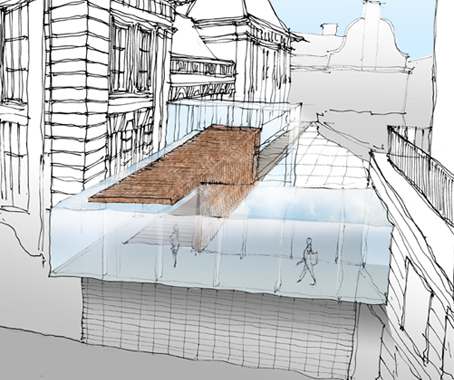
Edinburgh College of Art, design for connector bridge by The Collective
You’ve said that design for interiors is a popular profession but its sense of professional confidence is still lacking. Why do you think that is and what can we do?
We’re all fascinated with lifestyle. We can go shopping and compile a lot of stuff – lighting and drapery and fabrics – and then say, ’Look what I’ve done!’ But there isn’t any deeper thought behind how and why this compilation is shaping behaviour or whether it fits conceptually. Until we make it a deeper, more thoughtful, and considered discipline, it will remain decorative and we will not have respect. I think it’s a bigger question. It requires education. We need to examine in a deeper way.


Edinburgh College of Art, Evolution House designed by The Collective (breakout space above, principal’s office below)
And that’s the role of the International Federation of Interior Architects/Designers (IFI)?
It’s the role of everyone. I think our education system needs to challenge the public, and the public needs to challenge itself more. I think our legislators could look at the profession and support it differently.
But fundamentally, all of that sits with the profession. IFI is the singular world voice for interiors. We represent all the national associations. It’s a task of the national professional associations to take a stand in each country and say what we do for a living is bigger, it’s deeper, it’s theoretical, it has knowledge – specialised knowledge that needs to be studied. The profession needs to rise to the occasion. Not just here, but everywhere. IFI helps to do that.
Shashi Caan was a special guest at Saturday in Design Singapore. Her book has been published by Laurence King.
The Collective
sccollective.com
IFI
ifiworld.org
INDESIGN is on instagram
Follow @indesignlive
A searchable and comprehensive guide for specifying leading products and their suppliers
Keep up to date with the latest and greatest from our industry BFF's!
Calling all creative Corian® specifiers, the third annual Corian® Design Awards (4th edition) are now open for submissions. Inspired by the possibilities of this contemporary material, CASF have been recognising the creative use of Corian® in both Commercial and Residential design for three years. This year there have already been three editions, with a winner […]
The internet never sleeps! Here's the stuff you might have missed