Louise Martin-Chew heads to the State Library of Queensland for the Neilson Design Lecture, where Bruce Mau envisioned a new future for the state.
November 25th, 2011
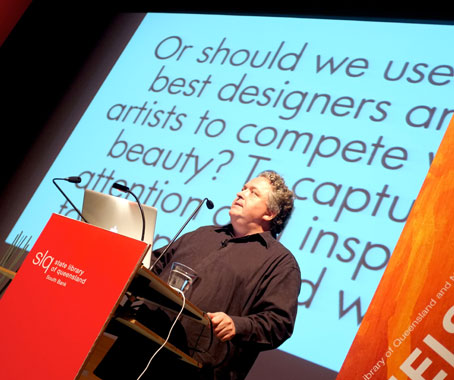
When Bruce Mau came to town, there was a full house in the State Library of Queensland ’s 200 seat auditorium, a screen in the Knowledge Walk for the large overflow crowd, and a vodcast for the rest of the world. There was the sense that Mau could provide something we need, urgently. And he delivered – being optimistic, visionary, stimulating.
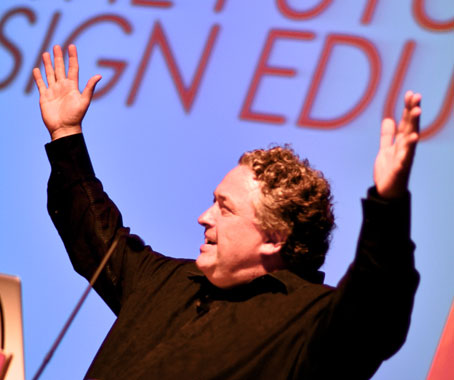
Mau’s subject is design, applied to every facet of life, institution and society – global and local. At the core of his message is a signal change to the green, eco-friendly, sustainable paradigm as it has existed for 50 years, one riddled with guilt, pain and an intrinsically conservative opposition to innovation or change. Mau noted, “We won’t solve the problems by inflicting pain, or looking back”.
Climate change, population growth (to the current level of one million children born weekly) and world poverty – all “staggeringly difficult” problems – may be solved, he suggested, by engaging the power and creative possibilities of art and design, putting together disciplines that have been divided. Joining technology with art or science with design has the power to create a holistic trajectory that has the potential to turn traditional thinking upside down and inside out, and deliver solutions in as yet un-thought of ways.
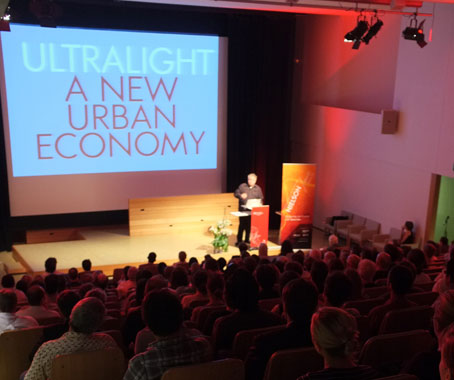
His visit focused on leading Brisbane’s creatives toward a new future for the state, offering a challenge to the city to take up “one of the most extraordinary opportunities in history”, to develop itself as a prototype. His ambitions for Brisbane included an energy bill of zero, the opportunity to become a world leader in civic life, exporting solutions to the globe.
While civic design thinking, reinventing “everything we do” is on his agenda, his most radical innovation may be his suggestion of a significant investment in art.
“How many people would travel to Venice had they had a one per cent for art program in the Renaissance? What if Brisbane had a 99 per cent for art program and led the globe in a beautiful synthesis toward this new world?”
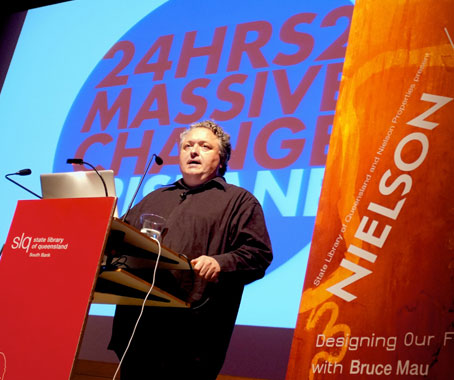
Photography: Tim Leslie
Bruce Mau Design
brucemaudesign.com
INDESIGN is on instagram
Follow @indesignlive
A searchable and comprehensive guide for specifying leading products and their suppliers
Keep up to date with the latest and greatest from our industry BFF's!
In the last instalment of our three-part performance seating series, Alex Bain from Architectus explains why sitting well shouldn’t feel like sitting at all and explores an unexpected success metric of the hybrid workplace: the grounding power of emotional support.
At 3daysofdesign 2026, AHEC’s immersive exhibition traced the journey of American hardwood from forest to finished product.
Aeron Chair’s new shades, Nightfall and Jasper, arrive with a sense of quiet cohesion – no bells and whistles, no loud technicolour; just two timeless, perfectly versatile near-neutrals. But the new hues aren’t just about colour – and their significance is much more profound than their surface-level subtlety might suggest.
Above Left Distributors and Agencies Pty Ltd will distribute all Tai Ping Carpet Brands effective immediately.
With more and more people returning to the office, we bring you a careers update of who is On The Move in November – with a special focus on female representation.
From the correlation between the way we learn and our working preferences and the death of ‘corporate starships’, to the all-important sense of temporary ownership in an environment of constant change – in the second part of “The Future of Work” we explore further shifts that define the evolution of the workplace.
The internet never sleeps! Here's the stuff you might have missed
At dedece Sydney, Anna Lenti introduced the Chromatic Alphabet, a new design tool intended to make architects and designers less hesitant about working with colour.
For centuries, stone and timber together have been used to translate architectural ideas into tangible spaces and places. There is a soul-level response to their sensory qualities, one that translates into an immersive feeling of connection and belonging.