The home of architecture and design in the Asia-Pacific
Get the latest design news direct to your inbox!

Get the latest design news direct to your inbox!
The prize money for the Aga Khan Award for Architecture has now been raised to US$1 million. Cycle 12 is now open for project submissions.
May 7th, 2012
The Aga Khan Award for Architecture, which is held once every 3 years, will be doubling its prize money to US$1 million in 2013 (Cycle 12).
His Highness the Aga Khan explains that the move is aimed at assisting and supporting the recipients, many of whom are neither well-known nor well-funded. “One of the important aspects of the Award,” he says, “is that winners should be able to reposition their future with the support they get from the Award, both professionally and institutionally.”

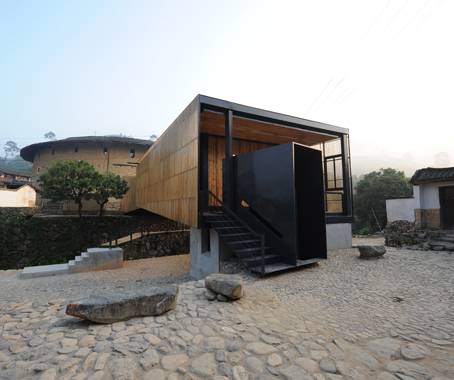
2010 winner: Bridge School in Xiashi, Fujian, China
Since it began in 1977, the Award has sought out projects that represent the broadest possible range of architectural interventions, with particular attention given to building schemes that use local resources and appropriate technology in innovative ways, and those that are likely to inspire similar efforts elsewhere.

2010 winner: Wadi Hanifa Wetlands in Riyadh, Saudi Arabia
The projects can come from anywhere in the world, but must address the needs and aspirations of societies in which Muslims have a significant presence.

2010 winner: Ipekyol Textile Factory in Edirne, Turkey
In keeping with the issues of the day, the Award, has, in recent cycles, encouraged the submission of projects which improve public spaces, address the quality of environment for employees, and which tackle the issues of rural societies and communities on the peripheries of urban centres.

2010 winner: Madinat al-Zahra Museum in Cordoba, Spain
In 2010, the 5 winning recipients were: Bridge School in Xiashi, Fujian, China; the Wadi Hanifa Wetlands in Riyadh, Saudi Arabia; the Ipekyol Textile Factory in Edirne, Turkey; the Madinat al-Zahra Museum in Cordoba, Spain; and the Revitalisation of the Hypercentre of Tunis, Tunisia.

2010 winner: Revitalisation of the Hypercentre of Tunis, Tunisia
Well-known architects such as Norman Foster and Cesar Pelli have also been recent recipients of the triennial award.
Nominations are now being accepted for the 2013 award. The deadline is 15 September 2012.
Visit akdn.org/architecture
Top image: 2010 winner, Bridge School
INDESIGN is on instagram
Follow @indesignlive
A searchable and comprehensive guide for specifying leading products and their suppliers
Keep up to date with the latest and greatest from our industry BFF's!
The internet never sleeps! Here's the stuff you might have missed