The home of architecture and design in the Asia-Pacific
Get the latest design news direct to your inbox!

Get the latest design news direct to your inbox!
Lacoste + Stevenson’s refurbishment of an old timber grandstand has given its utility a decorative gloss, writes Philip Drew.
July 14th, 2011
The grandstand at Reg Bartley Oval, in Sydney’s Rushcutters Bay was built in 1894, altered and extended in 1929 and later partially destroyed by fire. In 2005, the City of Sydney decided to restore the grandstand, which involved provision of fire egress, removal of a collection of buildings at the rear, and demolition of an air raid shelter from World War 2. The old kiosk on the other side of Waratah Crescent was demolished and replaced by a new structure to the north-east on the fifth tennis court that had blocked circulation around the oval.
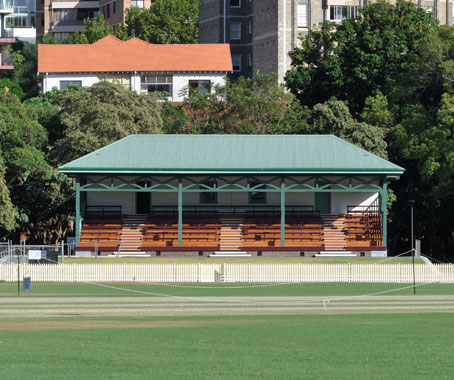
Lacoste + Stevenson have extended the existing timber grandstand, while maintaining its character. The structures hiding the back of the grandstand were replaced by three smaller two-storey pavilions (including female and male toilets, fire stair, store at ground level, lunch and change rooms and an office above), in identical profile 200mm wide Blackbutt boards to create view channels without effecting the existing trees. This preserved the integrity of the old restored stand and minimised impact from the new work.
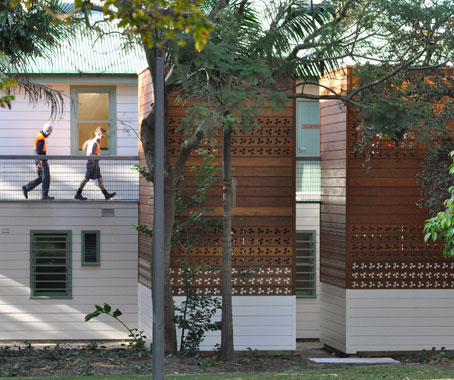
The stand is connected at the back to the three small pavilions by a minimal 50mm deep see-through link with two upper level function rooms. Two large changing rooms, a store and umpire’s room were refurbished under the stand.
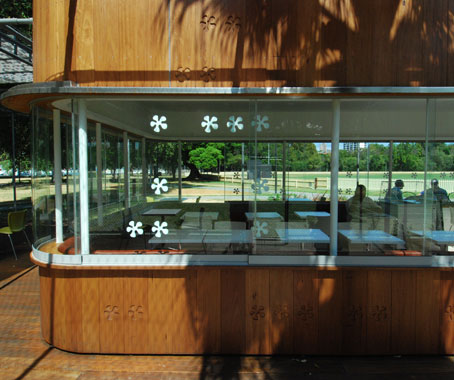
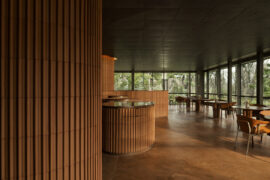
The new freestanding kiosk adjoins the bayside tennis courts. Its two overlapping rectangular volumes are skinned in the same Blackbutt weatherboard fixed vertically. Surrounding this, a stainless steel mesh canopy, similar to mesh used for the tennis courts, extends all round to produce a minimal veranda.
Climbing Mandevilla will in time spread a broad areola carpet of pink flowers over the mesh. Nearest to Rushcutters Bay, a glass canopy protects visitors from the weather. The scale is a delight. This is coupled with a harbourside maritime feeling enhanced by the extreme openness of the kiosk which allows views through into the surrounding landscape. It is facilitated by limiting the wall height under the sliding glass to the same level as the tables.
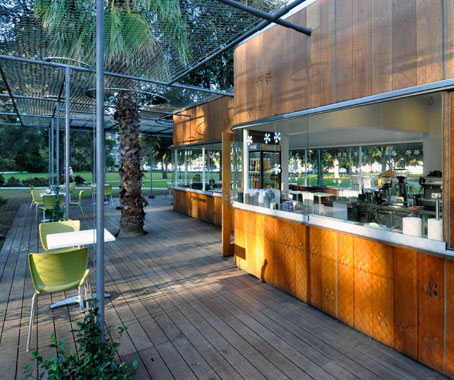
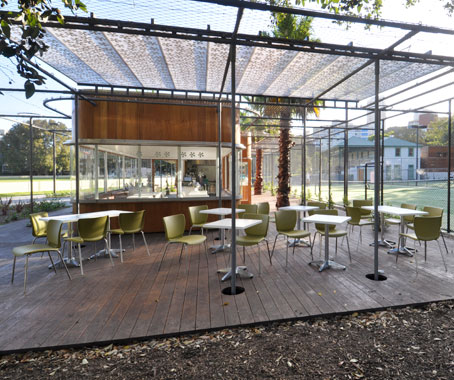
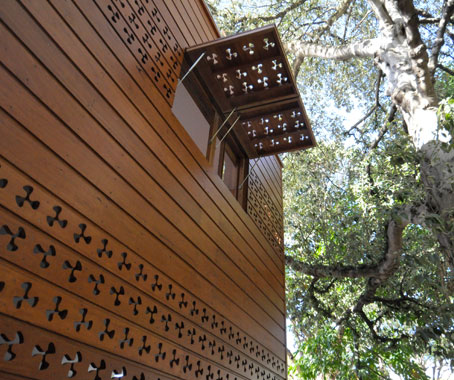
A regular, stylised clover-leaf or flower pattern motif is carried around the outside in a horizontal band above doorhead height. This pattern runs around the outside of all four structures to admit light and air to the toilets and further emphasises the horizontal stratification of the forms.
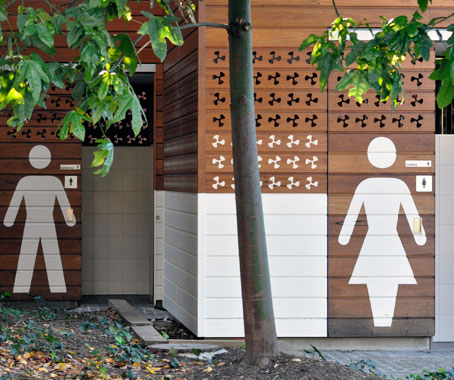
Like people, buildings have skins. A century ago, in 1908, Adolf Loos in Vienna attacked ornament as baby talk, maintaining that it was essentially erotic in origin and symptomatic of degeneracy as in Papuan savages. He linked tattoos to criminals and saw it as a mark of cultural backwardness.
Ornament once meant quality craftsmanship – which, for Loos, was a waste. Repetitive machine ornament is not only more economic, it can soften and humanise buildings. It appeals to our love of texture and need to touch the objects around us. Here, it lends the architecture warmth and intimacy. We are invited to come closer, to look through the pavilions, and see them not as opaque resistant objects, but as permeable transparencies.
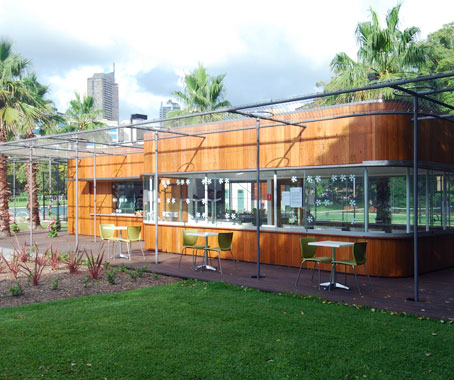
Ornament can be likened to tattoos that make us unique. Body tattoos are a fashion statement today and the tattoo taboo has relaxed – in parallel with the decoration of the external building skin, most often glass, with some form of emblazoned tattoo.
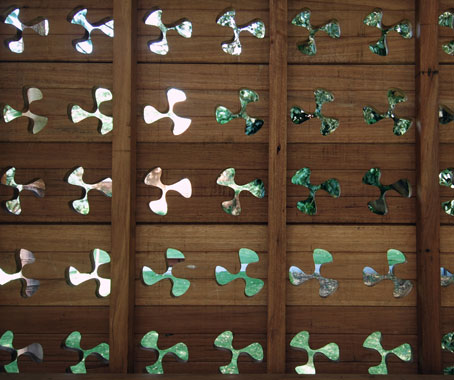
Tattooed leaf patterns carry through Lacoste + Stevenson’s sensitively detailed kiosk pavilion and amenities blocks as a consistent unifying thread. The repetitive flower or clover leaf cut-out motif on the blank timber skin around the toilets leads the eye from one pavilion to the next till it jumps across to the separate restaurant kiosk and up onto the glass canopy outside in a unifying gesture.
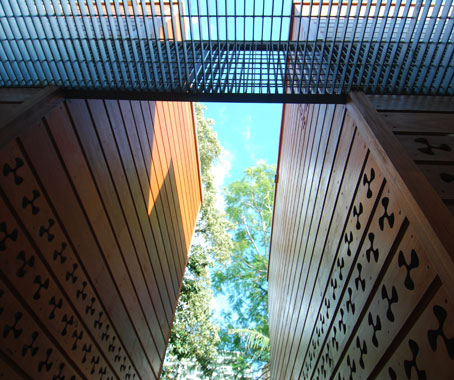
Sport and showground grandstands across Australia typically were constructed in timber in 19th Century. Lacoste + Stevenson rightly reinterpreted this customary use of timber in a delicate, somewhat fanciful fashion linked it to nearby rocking yachts. Rounded corners carry the marine character further.
Unlike so many sidewalk coffee spots beside busily trafficked streets in Sydney, the Rushcutters Bay kiosk is a joy to visit with its casual lightness that seems to dance within the bay.
Lacoste + Stevenson
lacoste-stevenson.com.au
INDESIGN is on instagram
Follow @indesignlive
A searchable and comprehensive guide for specifying leading products and their suppliers
Keep up to date with the latest and greatest from our industry BFF's!
The internet never sleeps! Here's the stuff you might have missed