The home of architecture and design in the Asia-Pacific
Get the latest design news direct to your inbox!

Get the latest design news direct to your inbox!
Elana Castle discovers that the Frame Moooi Award has an Australian contender in its midst.
March 21st, 2012
An Australian retail installation has been shortlisted for the prestigious Frame Moooi Award.
The award was launched in 2011 to celebrate distinctive lighting and fittings designed for a specific interior.
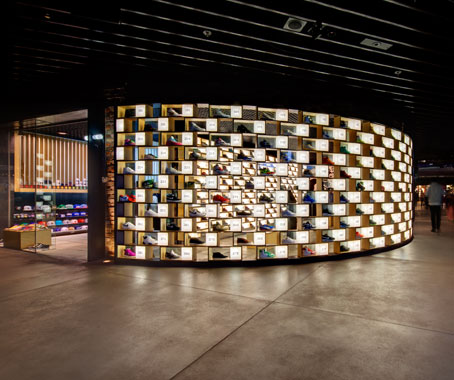
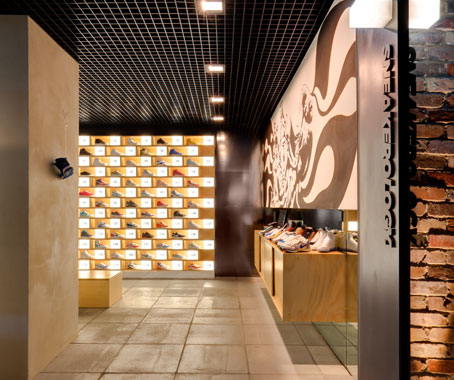
Facet Studio submitted their bespoke shoe-box display system for a sneaker store in Westfield’s Pitt Street, Sydney shopping centre. Their design was selected out of over 800 submissions by the award’s juror, none other than design icon Philippe Starck.
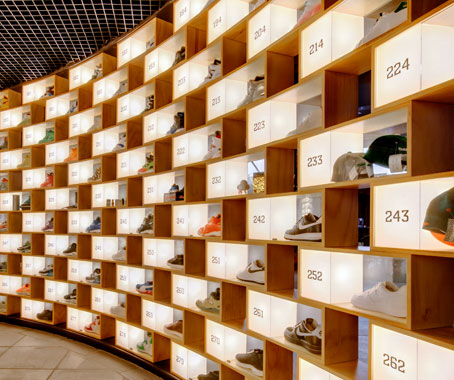
Facet Studio’s design consists of a wall of 200mm x 600mm plywood boxes which are systematically repeated and offset.
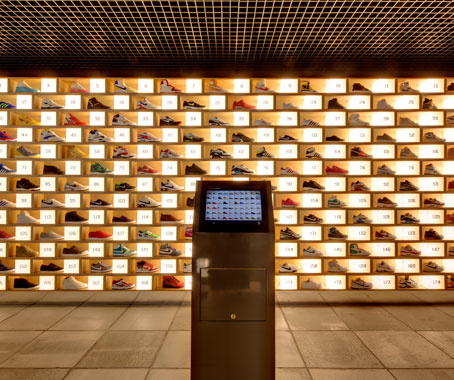
“This is something which has little meaning on its own,” explain Olivia Shih and Yoshihito Kashiwagi, the duo behind Facet Studio.
“However, when repeated 281 times over, it creates a euphoric effect for one to experience a heightened emotion.”
The wall acts both as a display within the shop, and as the façade which interfaces with the mall. The shop floor is illuminated by the light emitted by the shoeboxes – making the device a structural, display and lighting element all in one.
The design also mimics a museum-type installation, a theme underscored by the touch panels which provide background stories of the merchandise.
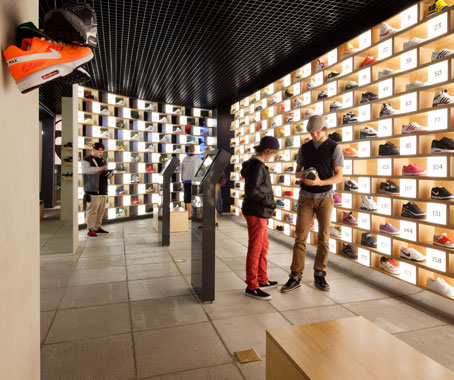
“Although there is really no such field of study as ’sneaker-ology’,” say the pair, “placing our design focus on ways to correctly understand the merchandise is an attempt at capturing ’sneakers’ in a scholarly fashion.”
The boxes also function as lighting components, elevating the humble sneaker above the everyday and adding extra gravitas to the relevancy of the submission.
Philippe Starck will be presenting the award, as well as the €25,000 grand prize, on 18 April in Milan.
Photography: Katherine Lu
Facet Studio
facetstudio.com.au
Frame Moooi Award
framemoooi.com
INDESIGN is on instagram
Follow @indesignlive
A searchable and comprehensive guide for specifying leading products and their suppliers
Keep up to date with the latest and greatest from our industry BFF's!
The internet never sleeps! Here's the stuff you might have missed