The home of architecture and design in the Asia-Pacific
Get the latest design news direct to your inbox!

Get the latest design news direct to your inbox!
Hua Bee coffee shop by day, Bincho by night – Loh Lik Peng’s recent project takes on two identities.
March 12th, 2014
With the influx of hip lifestyle and F&B outlets hastening the gentrification of the Tiong Bahru neighbourhood, it’s hardly surprising that its residents were suitably alarmed when their beloved Hua Bee coffee shop closed its shutters after 70 years of serving its famous mee pok (fish ball noodles).
It’s new owner, hotelier-restaurateur Loh Lik Peng has, however, managed to conceive a way for it to run alongside his new F&B establishment.
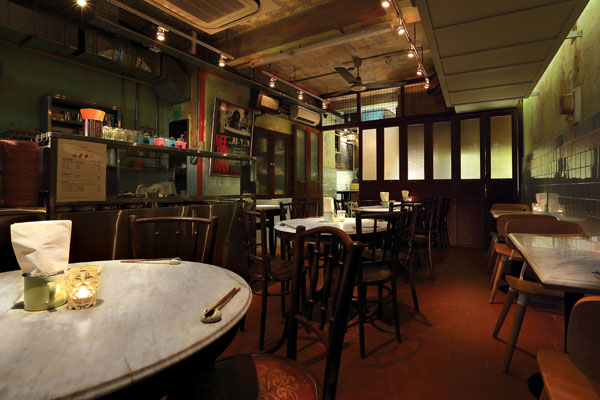
Hua Bee – the coffee shop was made famous as the set for Eric Khoo’s indie film Mee Pok Man (1995)
By day, Hua Bee is a kopitiam (coffee shop) that continues to serve its humble noodle dish. When dusk falls, modern yakitori joint Bincho takes over in a separate space at the back of the establishment.
“Bincho is influenced by two traditional concepts – a yakitori-ya we fell in love with in Osaka and Hua Bee, an integral part of Tiong Bahru’s heritage,” says Lik Peng, who appointed Hjgher to design the interiors. “We thought it would be interesting to work with a concept that not only preserves history and tradition but introduces a modern approach at the same time. And I wanted this to reflect not just in the cuisine but as the personality of the restaurant too.”
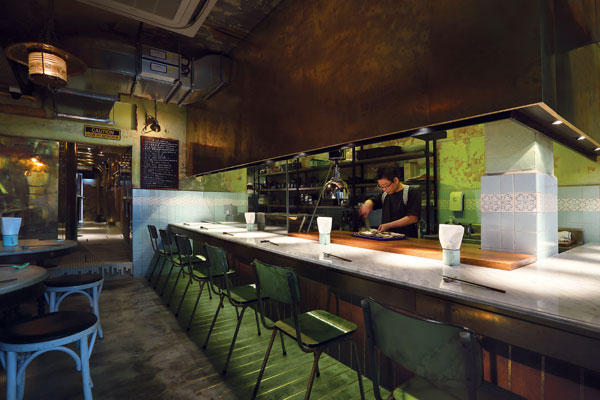
Bincho’s yakitori counter
In keeping with the spirit of the project, the original coffee shop has been spruced up slightly though the authenticity of its interior has been retained.
The entrance to Hua Bee and Bincho are also kept separate, with customers to Bincho having to enter by the backdoor, located near the car park and just under the air con vent.
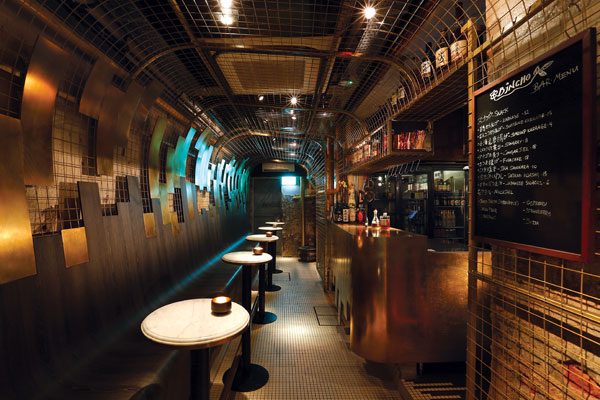
Inside Lik Peng’s new restaurant, original 70-year-old distressed concrete walls, retro blue tiles, rickety wooden chairs and evergreen marble tabletops merge with new and modern elements such as the copper furnishings around the yakitori counter and the sleek bar. Wire mesh is also used to carve out a somewhat futuristic capsule-like space within the latter.
The space, while tight, can accommodate 46 people; 9 seats are at the counter where guests can watch and chat with Chef Asai Masashi who helms the kitchen.
Bincho is located at 78 Moh Guan Terrace in Tiong Bahru and is part of Loh Lik Peng’s The Unlisted Collection.
Hjgher
hjgher.com
INDESIGN is on instagram
Follow @indesignlive
A searchable and comprehensive guide for specifying leading products and their suppliers
Keep up to date with the latest and greatest from our industry BFF's!
The internet never sleeps! Here's the stuff you might have missed