The home of architecture and design in the Asia-Pacific
Get the latest design news direct to your inbox!

Get the latest design news direct to your inbox!
Woods Bagot’s renewed vision for one of the world’s touchstone examples of contemporary workplace design called on the customisation and design capabilities of the team at Australia’s Designer Rugs.
April 29th, 2013
Campus MLC in North Sydney, Australia, is the culmination of decades of research and new learnings in the evolution of the modern workplace and work practices.
Originally built in 1957 the multi-story building underwent an extensive refurbishment in the 1990’s that demonstrated advanced thinking in how physical spaces were arranged, designed and designated to enhance productivity and work flow.

In its third incarnation as “Wealth Campus”, (offices of the newly amalgamated MLC and NAB) the interiors team at Woods Bagot set about building on the successes, indeed the prestige, of the site to enhance the experience for the inhabitants of the space – noting that happy and empowered workers produce work to a better standard in a more efficient manner.
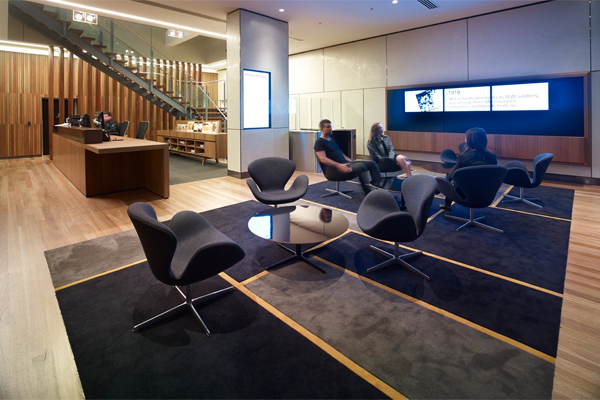
With each floor designated an aesthetic that reflects its primary function and purpose, the ten-storey tower almost assumes multiple personalities that keep at bay any chance of generic environments and predictability.
Integral to this process was the part played by Designer Rugs. Imbuing each space with its characteristic flair are the tailored rugs developed by Woods Bagot in collaboration with Australia’s Designer Rugs team.

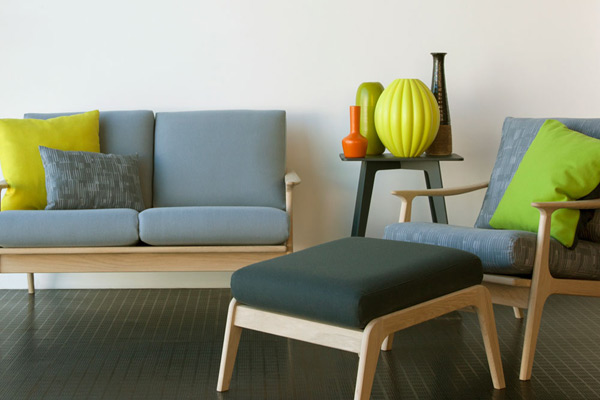
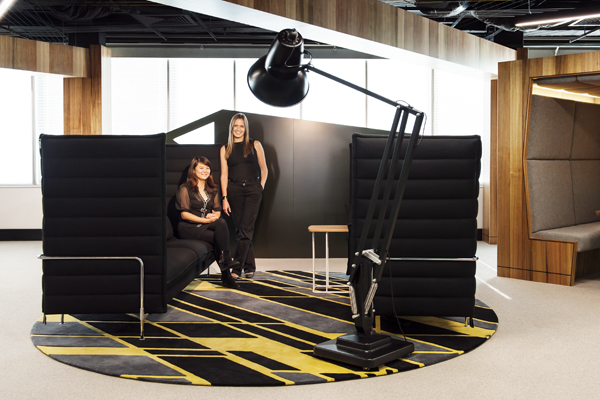
Here on level seven, designers Pei-Lin Chen and Kori Todd evoked a “living room feel” in response to the collaborative nature of the space. Drawing on a more relaxed vibe and with a focus on interactivity the Woods Bagot designers were able to apply theoretical concepts that defined the space in a graphical and evocative fashion.
“We designed multiple rugs to suit the personalities of each floor, this rug incorporates strong lines on a grayscale palette with canary yellow highlights,” Delineating the think-space with a rug that projects a sense of movement, confidence and executed to exacting commercial standards.
Designer Rugs
Woods Bagot
INDESIGN is on instagram
Follow @indesignlive
A searchable and comprehensive guide for specifying leading products and their suppliers
Keep up to date with the latest and greatest from our industry BFF's!
The internet never sleeps! Here's the stuff you might have missed