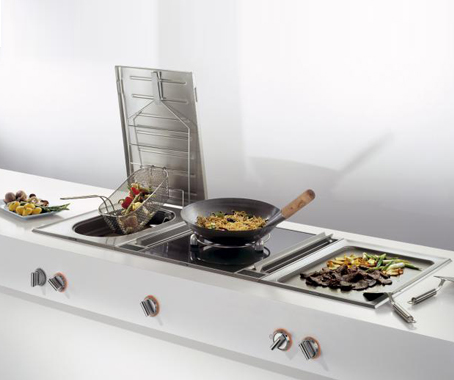
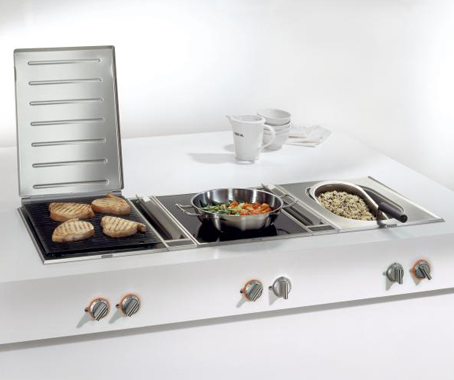
The Vario series features perfectly specialised appliances for every conceivable cooking challenge: classic glass ceramic, gas and induction cooktops and special appliances for grilling, deep frying and steaming, as well as suitable ventilation elements.
March 22nd, 2011
What’s more, everything can be combined. Appliances from the professional 400 series are 38cm wide and are made of brushed stainless steel. An illuminated orange ring surrounds the knobs on the front.
Included in the 400 series are:
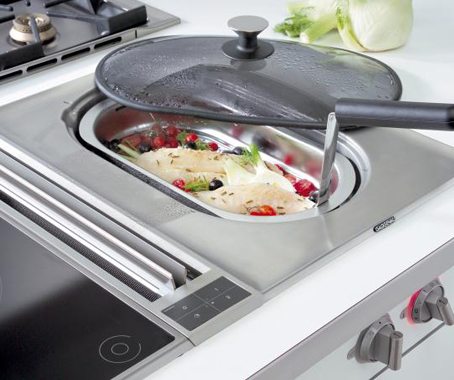
Steamer VK411- for steaming, keeping warm, defrosting and gentle heating at a precisely-controlled temperature. Two cooking inserts can be used for simultaneously steaming different food while ensuring that the taste of one is not transferred to the other. Electronic steam control saves time and energy as only the amount of steam needed is actually generated. The glass cover ensures that you can always keep an eye on the action.
Teppan Yaki VP421 – for cooking, frying or keeping warm on the whole metal surface or just half of it. Two cooking zones each with an output of 1150 watts.
Electric Grill VR421 – for grilling without the grease; directly on the cast grill grids. Two grilling zones, independently controlled for simultaneous grilling and keeping warm.
Induction Cooktop VI411 – when combined with the wok ring and the wok pan, it’s ideal for preparing Asian wok cuisine. Features automatic pot detection.
Sampford IXL
sampfordixl.com.au
INDESIGN is on instagram
Follow @indesignlive
A searchable and comprehensive guide for specifying leading products and their suppliers
Keep up to date with the latest and greatest from our industry BFF's!
Stepping into Intuit’s Sydney workplace certainly doesn’t feel like walking into an office. Why? In this film, we discover that, when joy takes precedence as a design driver, even a high-performing commercial CBD headquarters can feel like an intuitive wonderland that invites employees to choose their own adventure.
In the first instalment of our three-part series exploring what it means to sit your best, we pose the question to Gray Puksand’s Dale O’Brien, who discusses the importance of ease and majority rule when it comes to sitting and reveals why specifying a task chair is not unlike choosing a Volvo.
In the second instalment of our performance seating three-parter, we turn to DKO’s Michael Drescher and Jacob Olsen to peek behind Sayl’s confident architectural form and explore the ideas of inclusivity, adaptability and freedom to move as hallmarks of what sitting your best actually means.
Inspired by the textures and directionality of weaving, Tappeti’s new GRIGLIA range captures the striking grid form.
In 2007 Stylecraft hosted its first Ten Pin Bowling event for Architects, Designers, Project Managers and many companies associated with the design industry. The aim of the evening was to raise money for Breast Cancer Research in Australia. Bowling for Breast Cancer has been a huge success, is now an annual event and has raised […]
The 2024 Architecture & Design Sustainability Awards commend those who are leading the way in environmental responsibility.
Putting design on a global stage, the Salone del Mobile isn’t just for showcasing the newest product. Increasingly it’s about the activities outside the fairgrounds, and as commerce moves in at the juncture of art and design, one crowd of people are clearly being targeted.
The internet never sleeps! Here's the stuff you might have missed

Melbourne-based architect and object maker Adam Markowitz blurs the line between design and craft, bringing a deeply considered, material-led approach to his work. As both a practising architect and furniture designer, Markowitz explores how objects can respond to space, light and human use.
Presented by Designer Rugs
In the last instalment of our three-part performance seating series, Alex Bain from Architectus explains why sitting well shouldn’t feel like sitting at all and explores an unexpected success metric of the hybrid workplace: the grounding power of emotional support.
In this interview, Michael Leeton reflects on his philosophy of placemaking, connection to landscape and the importance of designing homes that balance intimacy with scale, using his award-winning project House on a Hill as a central reference point.