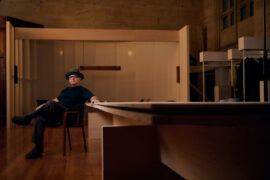
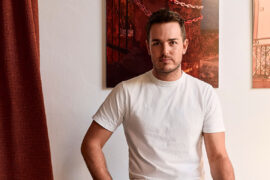
Aleesha Callahan talks with Rhys Cooper, an emerging Australian furniture designer, about all things design, materials and manufacturing.
April 20th, 2021
With the launch of Jam – JamFactory’s new all-Australian line up of locally designed and manufactured products, furniture and lighting – Aleesha Callahan chats with Rhys Cooper, whose Cusp Collection features in the Jam range, about his approach to design, materials and manufacturing.

Rhys Cooper: The Cusp collection is made using contemporary joinery techniques such as solid mortise and tenon joinery along with bent plywood for the backrest and seat.
I designed the Cusp range early in my career, the initial concept was simply to design a contemporary tub chair. The early stages of development involved a lot of model making and prototyping, with feedback provided by my peers. I then made the initial prototype and after some minor changes JamFactory agreed to produce the collection.

“Without Australian manufacturing, we will continue to lose valuable trades and craftspeople, and before we know it the industry will be lost.”

Material selection comes pretty early on in the design process and helps inform the direction, I find that if I don’t decide on the material and production process I tend to jump between ideas too much. I work with a variety of materials, predominantly timber, but really enjoy working with ceramics, glass and textiles.
Without Australian manufacturing, we will continue to lose valuable trades and craftspeople, and before we know it the industry will be lost. People should support local manufacturing where they can.

INDESIGN is on instagram
Follow @indesignlive
A searchable and comprehensive guide for specifying leading products and their suppliers
Keep up to date with the latest and greatest from our industry BFF's!
The Geelong College’s Sport and Wellbeing Centre ‘Belerren’ designed by Wardle is designed around bringing in natural light. But Shade Factor’s job was to help modulate and precisely control it for the most important competitive moments.
Aeron Chair’s new shades, Nightfall and Jasper, arrive with a sense of quiet cohesion – no bells and whistles, no loud technicolour; just two timeless, perfectly versatile near-neutrals. But the new hues aren’t just about colour – and their significance is much more profound than their surface-level subtlety might suggest.
In the second instalment of our performance seating three-parter, we turn to DKO’s Michael Drescher and Jacob Olsen to peek behind Sayl’s confident architectural form and explore the ideas of inclusivity, adaptability and freedom to move as hallmarks of what sitting your best actually means.
As Woven Image celebrates 40 years, it introduces a new collection developed in collaboration with Australian artist Ben Goss, inspired by his original artwork Where the Kookaburra Sits into a vibrant collection of digitally printed EchoPanel® murals and patterns.
With a plethora of talks, installations, exhibitions and happenings responding to this year’s theme (Design The World You Want), the eleven-day festival was the largest to date and arguably the most accomplished since inception.
An array of coloured circles overlaid in perfect geometric sequences create a spectrum of musical auras in artist David Sequeira’s Bundanon Art Gallery commission, Form from the Formless (Under Bundanon Stars).
From furniture and homewares to lighting, Dirk du Toit’s Melbourne-based studio Dutoit is built on local manufacturing, material restraint and the belief that longevity is central to sustainable design.
With a bold, singular vision and a new factory just around the corner from their Western Sydney manufacturing heartland, Maxton Fox’s evolution takes the best of its history while setting its eyes on the future – and keeping its feet firmly planted on Australian soil.
The internet never sleeps! Here's the stuff you might have missed

Our recent exhibitor session showed a renewed SID moving towards hospitality, process and more meaningful showroom experiences.
Arts writer and editor Victoria Hynes reports on the breadth of this year’s Venice Biennale, drawing out highlights from national pavilions including Australia, Morocco, India and the UK.