Currently working to bring Sydney’s $1 billion-dollar Quay Quarter Tower to fruition, Eve Clark shares how her philosophies underpin innovative and efficient high-rise design.

IDL: What are your key priorities/criteria when selecting which innovations to adopt within the development of new high-rise projects?
Eve Clark: First and foremost, as a global investment manager, our role is to create exceptional real estate experiences that deliver sustainable outcomes for our clients but also support the success of our tenant customers and add value to the millions of people who either work, shop or visit our buildings. This is our ultimate priority in high-rise projects such as Quay Quarter. Overall, the criteria for innovations we adopt are:
- Market demand,
- Focusing on the future, and
- Being flexible to enable innovation to give rise to exceptional properties.
What do developers look for the most when choosing the right architect to design a high-rise project?
Expertise in high-rise towers are unlike any other building typology and require specific expertise. Whether commercial, residential or other asset classes, there are specific principles that must be considered to deliver commercially viable outcomes. Unlike many low rise building typologies, which are generally more flexible and variable in plan, there must be a significant focus on structure and buildability as well as efficiency for towers.
- Commercial sensibilities – We try to select architects that understand the commercial metrics and market forces that drive tower properties. From construction cost, to buildability and program, to revenue and various sales/leasing metrics – architects that have an inherent understanding of these key development and investment drivers can design unique tower projects that are innovative yet intuitively focused on achieving a viable project outcome,
- Innovative approach – We are not just interested in simple extruded tower forms. While it is vital to design a floor plate and overall design that works from a metrics point of view and that suits the market, we also promote creativity and innovation in our projects. With the changing nature of work, promoting different ways of coming together and collaborating, it requires a new way of designing towers, such as at Quay Quarter Tower with these unique sky villages and extraordinary atria – the concept from 3XN was to change the way people work through the inherent form of the architecture, and
- Flexible approach – While architects need to push the boundaries and be innovative, they also need to be flexible and not too ‘steadfast’ on their concepts. With value engineering and feasibility refinement, their concept needs to be able to manipulate, grow and transform – to be able to truly realise and deliver exceptional property outcomes.
.
“We are not just interested in simple extruded tower forms.” – Eve Clark
.
Have the relationships between developers, architects/building designers and builders evolved over time due to technological advancements and innovations? How will continued advancements and innovations continue to impact these relationships in the near future?
We believe that the onus is not only on the architects, designers or engineers to bring new technologies and innovations to our projects, which may have been the case in the past. It is vital that developers and even landowners are kept abreast of technological advancements and also advancements in structural and services engineering, future workplace principles, new residential typologies (such as Build to Rent) and even planning strategy reforms, to ensure that their properties are underpinned by innovation and are well positioned for tenants/owners’ needs now and into the future.
We rely on all our consultants, who are at the coal face, to understand new technologies and advancements to inform us and challenge our pre-held ideals and briefs for our properties. We believe this will strengthen relationships with our key partners and consultants into the future as we challenge each other in delivering optimal real estate solutions.
.
“There must be a significant focus on structure and buildability as well as efficiency for towers.” – Eve Clark
.
How will Quay Quarter Tower contribute to the renewal of Circular Quay? How can tall towers help to redefine urban environments in general?
Quay Quarter Tower is just one component of our overall development at Quay Quarter Sydney. Across two city blocks, totally 11,000-square-metres of site area, we are developing seven buildings. In addition to the tower, is the development of three new high-end boutique residential buildings with some of Sydney’s finest apartments. 8000-square-metres of retail will deliver a high-end convenience offer to workers, visitors and residents alike along with some of Sydney’s best food and beverage operators joining forces to create a unique destination for not only the week but through the evenings and over the weekend.
AMP Capital is contributing to the overall renewal of the Circular Quay area through our extensive placemaking strategy, the boutique retail and laneways, revitalisation of heritage buildings and incorporating over one acre of green spaces into the development. In addition, we have a public art overlay, indigenous cultural interpretation and on-going liaison with the cultural institutions who contribute to the creative city.
.
“Quay Quarter Tower is just one component of our overall development at Quay Quarter Sydney.” – Eve Clark
.
As a commercial tower, Quay Quarter Tower on the premier address of Bridge Street is the start of Sydney’s commercial CBD. The renewal of Circular Quay and all the commercial development along the Quay will extend the commercial heart of the CBD closer to the water. This coincides with the increasing desire from tenants to have engaging workplaces and with the overall revitalisation of the precinct into a new destination with diverse new retail, vibrant restaurants, cafés and bars, and extensive well-being, recreation and green spaces, the workforces of tomorrow will thrive.
How challenging has it been to develop a visually appealing and yet environmentally friendly tall building, in the form of the Quay Quarter Tower?
AMP Capital is committed to achieving long-term sustainable outcomes at our real estate assets, through our supply chain and in the communities in which we operate. Our sustainability strategy addresses environment, social and governance issues in order to:
- Enhance value and minimise risk for our investors,
- Deliver exceptional real estate experiences for our customers,
- Perform in line with global best practice,
- Develop our people and our partners’ sustainability knowledge, and
- Build a culture which embraces sustainability as a core value.
Becoming carbon neutral by 2030 is just one of the ambitious long-term targets that make the part owner of Quay Quarter Tower, AMP Capital Wholesale Office Fund (AWOF), an attractive investment for sustainability-focused investors such as the Australian Government’s Clean Energy Finance Corporation (CEFC), which have invested AUD $100 million in the fund.
Quay Quarter Tower, which is targeting a 6 Star Green Star and 5.5-star NABERS rating once completed is also pursuing certification against the leading edge WELL Building Standard to address tenant interest in boosting the productivity and wellbeing of their staff.
.
“Becoming carbon neutral by 2030 is just one of the ambitious long-term targets [for Quay Quarter Tower].” – Eve Clark
.
The construction industry accounts for one-third of all the waste and CO2 created and more than a third of the all the material used globally. The most innovative sustainability feature of the landmark 200-metre skyscraper is that it is reusing and upcycling an existing tower on the site. It retains circa 60 per cent of the structural skeleton and 98 per cent of the structural core walls. This saves significant time in construction and material resources, which equates to a significant cost saving that can be used towards creating a new and better building for its users.
Traditional façade design has involved adopting the maximum possible high-performance glazing without true consideration for environmental performance. Buildings which follow this approach have tended to suffer from poor thermal performance, occupant discomfort and a high reliance on automated blind operation, which prevents access to views for a large portion of the year.
The Quay Quarter approach has reversed this trend. 3XN designed a highly unique tower design with a distinctive articulated façade that not only places environmental performance at the heart of the architecture through passive shading devices, but also assists in breaking down the scale of the large tower. The façade design uses passive means to:
- Maximise views out,
- Maximise daylight in,
- Ensure excellent internal thermal comfort, and
- Completely eliminate the need for blinds to control the thermal environment.
.
“3XN designed a highly unique tower design with a distinctive articulated façade that not only places environmental performance at the heart of the architecture through passive shading devices, but this articulation also assists in breaking down the scale of the large tower.” – Eve Clark
.
The design response is a high performance, low shading coefficient, high visual light transmission, double glazed unit with an external sun shading frame. The depth, shape and position of the sun shading frame have been specifically engineered to fulfil the environmental criteria and respond to each façade orientation. Furthermore, the approach provides excellent passive thermal control and works in harmony with the mechanical services system.
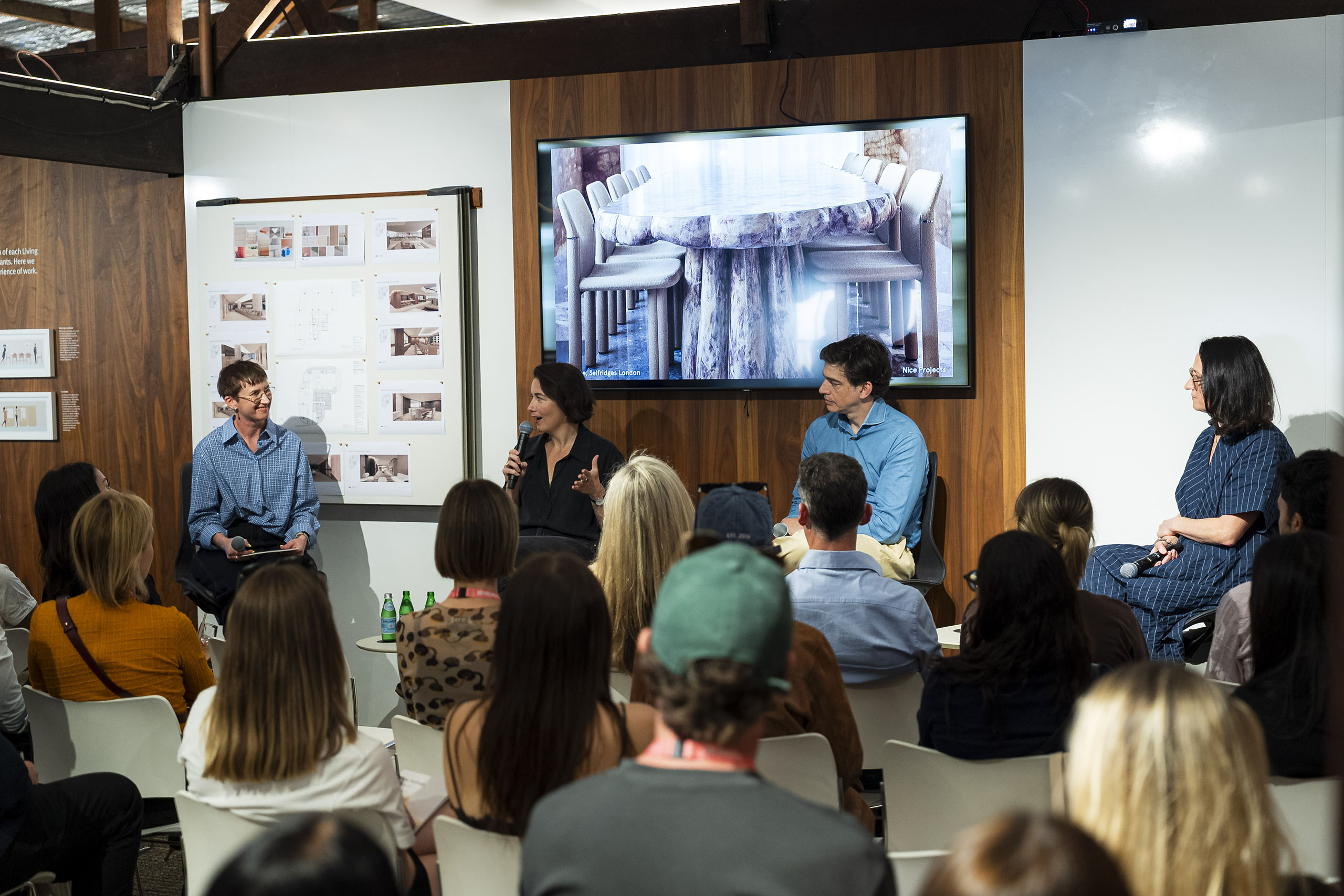
Eve Clark appeared on a panel discussion focusing on high-rise projects from the perspectives of property developers at the Australian Smart Skyscrapers Summit recently.
Read about socially sustainable skyscrapers here.
–
Never miss a beat, sign up for our design industry newsletter.