The home of architecture and design in the Asia-Pacific
Get the latest design news direct to your inbox!

Get the latest design news direct to your inbox!
Proving that the next generation of designers have their eyes on solving some of the world’s most pressing issues – waste and plastic use among them – we spend five minutes with rising talent Maddison Ryder to hear more about her award-winning Lettuce Eat project.

Plastic use and waste are just a couple of the big challenges facing humanity. But all hope is not lost as there is a new generation emerging and the designers among them are already finding ways to change the status quo. Maddison Ryder is a recent graduate of RMIT’s Industrial Design program and her final year project – Lettuce Eat – just won in the Tertiary category in the Victorian Design Challenge. With plenty of buzz around her and her invention, we set about asking her some questions about the project and where material development is heading.

Maddison Ryder, photo by Jason Edwards.
Maddison Ryder: In response to the abundant amount of waste seen in Australia, Lettuce Eat demonstrates how food waste can be transformed into a material of workability and adaptability. Lettuce Eat is a collection of biodegradable single-use plates made completely from waste iceberg lettuce.
This idea came to fruition upon understanding that almost one-third of all food grown for consumption in Melbourne, Australia is lost or wasted. With further research, it was uncovered that 41 per cent of this waste is due to the consumer directly. Observing the food discarded within my own home, I decided to divert fruit and vegetables from the bin to create materials from this waste.
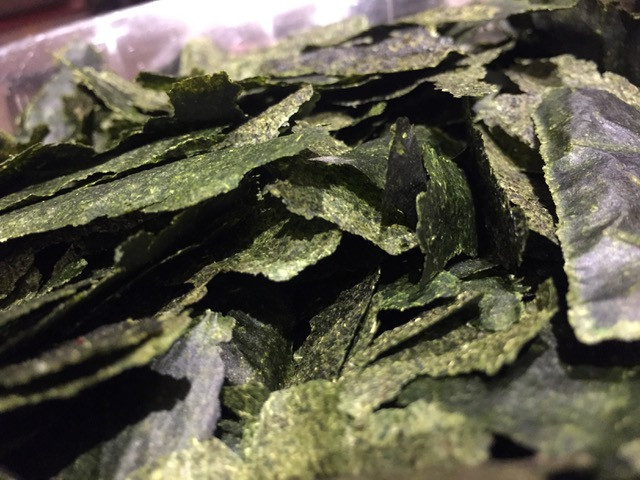
Part of the process, dehydrated lettuce sheets.
After months of experimentation, I discovered that the humble lettuce leaf could be transformed into a strong and beautiful material by means of blending and dehydrating. The final plate is then laser cut and assembled to create this striking geometric form which is then finished with a food safe and water resistant coating.
Presenting Lettuce Eat to a broad audience has been an incredible experience. Although it was nerve-racking standing on an illuminated stage in front of an esteemed jury and a sea of strangers, as I began to speak the nerves dissipated as my passion for what I have created came out. The support and encouragement from the public has been fantastic and is demonstrating that inventions like my lettuce plates are not only being accepted but shows that there is a demand for these highly sustainable products.
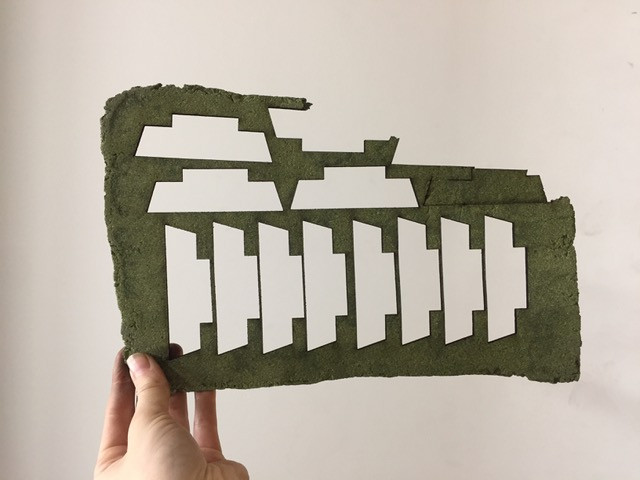
The laser-cut sheet.
Experimental materials will soon become the norm. At this point in time, projects just like Lettuce Eat are educating the public to change their perceptions from what waste is, to what it can and should be. With this altered view we can grow to not only support, but also accept these materials so they can replace plastic and paper products in the near future.

The final product.
It is difficult to be completely environmental when unsustainable products without adequate recycling systems surround us. Therefore, as a designer, I believe that it is our responsibility to design products that support a closed loop system. Products that ensure all elements of its creation, from concept to use, to disposal are considered with sustainability as a key driver. When all areas of a product are environmentally conscious, practising an eco-friendly lifestyle becomes a no brainer for the consumer.
Follow Maddison on Instagram @eatwasterepeat.
Get more sustainability inspiration here. And for a weekly design dose, join our mailing list.
INDESIGN is on instagram
Follow @indesignlive
A searchable and comprehensive guide for specifying leading products and their suppliers
Keep up to date with the latest and greatest from our industry BFF's!
The internet never sleeps! Here's the stuff you might have missed