The home of architecture and design in the Asia-Pacific
Get the latest design news direct to your inbox!

Get the latest design news direct to your inbox!
The German design duo collaborates with Wilkhahn for the first time on a conference chair that puts a humane spin on things. Rachel Lee-Leong speaks with them while in Milan.
May 4th, 2012

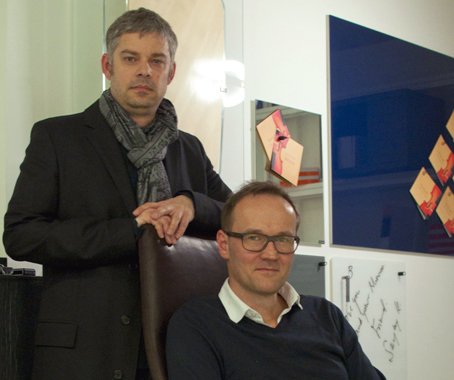
Markus Jehs and Jürgen Laub have always been very careful about who they work with. They have little patience for bureaucracy and red tape during the design process and prefer to work directly with those at the highest levels of a company. In the words of Markus Jehs, they don’t want to “waste time on the internal communications of a company” – all the focus should be on the product. And their aim? To create a product that has been distilled to its very essence, whether in concept or form. Wilkhahn, apparently, agrees. It has teamed up with Jehs+Laub for the very first time for the ‘Graph’ chair. The design duo shares more with Rachel Lee-Leong.

What were some ideas you were exploring with the ‘Graph’ chair?
Jürgen Laub (JL): The brief we received from Wilkhahn was to think about a conference chair. We thought about the really beautiful conference chairs like the ‘Aluminium’ chair by Charles Eames or the ‘Oxford’ chair by Arne Jacobsen – it’s a very silent chair. All these chairs have a beautiful image, but their comfort is not up to date because they have been designed 60 years ago. And if you look at office or conference chairs from today, most of them are machines. So, our intention was to design a chair that was a beautiful sculpture with no mechanics – or with natural mechanics.
Markus Jehs (MJ): We wanted also to have the feeling that if you enter the room, you would have the impression that there is already someone in the room because the chairs have enough personality. If you see the version with the high back around the table, you would have the impression that there are already people sitting around the table.

The chair has a very graphical profile. Could you tell us more about that?
MJ: We had an idea to follow old details. We tried to cut a simple, normal shell from the ‘50s so that you get different parts. We took these apart and [inserted] another material (die-cast aluminium). So the interesting thing is that the armrest holds the back and the seat together and it [creates] a new image.
JL: It’s a modular system. You have the same structure and you can have backs of different heights. One of the big challenges was to [resolve] the joints. To connect a die-cast arm with an upholstered part was very difficult and we had to build many prototypes until we were satisfied that it looked… easy. In the end you have a product that looks very simple, but it’s usually the hardest thing to reach this simplicity.

And in terms of comfort?
MJ: We said we didn’t want any mechanics. We had a steel frame, and foam and springs inside so that the steel frame itself is flexible – like a human body. In the rear, we have a leafspring, from trucks. This is the reason why the chair [can move] left and right, and front and back. If you move, the whole chair moves with you, so you have a 3-dimensional way of sitting.

What do you like about working with Wilkhahn, this being your very first collaboration with the brand?
MJ: They are very professional and the design of all Wilkhahn products is very integrated. If you change the technology or the hardness of the materials, everything [else changes]. In the end, the product needs to be very self-explanatory, very logical, very natural.

Let’s talk about the creative conflict that the both of you are known to have.
JL: One of us might be designing something, and the other one has a comment. Sometimes he says it is nice, sometimes not nice. But most of the time he says it is ugly…
MJ: OR this is horrible, so restart. But it’s important that you fight because it is important to do things right. If you are always thinking that the design is nice enough, if you don’t fight, then you don’t get to that point when something [really good] is happening.
Jehs+Laub
jehs-laub.com
Wilkhahn
wilkhahn.com
INDESIGN is on instagram
Follow @indesignlive
A searchable and comprehensive guide for specifying leading products and their suppliers
Keep up to date with the latest and greatest from our industry BFF's!
Living Edge opened it’s first Adelaide, SA, showroom today. The team are celebrating with an official opening party this evening at the showroom’s Pulteney Street location. This is the second big expansion for the Australian owned furniture company this year. They also opened a showroom in Los Angeles last month. www.livingedge.com.au
The internet never sleeps! Here's the stuff you might have missed