The home of architecture and design in the Asia-Pacific
Get the latest design news direct to your inbox!

Get the latest design news direct to your inbox!
American artist Janet Echelman talks forms, nature and design in her impressive installations.
December 17th, 2009
Janet Echelman is an American artist specialising in public art installations and sculptures. Her monumental installations in public spaces have garnered her worldwide acclaim and her work has been exhibited all over the world.
Your work reshapes urban spaces. In what way do you feel it intersects with design and/or architecture?
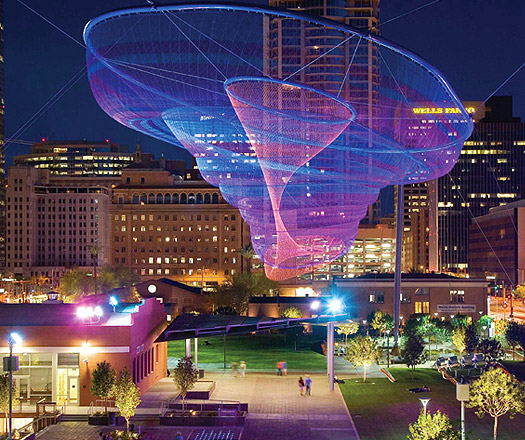
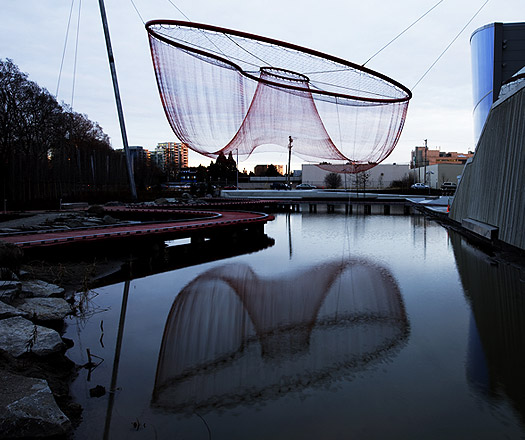
It is design — its function is shaping the experience of a person as they move through the space. It relates to architecture in terms of its scale and relationship to the ground plane and the sky. It contrasts with architecture in that it is fluidly moving, and is never the same at any given moment in time. Another difference from architecture is its translucency, because it can hold a major space and yet allows you to see through to the other side.
What kind of skills/professions are needed/engaged to bring your pieces to fruition? Do you work alongside a lot of architects or tradesmen?
I could not realize my work without the immense talent of my team of experts: architects, lighting specialists, structural and aeronautical engineers, computational design programmers, urbanists, landscape architects, industrial workers and artisans.
Tell me a little about your latest work, where it is, and how it transforms the space in which it is installed.
I think a lot about viewing corridors and creating visual excitement that is compelling at both short and far distances. In addition to a visual transformation of space, I’m also interested in creating behavioral changes in space.
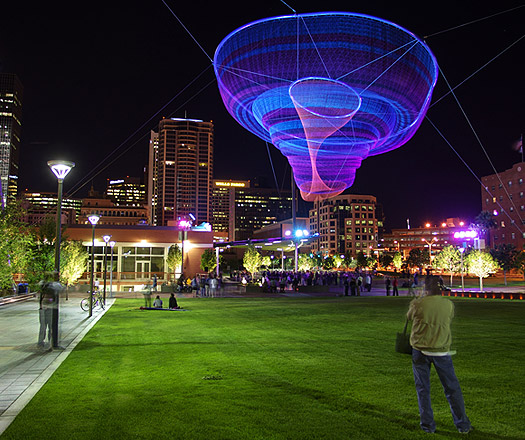
I’m engaged in the challenge of creating a visual, emotional, and behavioral transformation of a site. My goal is to create public artwork that can pull us out of our private worlds and into a shared experience of civic space. For example, in downtown Phoenix (USA), I’m told people now spend time lying in the grass under the sculpture, gazing upward — something that’s never happened there before.
What is it about your work, that you feels draws the viewer — as well as commissions?
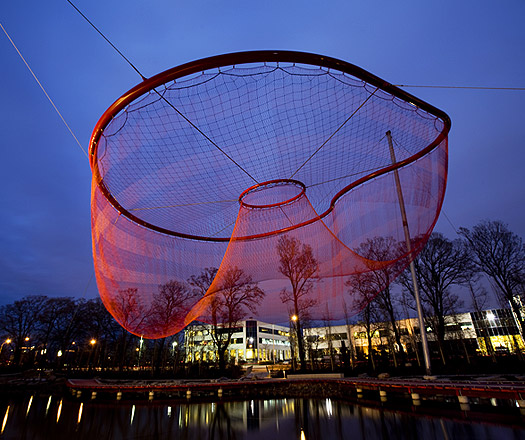
There is something about the delicacy and softness of the work combined with its monumental form that allows a person to get lost in an experience. Also, the ephemeral quality of the work, as it moves and changes with wind and light, allows people to form a relationship with the work that can change through time, just as human relationships change through time.
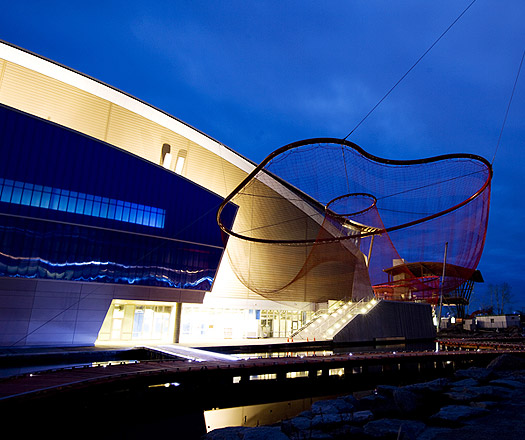
Your pieces respond to wind, water and sunlight: in what way do they do this? Physically, visually, or is it the source of inspiration?
All three. I am forever a student of nature and its patterns. Physically, the work responds to changes in air currents, allowing it to be choreographed by the wind. Visually, this changes it physical form.
My goal is to create works that feel as if they are breathing, animated by the wind itself. Regarding light, I see the shadows cast upon the ground as a kind of drawing, and am keenly aware of the work’s interaction with sunlight. As a pedestrian, when the shadow drawings are cast upon me and others walking through a site, we become participants in the work.
With nighttime illumination, I work to create different lighting conditions. Sometimes this can be quite simple, to illuminate the existing color of the materials; in other works the lighting involves a range of colors and changes very gradually on an annual cycle.
Janet Echelman
echelman.com
Hero image courtesy of Janet Echelman, Inc. © Valentin Berechet
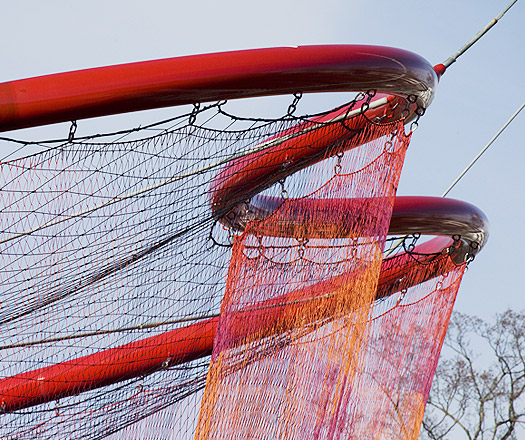
All photos courtesy of Janet Echelman Inc. © Peter Vanderwarker.
INDESIGN is on instagram
Follow @indesignlive
A searchable and comprehensive guide for specifying leading products and their suppliers
Keep up to date with the latest and greatest from our industry BFF's!
Corporate Culture, Designer Rugs and Euroluce are holding their combined weekend Garage Sale on Friday 17, Saturday 18 and Sunday 19 February. Unit 17, 30-32 Beaconsfield, Alexandria open 10-4pm on each dayContact details are: 9690 0077 info@corporateculture.com.au There will be up to 70% off furniture, rugs and lighting from brands including Cappellini, Mater, Hay, Fritz […]
The internet never sleeps! Here's the stuff you might have missed