The home of architecture and design in the Asia-Pacific
Get the latest design news direct to your inbox!

Get the latest design news direct to your inbox!
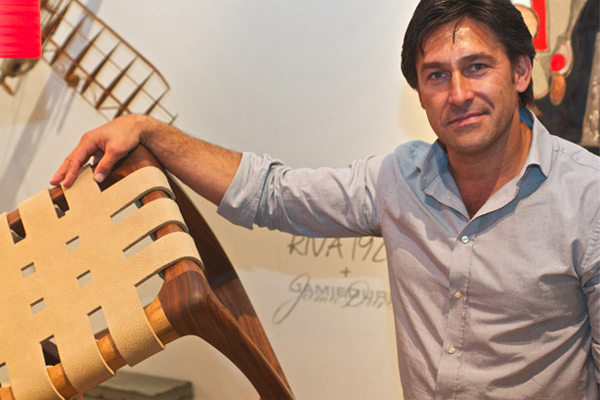
Jamie Durie’s new collection for Italian manufacturer Riva 1920 was launched this year in Milan. Nicky Lobo caught up with the Australian Landscape Designer to discuss the process and the journey behind his first foray into furniture design.
May 29th, 2013

Nicky Lobo: Can you tell me a bit about your designs? Maybe a bit about your Tubular Shelves?
Jamie Durie: Well, we wanted to make the customer’s feel like the designer – where ‘Jamie’ is only holding your hand through the process so you can really design it. Built like a modular system – so the owner can control its structure – it is a kind of mid-century Modernist flash back. The whole entire system can change and move to fit any room, and any space. That is the beauty of this design. In fact, I initially came to them with 18 designs, but with only ran with 6.
With all my designs for RIVA, we only started prototyping 2 months ago! And it was only 18 months ago that we even had our first conversation. Initially they sent me a packet of materials and asked me to think about the designs I would make with those materials. Then, we met – I showed them my designs and after that they asked me if I wanted to collaborate with them on this project. I was like, ‘absolutely’!!
NL: So why do you think they approached you?
JD: I honestly don’t know. I wish I could say it was because of my skills as a designer, but, I actually have no idea. But it is a great experience, and I’m so glad they approached me.
NL: Do you think that your past work in outdoor design helped you in this process?
JD: Totally. Maybe that might have been what got Riva’s attention initially. Every commercial hotel I’ve worked on in the past, I’ve always designed my own furniture for that space. But I’ve never had a ‘partner’ as such that was exclusive to my designs. When I met with Riva, I showed them the furniture I had done for all these commercial projects, and well, they obviously liked them! And it has just continued to grow from there. I have just hit ground running since then.
NL: Is this going to be a big change for you?
JD: It’s just a matter of mutating the business a little bit, I think. For years I’ve had around 30 architects and landscape architects working with me on commercial designs. Now, I am keeping the computers but changing the trades. And I’m just having an absolute ball. You can design a garden, and it will only touch one person. But you can design a table and it can touch thousands. Industrial design is offering me new and bigger possibilities.
I have a huge passion for mid-century modern architecture and design. In fact my house in LA is all mid-century: I’ve collected a lot of George Nelson’s pieces. I think this period has definitely inspired my designs. But with the Ficus Stool, well you can guess what inspired me there.
NL: What have you learned from this process?
JD: You need to start prototyping twice as early as they suggest! This was also a big geographical problem – you can’t just pop over and have a look at it.
NL: What is the broader idea behind your designs?
JD: Its all about space. Space is getting smaller these days – people are no longer living in huge, suburban homes. So I wanted to design a clever piece that could fit a lot in a small space. It is just so exciting. Initially I wanted to have some of these products in brass. However, Riva decided to powder-coat them, because it is more accessible to broader marker. And they were right. They are also available in oak, walnut and maple.
I love the company. This is my first range, and its all interior, and not one piece is exterior. I have been designing outdoor furniture with Big W for 9 years. But whether you work for the mass market like Big W or a more refined, smaller niched like here, it is still the same basic system, just on a different scale… And price bracket!
Actually, I can remember sitting on the factory floor five years ago in Taiwan, putting together some pruners I had designed. And that is where I learnt about products, and making sure they had both structural integrity and pricing accessibility. However with Riva, you don’t have to restrict yourself with affordable materials, you can go all out! But I do still believe in my philosophy: democratic design. Meaning that everybody should be able to have decent, good and affordable design.
NL: When can we expect to see these designs in Australia?
JD: Hopefully in three months.
NL: And this is your first time exhibiting here in Milan?
JD: Yes, this is my first time exhibiting. But I have been coming here for 7 years just to have a look and be inspired by what is happening in the design world.
NL: And now, for word association….
Dog: Bodhi – she is my dog. And I miss her!
Celebrity: Headache
Sustainability: Al Gore.
Bad Design: Whole Foods’ paper bag.
Culture: Sri Lanka.
Home: Sri Lanka.
Australia: Sydney.
Milan: Riva.
NL: And finally, what else are you excited to see here in Milan?
JD: Minotti and Cappellini – they are my favourites.
Riva 1920
INDESIGN is on instagram
Follow @indesignlive
A searchable and comprehensive guide for specifying leading products and their suppliers
Keep up to date with the latest and greatest from our industry BFF's!
The internet never sleeps! Here's the stuff you might have missed