The home of architecture and design in the Asia-Pacific
Get the latest design news direct to your inbox!

Get the latest design news direct to your inbox!
…and the honour goes to Mari Funaki. Read the extract article by Jan Howlin from Indesign Magazine Issue #33 here
May 29th, 2008
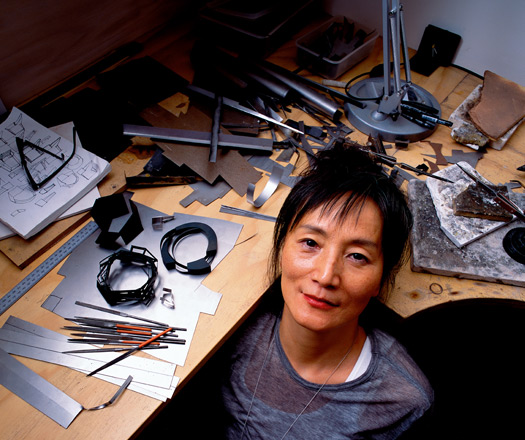
In Melbourne, Mari Funaki has an aura all of her own, reflecting the enormous respect accorded her, both for her own jewellery and for her support of other local and international jewellers through the Gallery Funaki.
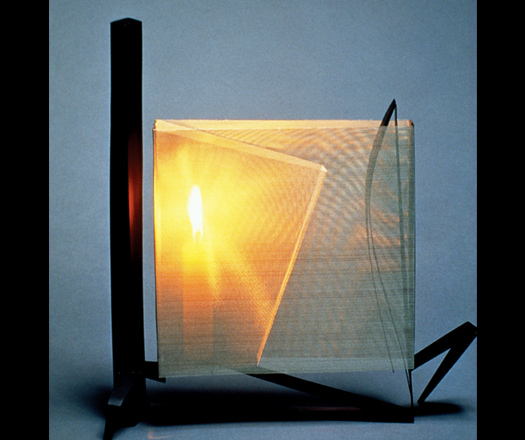
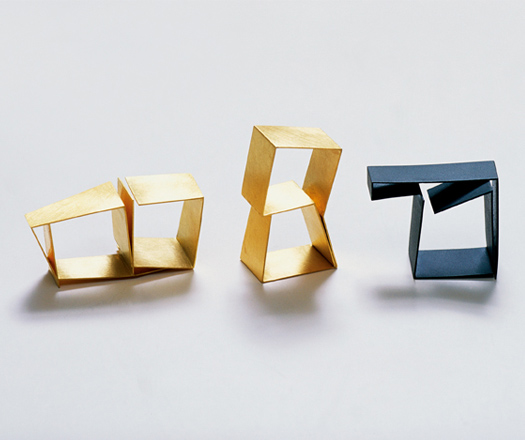
To look at the world through the eyes of Mari Funaki is to see a place drawn in fine, sharp lines and arcing planes, a stage populated by prancing arthropods, estranged industrial oddments and complex articulated forms caught, like a single film frame, in mid-action. While Funaki’s works are not large, and only ever appear in either black or white, they have a presence that allows them to dominate the spaces they inhabit. Pick them up and turn them in your fingers and you feel they are very nearly weightless. And with their prickly vitality, they possess an intriguing and compelling attraction.
Born in Japan, Funaki began developing her personal language of forms and held her first solo exhibition in 1991. In 1996 and again in 1999, she was awarded the Herbert Hofmann prize at the Munich International Trade Fair, one of the world’s most prestigious contemporary jewellery awards. “I only exhibited three times,” says Funaki. “I was overwhelmed.” As the first Australian to receive this award, the distinction and exposure quickly established her reputation, particularly in Europe.
She subsequently won the City of Hobart Art Prize in 2002, and her work is now held in most Australian State galleries, the Powerhouse Museum and the National Gallery of Australia. The success of her 2006 solo show at Funaki Gallery was followed by her inclusion in the Cicely and Colin Rigg Design Award at the National Gallery of Victoria. The nine bracelets she exhibited there attracted much attention and numerous commissions, including one substantial private commission and another pending from a major institution, both of which involve the translation of her work into a grand scale and represent a new, strictly sculptural, direction for Funaki.
While such highlights might normally be expected to encompass an artist’s complete career, as a gallery owner and director, Mari Funaki lives somewhat of a double life. After establishing Gallery Funaki in 1995 because she could find nowhere else to exhibit or sell contemporary jewellery and objects, she has since encouraged public awareness and appreciation of local and international work, represented and built a market for her artists, fostered connections with the international contemporary jewellery community and promoted quality and originality in design.
This year, in recognition of this contribution, she will be honoured with an Emeritus Award from the Australia Council for the Arts. So in both her lives, concurrently, Funaki, is receiving accolades. “It’s nice, at my age, finally, to get some recognition. It is very, very nice.”…
To read the whole luminary article, see Indesign Magazine #33 (May Issue), currently in newsagents.
INDESIGN is on instagram
Follow @indesignlive
A searchable and comprehensive guide for specifying leading products and their suppliers
Keep up to date with the latest and greatest from our industry BFF's!
The internet never sleeps! Here's the stuff you might have missed