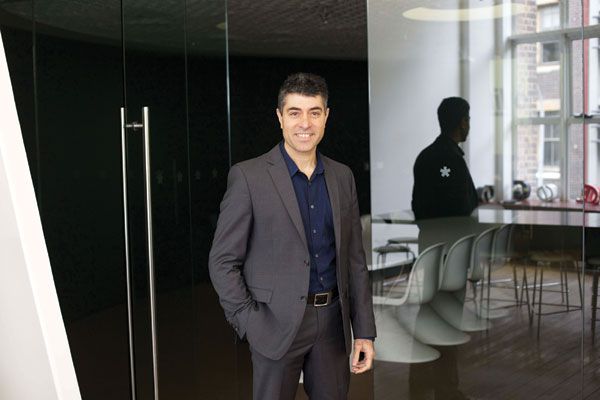
Can you tell us a little bit about your background?
From a very early age I was interested in the visual arts, particularly drawing. As a boy I would cover the walls of my bedroom with hand drawn illustrations – my parents were very understanding. I would often produce sketches of my family and friends and naturally gravitated towards art and design. When I completed the HSC, my art teacher recommended I pursue this interest. I enrolled in a four year visual communications degree at Sydney College of the Arts, graduating at the end of 1985.
My first full time job was in 1986 working as a junior art director at a small advertising agency called Davis Madden. I was there for 12 months but was let go after a major account was lost. Shortly after I discovered that Emery Vincent Design was setting up an office in Sydney to primarily service the large volume of work they had won for the Bicentenary. I went for an interview and was offered a position as a junior designer.
I spent the first month of my employment working in the Melbourne head office. As a young impressionable designer it was an amazing experience to work with a design luminary such as Garry Emery. It was a steep learning curve, but one for which I am grateful. I worked with many talented people in that time, including Penny Bowring who ran the Sydney office, Ray Parslow and Graeme Smith.
I was with Emery Vincent for 16 years from 1987 to 2003. In that year Vince Frost joined the company and we became Emery Frost. In November 2005, the Sydney office of Emery Frost was sold by the Clemenger Group to Vince Frost, Ray Parslow and myself and we became Frost Design.
In July 2014, Frost* evolved into three specialist agencies. The company restructured to become the Frost*collective, an umbrella company, with the business’ specialist divisions becoming separate business entities of which Urbanite is one.
Can you please tell us about your role at Frost*collective?
My primary role is Head of Environments at Urbanite, running a team of 10 designers and design managers. Urbanite is one of Australia’s foremost authorities on brand in the built environment. We partner with architects, interior designers and marketing teams to create graphic and communication solutions that harmonise with spatial design.
It’s exciting working across a broad range of sectors such as corporate, retail, transport, education, health, cultural, and public spaces. We think of ourselves as an invaluable strategic creative partner, adding value by unveiling key user insights, which are used to create effective design for memorable branded experiences. I still work on the creative side of the business providing creative guidance and mentorship. Design and creativity is still my first love.
What inspires you about this particular position ?
Every new project is a fresh opportunity to create something great. Working with other creatives such as architects and interior designers also inspires me. I enjoy working on business development and fostering relationships with clients and creative partners. What inspires me most is mentoring the team and growing their skills. One of the responsibilities we have as leaders in our industry is to grow our creative talent and pass on our knowledge and expertise for the next generation. This is our legacy.
Can you explain your approach to environmental design projects?
Every project has a unique problem that needs to be solved. Uncovering the optimum solution is what we strive for. The projects we work on range from developing graphic schemes for office fit-outs to complex way finding systems for hospitals and university campuses.
We follow a rigorous creative process that starts with learning everything we can about the project and discovering insights. Only when this is done can we move forward with confidence to the strategic design phase. We collaborate closely with all project stakeholders and involve them every step of the way. This ensures that the solutions we develop emerge from a deep platform of knowledge and insight.
What interests you about the discipline of brand experience?
Connecting people to their environment and developing a sense of place or journey unique to a brand is what interests me most. When developing our solutions we strive to enrich both the space and the lives of those who interact with it. I enjoy the intellectual rigour of our discipline. It’s as much scientific as it is creative. When developing a way finding system for a public space for example, one has to consider multiple factors, many of which are governed by building codes, legislation and practicality.
Tell me about contributions to the built environment that you believe have made a positive impact on our relationship with it.
In recent years we have worked extensively in workplace design, developing graphic and way finding schemes for companies such as American Express, Commonwealth Bank, Rio Tinto and the recently completed fit out for Westpac at Barangaroo. Architects and interior designers are acknowledging more and more that the design of the environment needs to be as flexible as people’s work practices. This has resulted in solutions that are more keenly tuned to human needs. It is important to acknowledge that in order to have a happy and productive workforce you need to place people’s wellbeing at the forefront.
What does a client look like?
The client is everyone who interacts with the space. We design for people, so you must always keep the end user in mind. In the realm of the built environment the best approach is to design for the broadest audience possible. Not all users are able bodied and have 20/20 vision, so you need to take a more democratic approach. We design with the assumption that everyone is experiencing the space for the first time. This ensures that we accommodate all the project’s requirements.
Can you explain some of the challenges that come with the role.
Juggling multiple tasks and getting through the volume of work is often a challenge. From a creative perspective, it can also be challenging to constantly push the envelope when striving to achieve the best possible result.
How do you overcome these?
I tend to be quite organised and disciplined. I work methodically and prioritise what I need to achieve. I have a great management team beside me who runs our projects and a team of inspiring young designers that produce great creative work.
It’s important to have a balanced life. I try to eat well and exercise regularly. It’s also vital to have other interests outside of your work life. I have been training in the martial arts for over 15 years, and recently attained my third dan black belt in Karate. I find my martial arts practice a great outlet in relieving stress and providing mental balance.
I also have a very supportive and understanding wife and two awesome children who provide a sanity check when things get a little crazy at work.
Urbanite
frostcollective.com.au