The home of architecture and design in the Asia-Pacific
Get the latest design news direct to your inbox!

Get the latest design news direct to your inbox!
Cinnamon Lee’s creations explore the space between man and machine-made, traditional and contemporary.
February 22nd, 2012

“It found me,” says designer and metalsmith Cinnamon Lee when asked how she first discovered her passion for design.
Lee takes inspiration from “nature, technology, humanity” to create jewellery and lighting that plays with the perceptions of those that encounter it, her studio following a “two-pronged approach” that lets her balance what she creates according to demand.
“Over the last 18 months bespoke jewellery and commissioned work has dominated, which helps support the exhibition/experimental side of my practice,” she explains.

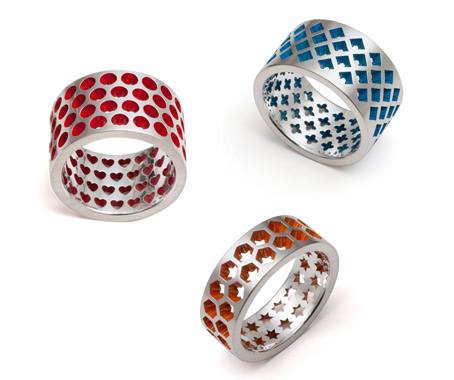
“This has not really been a result of precise planning but more a case of going with the flow and responding to what happens around me, especially given that the market for what I make is undergoing significant changes and what I make is quite specialised.”
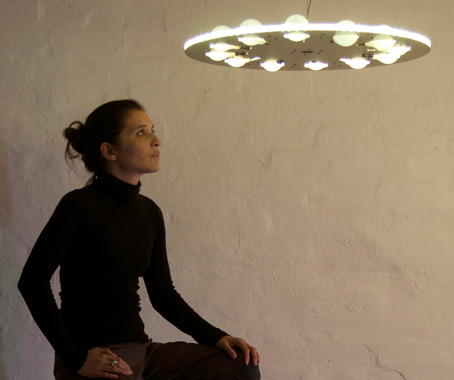
Lee’s Long Life Bulb Chandelier was a showstopper at 2011’s Launch Pad finalist exhibition. Expired lightbulbs, once redundant, are given a new life by providing a decorative element to the large disc-shaped piece, which is in fact illuminated by a ribbon of LEDs.
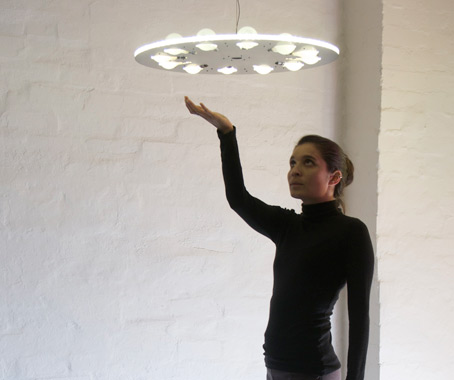
Controlled by a proximity sensor, the light is switched on and off with a wave of the hand, the light changing colour temperature and brightness depending on the proximity of the operator.
Lee used the interactive switching component in developing her latest series of lamps, Chameleon (currently on show as part of Object Gallery’s ’Stories in Form’ exhibition), interactive pendant lights that change hue as they interact with the user.
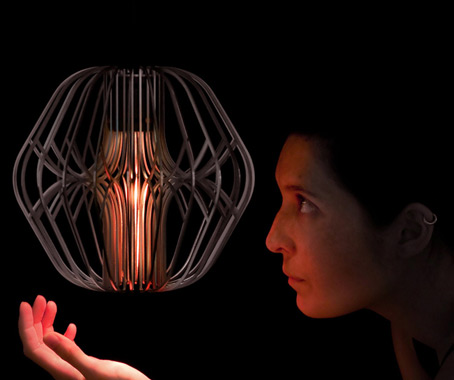
“The Chameleon lamps employ new technologies in order to create a product that extends the perceived potential of what a lamp may be,” Lee explains.
“Traditional lampshade forms have been adopted as the starting point, however their profiles have been dissected and repeated rotationally in order to produce deconstructed double-skinned versions.
“The shade in this case doesn’t perform its conventional duty of directing glare, but instead, given the unique nature of the LED light source, provides a different functional platform – reflecting the coloured light – thus focusing attention on the wire detail within the lampshade, instead of averting it.”
With a practice spanning 15 years, Lee stresses the importance of opportunities for support and engagement between designers and manufacturers to bolster Australian design, as well as government support for prototyping research and development grants, initiatives that follow through on product development, as well as increased support from specifiers – “for local design,” she says, “instead of cheaper imports or rip-offs.”
Photography: John Lee Photography
Cinnamon Lee
cinnamonlee.com
INDESIGN is on instagram
Follow @indesignlive
A searchable and comprehensive guide for specifying leading products and their suppliers
Keep up to date with the latest and greatest from our industry BFF's!
The internet never sleeps! Here's the stuff you might have missed