The home of architecture and design in the Asia-Pacific
Get the latest design news direct to your inbox!

Get the latest design news direct to your inbox!
The 2024 NSW Architecture Awards celebrate First Nations reclamation, social housing, sporting facilities and more.

July 2nd, 2024
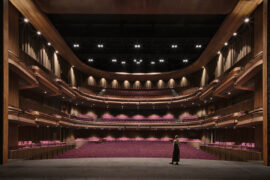
The New South Wales architecture community came together on Friday 28th June at the City Recital Hall in Sydney to celebrate a wide range of winners in the past year. Among a series of larger winning projects, the NSW Medallion was especially notable for being awarded to North Head Viewing Platforms by CHROFI and Bangawarra (with National Parks and Wildlife Service).
North Head Viewing Platforms received the headline prize on the basis of designing for, and with, Country in a project that showed a sincere commitment to honouring First Nations perspectives and values as well as environmental sustainability. On the Country of Car-rang-gel, the two platforms – Burragula (the time of sunset) and Yiningma (a cliff edge) – create “poetic, generous ways to share stories and opportunities for learning, and create a truly meaningful connection with Country.” The Robert Woodward Award also went to this project.

The Lord Mayor’s Prize was awarded to DesignInc for the regeneration of Redfern station, a project that makes use of the pre-existing urban fabric to tie in heritage to the infrastructure of what is a major transport hub. The station was also recognised in Heritage with the Creative Adaptation Award as well as a commendation in the Public Architecture category.
The Premier’s Prize, meanwhile, went to SJB for their significant Nightingale Marrickville project in Sydney’s inner west. In the context of the city’s housing affordability – set itself within wider questions of urban density that we discussed with SJB’s Adam Haddow not long ago – the project provides affordable rental housing without compromising on quality design. Communal areas are interwoven in the project, which also features 100 per cent electrification and a large bike storage space.

Sibling Architecture took away the Blacket Prize, named after early colonial British architect, Edmund Blacket. The South East Centre for Contemporary Art (SECCA), located in Bega, was recignised for achieving design excellence in a regional context. Covering over 500 square metres, the expansion of the former Bega Valley Regional Art Gallery reprograms existing functions, bringing gallery spaces to the periphery to showcase exhibitions through large openings in the textured aluminium facade screen. The project has provided a vibrant and playful new facade which engages with the surrounding landscape and civic precinct.
Elsewhere, Jennifer McMaster of TRIAS was named as this year’s Emerging Architect. Recently appointed as a Professor of Practice at the University of Sydney, her work is orientated towards the critical consideration of embodied carbon, regenerative materials and the contemporary material economy with research intended to be shared with the profession at large.

Other named awards included: the Sir Arthur G Stephenson Award in Commercial Architecture for Campbell House Private Office by Tonkin Zulaikha Greer (TZG); the William E Kemp Award for St. Patrick’s College: Scientia Building by BVN; the Enduring Architecture Award for Glass House by Ruth and Bill Lucas; the Greenway Award for the Porter House Hotel by Candelapas Associates; the John Verge Award for 477 Pitt St by Wardle; the Hugh and Eva Buhrich Award for Aru House by Curious Practice.
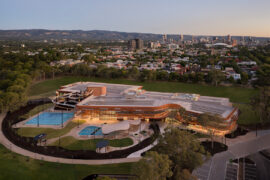
The Sulman Medal went to Grimshaw and Andrew Burges Architects with McGregor Coxall for Parramatta Aquatic Centre, with Sydney Football Stadium by Cox Architecture another sporting project that was given the Lloyd Rees Award. Blacktown Exercise and Sports Technology Hub (BEST) by ARM Architecture with CO.OP Studio was also notable as a sports project with multiple awards on the night.
The Aaron Bolot Award went to Bates Smart for Iglu Mascot, while the Wilkinson Award was picked up by Victorian practice, Studio Bright, for Maitland Bay House. Architectus received the Milo Dunphy Award for Barker College Maths and Student Hub, while the EmAGN Project Awards went to Pasqual Architects and ALCAMI ARCHITECTURE for Mavis Terrace and TERRACE HOUSE MIRAGE respectively.


INDESIGN is on instagram
Follow @indesignlive
A searchable and comprehensive guide for specifying leading products and their suppliers
Keep up to date with the latest and greatest from our industry BFF's!
The internet never sleeps! Here's the stuff you might have missed