Do you like walls but can’t stand the completely overdone and boring method of building them by stacking a bunch of bricks on top of each other and calling it a day? Do you like mixing a whole bunch of materials together to get a mixture that is greater than the sum of it’s parts? Do you like sustainable construction (seriously, who doesn’t?)? Then you need to look into the exciting new (by which we mean extremely ancient) trend of the rammed earth wall!
Rammed earth, is a technique for constructing foundations, floors, and walls by using natural raw materials. Materials like earth, chalk, lime, or gravel. It has a long history stretching back to about as early as humans were making buildings with evidence of it being used as far back as 8000 BC in the Fertile Crescent so if it was good enough for Mesolithic man it’s good enough for us.

Photo source: BabelStone
Making rammed earth generally means compacting a damp mix of sub soil that has the right amounts of sand, gravel, clay, and stabilizer (historically this meant lime or… animal blood) into a formwork (meaning a frame or mold).
The Soil mix is poured into the formwork to a suitable depth and then compacted to approximately half its original volume. The soil is compressed in batches or courses, gradually erecting a wall up to the top of the formwork. Tamping was historically done a long ramming pole, meaning a whole lot of work for the person or people doing it. Thanks to modern technology pneumatically powered tampers are now the preferred method but feel free to go all paleo and break your back if that’s the way you want to go.

Photo Source: Moshirah
The strength of rammed earth will actually increase as it cures with compressive strength of rammed earth decided by factors like soil type, particle size distribution, compaction level, moisture content of the mix and type and amount of stabiliser used. A well produced cement stabilised rammed earth wall can be anywhere between 5 to 20 MPa but you could get even more strength out of it if you were to use more cement. Once they’ve cured the walls can be painted, are as fire resistant as the materials used in them and depending on the strength can be load bearing, pretty much like any other wall.
Cost once again depends on the materials used it can be cheaper than alternatives but the cost in labour may mean it turns out pricey. They will require at least one skilled labourer and require special tools (unless you want to go all ‘early man’ here) so it’s not exactly a good call to do this one as a DIY project on a long weekend.

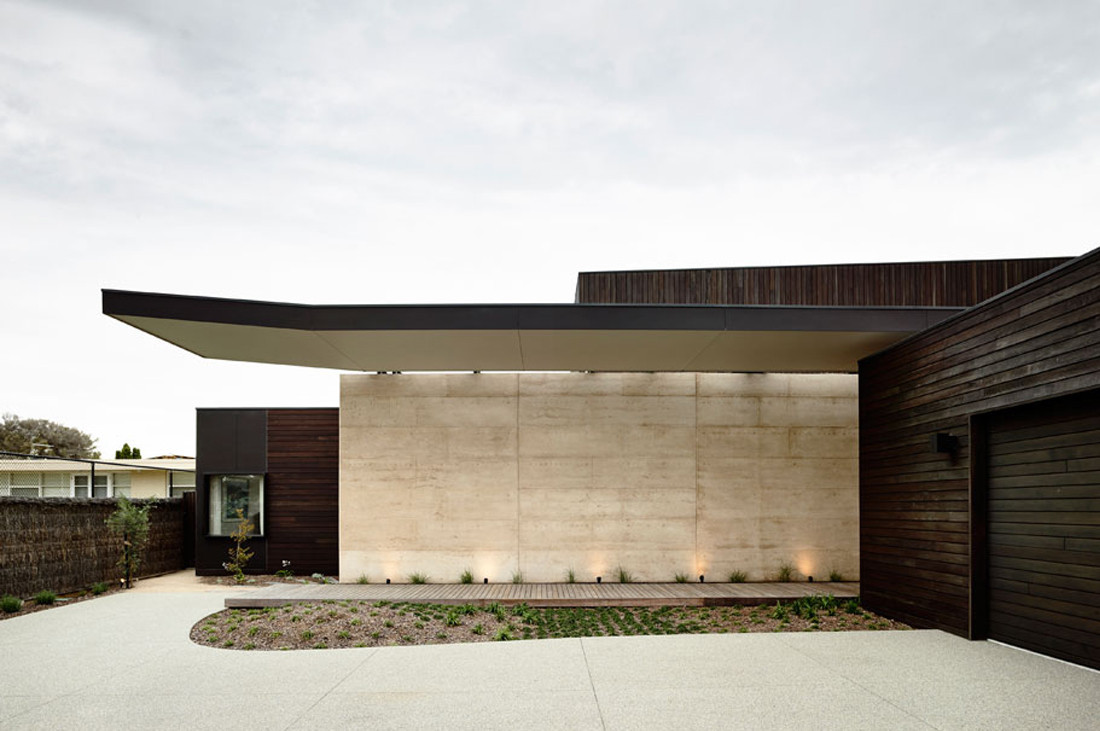
Photography by Michael Nicholson
In addition to needing to be professional constructed there are some other disadvantages, to name a few, they need roof overhangs to protect them from the rain and erosion, they’re terrible insulators in colder climates, depending on the circumstances and the need for experienced labourers it isn’t exactly cheap . Also, once it’s made, it’s pretty hard to alter it in any way, you’re stuck with what you’ve got.

So why choose the rammed earth wall or even a rammed earth house? Well one huge benefit is its high thermal mass, it absorbs heat during daytime and releases it at night. So in a hot country like Australia it’s a good material. Rammed Earth is also an effective regulator of humidity, it can be made to regulate humidity at a perfect range for people suffering from asthma.

Brick Kiln House by Made In Earth
Rammed-earth walls have the colour and texture of natural earth. If you’re into a natual look, this is the way to go. Thickness can be determined based on what they’re needed for. As little as 15cm all the way up to 61cm for something load bearing. Their density also make them perfect to block sound. They are fireproof, resistant to insect damage and non-toxic. The technique isn’t just limited to a standard or retaining wall but could be applyed to construct a floor as well.

Their main advantage, however, comes from the fact that they are more sustainable and environmentally friendly than any other construction material. When compared to standard building materials, rammed earth is THE green alternative.
So as far as the details go, while there are higher costs associated with their construction rammed earth walls just as strong as other walls, last just as long and are more sustainable by a long shot. In a world where global warming is becoming the number one priority, where we need to be considering more sustainable ways to construct homes and commercial spaces, this is something we’d like to see used more in architecture projects across the country.