The home of architecture and design in the Asia-Pacific
Get the latest design news direct to your inbox!

Get the latest design news direct to your inbox!
Unleashing the immense power of visual imagery, Positive Posters utilises graphic design to welcome global change.
October 20th, 2009
Inspired by the desire to help the greater community and combat a general air of negativity, Positive Posters was founded to promote change around the world.
The organisation’s founders, a group of creative Gen Y’s, broke through their lazy stereotype to create Positive Posters, a competition which invites professional graphic designers, illustrators and design students to create an image which reflects positive themes.
The winning poster is plastered on the streets of every continent in the world, particularly in areas where positive thought is said to be needed, in a scheme to get the entire globe smiling.
Positive Posters founder Nick Hallam explains, “There was a general negative vibe floating around the world. We wanted people to know that there is still some positivity in every situation. Some light in every tunnel.”
A graphic designer himself, Hallam recognized the enormous strength of the visual image and understood the competition as “a way to get everybody involved in graphic design,…to harness that power and slap it around the streets.”
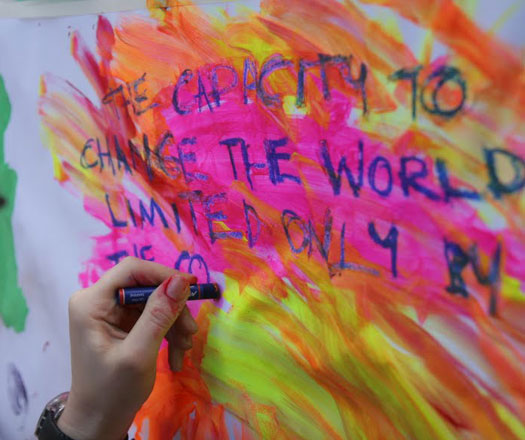
To publicize the competition, Positive Posters left their mark on Melbourne’s RMIT City Campus by creating a giant positive poster in the university’s thoroughfare.
Passersby were invited to contribute personal messages of change to a massive poster and collectively promote optimistic attitudes.
Based on an idea to provide the public with a blank canvas upon which to spill their thoughts, this event also provided participants with a voice to communicate their goals and inspire actualization.
This event linked people’s hopes and desires to graphic design and thereby cleverly introduced the public to the significant power of visual imagery.
Hallam sums up the event’s aim through his own personal conviction that “you can’t win by thinking. To achieve ideas you must first put them to paper or put them out there for everyone to hear.”
And just like that, so did this giant Positive Poster in the middle of a busy university walkway, transform its desire for change into a reality.
Entries close October 29, for more information visit positive-posters.com
INDESIGN is on instagram
Follow @indesignlive
A searchable and comprehensive guide for specifying leading products and their suppliers
Keep up to date with the latest and greatest from our industry BFF's!
Designer Rugs are celebrating their 25th anniversary with a massive sale. Head down to a Designer Rugs showroom in Australia and save 20%-50% on selected floor stock, including contemporary, traditional and textured handmade rugs. The sale is now on – so hurry down while stocks last! Designer Rugsdesignerrugs.com.au
The internet never sleeps! Here's the stuff you might have missed