A design expert says government influence and intelligent material use will produce economically-viable green products, Anthony Caggiano reports.
October 14th, 2010
Government influence and intelligent use of available materials and design principles are the keys to designing economically viable eco-friendly products, a design expert says.
At the Design Institute of Australia (SA Branch)’s last Snap, Crackle and Speak breakfast, WSP Environment & Energy Senior Sustainability Associate John Gertsakis said 70 percent of a product’s environmental impact is determined at the design stage.
“There’s more than just using ‘hero’ materials… there’s just a need to use materials more efficiently,” he said.
Mr Gertsakis said designers should use a “lock in, lock out” method where the most environmental benefits are set at the design phase.
Also, as the executive member of Product Stewardship Australia, Mr Gertsakis has been instrumental with the Federal Labor government’s National Television and Computer Product Stewardship Scheme.
Under the scheme, manufacturers and importers of televisions and computers will be responsible for recycling products they sell in Australia at the end of their lives. “You made it, you take it back,” he said.
It will be the consumer’s responsibility to return the products to a designated collection point free of charge. However they may pay a fee when they first buy a product to cover the future costs of collection and recycling.
The exact implementation of the scheme is currently open for consultation and can be found at online here.
DIA
dia.org.au
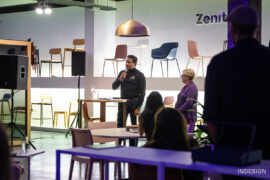
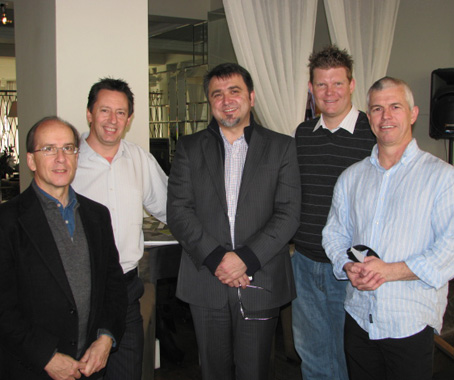
Hero image: Professor Paul Downton, Ontera Modular Carpets’ Mark Robinson, John Gertsakis, DIA (SA Branch) treasurer Brendon Harslett and DIA (SA Branch) co-president Andrew Whittaker at the Branch’s Snap, Crackle and Speak breakfast.
INDESIGN is on instagram
Follow @indesignlive
A searchable and comprehensive guide for specifying leading products and their suppliers
Keep up to date with the latest and greatest from our industry BFF's!
Stepping into Intuit’s Sydney workplace certainly doesn’t feel like walking into an office. Why? In this film, we discover that, when joy takes precedence as a design driver, even a high-performing commercial CBD headquarters can feel like an intuitive wonderland that invites employees to choose their own adventure.
In the last instalment of our three-part performance seating series, Alex Bain from Architectus explains why sitting well shouldn’t feel like sitting at all and explores an unexpected success metric of the hybrid workplace: the grounding power of emotional support.
Natural stone shapes the interiors of Billyard Avenue, a luxury apartment development in Sydney’s Elizabeth Bay designed by architecture and design practice SJB. Here, a curated selection of stone from Anterior XL sets the backdrop for the project’s material language.
For the Australian launch of Bernhardt Design, KE-ZU hosted design maven Suzanne Trocmé
HASSELL appoints award-winning architect Ben Duckworth as a Principal to be based in their Melbourne studio
In the bustling halls of Orgatec many innovations could be seen, but one company in particular took the classic sit-to-stand desk to all-new heights.
The Sydney Theatre Company (STC) is a much loved and revered institution, not only in its hometown of Sydney and across Australia, but also around the globe. Now that it has a revitalised and renewed home at The Wharf in Walsh Bay is the icing on the cake for both the staff of the STC and the theatre going public.
The internet never sleeps! Here's the stuff you might have missed

Powerhouse Parramatta has commissioned more than 50 leading designers from across Australia to shape the spaces and experiences of the new museum, including public, exhibition, restaurant and retail spaces.
Led by SJB, Newcastle Quay is imagined as a mixed-use waterfront precinct where housing, hospitality, public space and heritage work together to reconnect Newcastle with its harbour.
Melbourne-based architect and object maker Adam Markowitz blurs the line between design and craft, bringing a deeply considered, material-led approach to his work. As both a practising architect and furniture designer, Markowitz explores how objects can respond to space, light and human use.
In the last instalment of our three-part performance seating series, Alex Bain from Architectus explains why sitting well shouldn’t feel like sitting at all and explores an unexpected success metric of the hybrid workplace: the grounding power of emotional support.