The home of architecture and design in the Asia-Pacific
Get the latest design news direct to your inbox!

Get the latest design news direct to your inbox!
Linehouse designs a semi-open enclosure that imparts transparency, privacy and flexibility to the creative office of Chinese electric car brand NIO.

Shanghai-based architectural practice Linehouse has designed a creative studio for NIO, a brand by Chinese electric car startup NextEV. Located in Xintiandi, Shanghai, the 250-square-metre studio offers the team greater accessibility and convenience, in comparison to its main campus in the outskirts.
As the number of staff working in the studio varies from day to day, Linehouse has devised a floor plan to accommodate a variety of workstations, including fixed desks, hot desks and break out zones. “The main consideration was to create spaces that could be used by the staff in a really flexible way, in hopes of encouraging dialogue, teamwork and creativity,” says Alex Mok, the co-founder of Linehouse.
Apart from staff members, the studio will also be accessed by visitors during showcase events. A gallery has been built at the entrance and is the first thing to greet visitors. This is followed by an “inhabitable wall” or central enclosure, which functions as the primary working space, accommodating up to 31 staff members on permanent workstations and hot desks.
“This was a play on public versus private, considering how visitors would enter the space and move through it without seeing the ‘back side’ of the office,” says Mok, who adds that the team wanted movement and activities in the office to be visible.
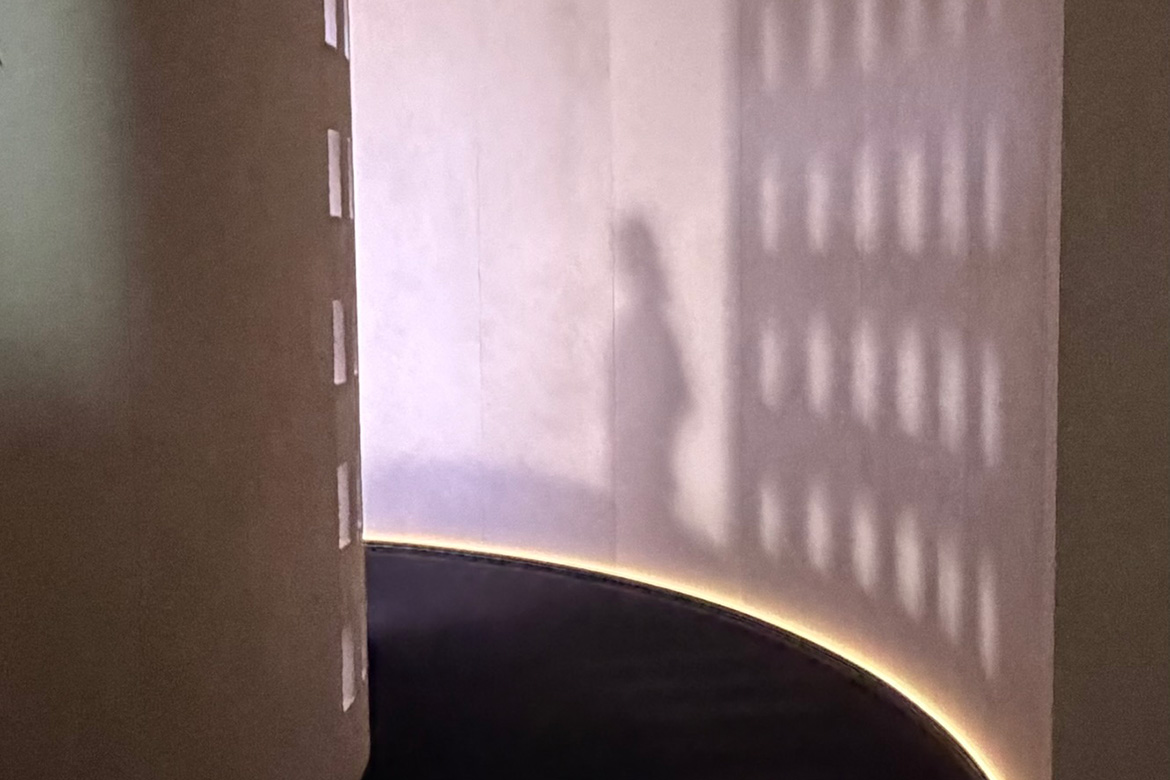
A glass skin shifts from the interior to the exterior of the curved enclosure, transforming either side of the wall into a feasible workspace. The glass skin is etched with a white vertical gradient that is opaque at the lower half of the glass and clear at the top, shielding the bottom of the enclosure while remaining transparent at eye level.
Inviting an adequate amount of natural light to filter through, the gradient glass also injects an ephemeral quality to the workspace, poetically reflecting the brand’s vision of a more sustainable future, as summarised by their Chinese name, “Blue Sky Coming”.
Besides offering a screening mechanism, the oak and glass “inhabitable wall” serves as a divider for private meeting rooms, IT and administrative zones allocated outside the enclosure. It also functions as work desks and storage spaces.
At the rear of the office, a ‘living room’ filled with lounge chairs and sliding pin up boards serves as an informal meeting place.
While all working desks were customised, the office features furniture by Hay, Muuto and Vitra, alongside lighting pieces by Foscarini and Flos.
Photography by Dirk Weiblen
INDESIGN is on instagram
Follow @indesignlive
A searchable and comprehensive guide for specifying leading products and their suppliers
Keep up to date with the latest and greatest from our industry BFF's!
The internet never sleeps! Here's the stuff you might have missed