The home of architecture and design in the Asia-Pacific
Get the latest design news direct to your inbox!

Get the latest design news direct to your inbox!
Diversity was a key strength of the third edition of Art Basel in Hong Kong, Christie Lee reports.

March 18th, 2015
Top image: Galerie Urs Meile
This year’s Art Basel in Hong Kong officially came to a wrap on 17 March. The third edition of the fair saw 233 exhibitors flying in from over 37 territories and regions, and was attended by nearly 60,000 visitors. With the slight change in viewing dates – the VIP preview was moved to a day ahead of Vernissage – strong sales were reported across the grounds.
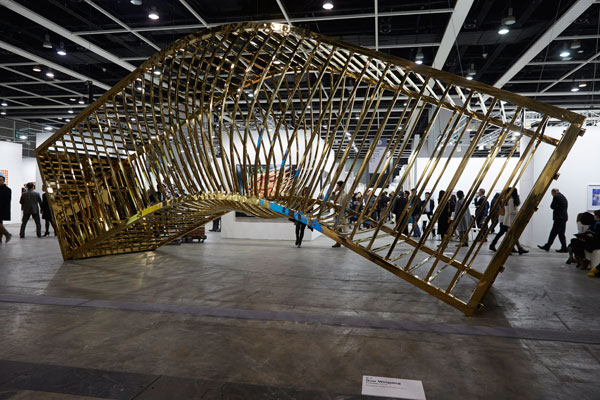
Gao Wei-gang, represented by Shanghai Gallery of Art
Ting Keng, founder of Taipei’s Ting Keng gallery, says, “We are very happy to see that collectors are now more informed and are purchasing works much faster. On the first day of sales we had a number of collectors, both old and new, with our known clients often introducing others to our gallery.” The gallery sold a 1980 Zao Wou-ki triptych for a record-breaking US$30 million to an international dealer.
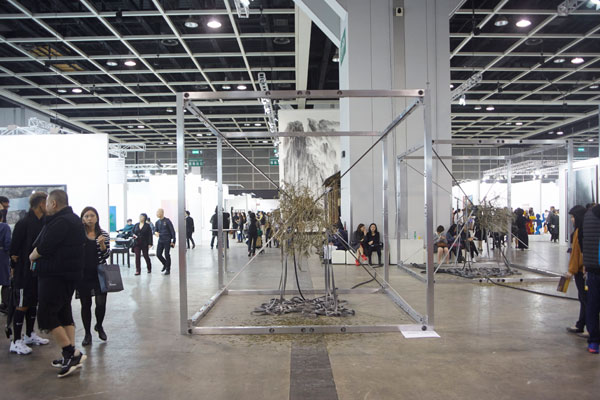
Siobhan Hapaska, represented by Kerin Gallery
“We have been hugely impressed by the dynamism here, and by the engagement of curators and collectors – many from a young generation,” first-timer Thomas Dane Gallery says.
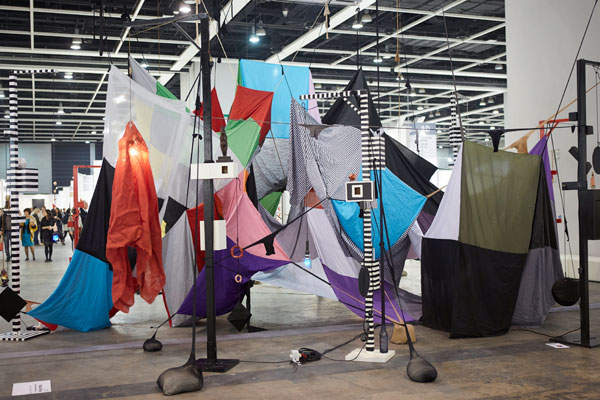
Mikala Dwyer, represented by Roslyn Oxley9 Gallery
The selection was generally more diverse this year, with less of the Chinese political pop art as seen last year, and more representation from Southeast and South Asian artists. Curated by newcomer Alexis Glass-Cantor of Artspace in Sydney, the Encounters section was another highlight in this edition of the fair, with the debut of new works by David Claerbout, Dzine (Carlos Rolon), Taeyoon Kim, Zai Kuning, Yang Maoyuan, Dane Mitchell, Eko Nugroho, João Vasco Paiva, Shooshie Sulaiman, Gao Weigang and Zhao Zhao. Common themes connecting the 20 large-scale sculptures and installations on display included dislocation, globalisation and enclosure.
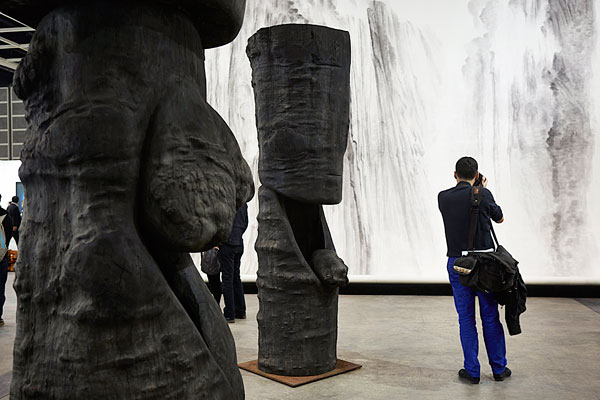
Wang Keping, represented by 10 Chancery Lane Gallery
Composed of three uprooted olive trees, each encased in a large, open cube made of anodised aluminium, Siobhan Hapaska’s Intifadals was as much an all-too-painful reminder of the ephemerality of nature, especially in a highly machinated era, as it was an embodiment of the spirit of uprising – not necessarily in a political sense, but a general ‘shaking off’ of dogmatic traditions. Loud as it might seem, Gao Wei-gang’s Consume was a nuanced examination of the futility of the act of ‘crossing the bridge’, or in a more general sense, travelling. Despite its majestic form and glimmering sheen of gold, that it was perforated ultimately deemed it counterproductive.
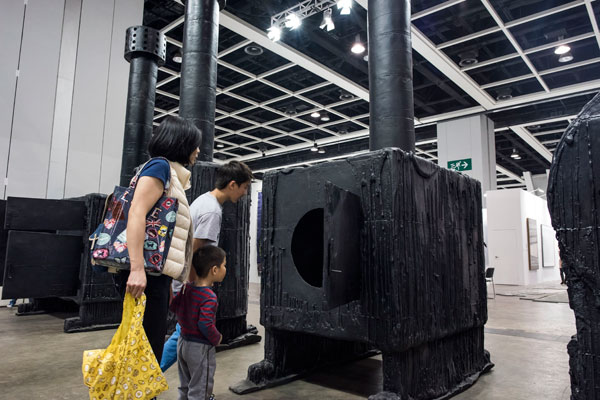
Sterling Ruby, represented by Gagosian Gallery
Photos courtesy of Art Basel
Art Basel Hong Kong 2015
artbasel.com/en/hong-kong
INDESIGN is on instagram
Follow @indesignlive
A searchable and comprehensive guide for specifying leading products and their suppliers
Keep up to date with the latest and greatest from our industry BFF's!
The internet never sleeps! Here's the stuff you might have missed