Education is one of those deceptively slow-moving industries that seems to take its time when it comes to change. But think about your education experience 10 or 20 years ago and then look at what’s currently on offer, both across Australia and internationally. Pedagogies have shifted dramatically over the years and anyone who thinks the sector hasn’t improved, progressed or adjusted would be well-advised to take a closer look!
One of the most exciting things about these changes is the response of designers and architects tasked with creating new learning environments. They’ve had to be nimble in their thinking in order to cater to the needs of different groups of learners. It’s a student-centred model with which they’re working and so the focus is on producing spaces that are highly flexible and easily personalised. The very best facilitate collaboration, foster self-directed study and provide plenty of opportunities for both social and digital interaction. Interestingly, people’s conceptions of what constitutes an educational space have also changed and so we’ve opened up the conversation in this issue of Indesign to include non-traditional learning environments.
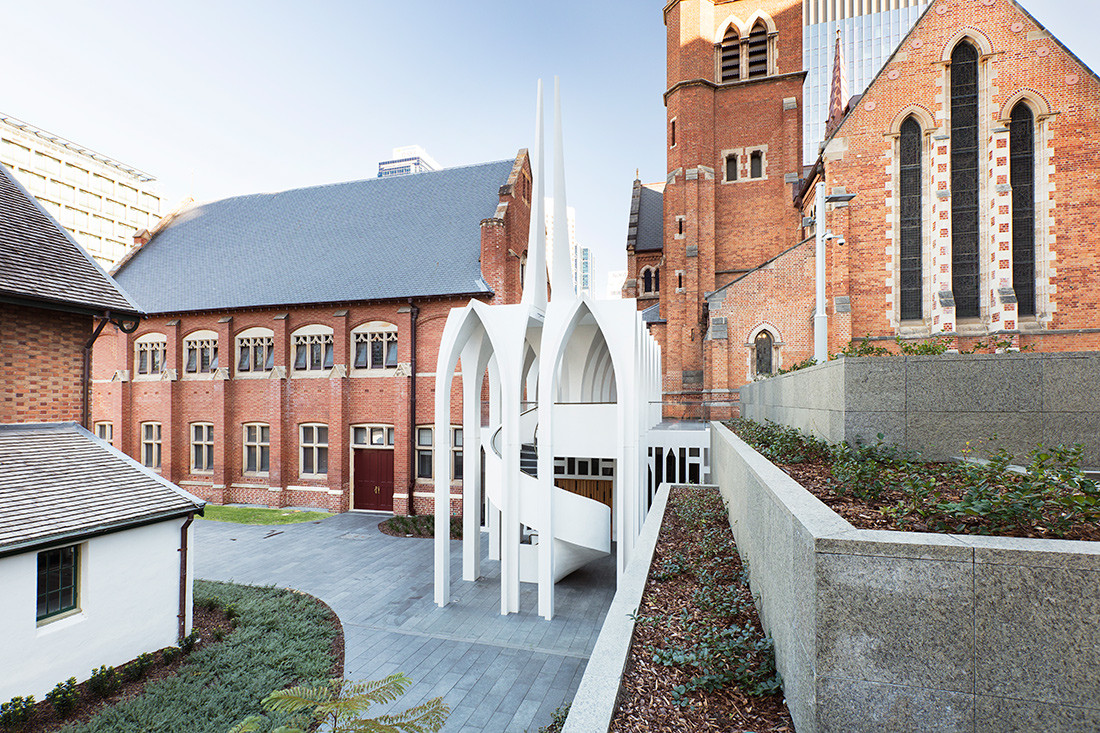
Song School by Palassis Architects. Photo by Bo Wong.
Hayball Sydney studio director Fiona Young argues that every place is a learning space and so the tools for teaching can be employed within different contexts for the benefit of all, regardless of age. It’s an incredibly attractive proposition and one that has designers and architects producing increasingly ingenious work as the lines between sectors, including cultural and commercial, continue to blur. And schools are no longer as straightforward as they once used to be. Case in point, Perth’s delightful new Cadogan Song School by Palassis Architects. While libraries are being taken to the next level in somewhat of a design Renaissance, best exemplified by Monash University’s Caulfield Library in Melbourne, and Sydney’s ambitious Green Square Library and Plaza.
All the projects in this issue are in some way smart, whether technologically, spatially or materially, and their ultimate success lies in the way they engage with the end user. Physical connection is emphasised as the realisation that learning is not and will not ever become a purely online pursuit. So why not make the experience for next-generation learners as joyous as possible? Certainly, Margaret Cribb Early Learning Centre and Jacaranda aspire to do so via biophilic designs that encourage discovery. And how about breaking down workplace silos within the research and education sectors to foster stronger interpersonal skills, as Bio 21 Institute Nancy Millis Building does?

Jacaranda by Labics. Photo by Marco Cappelletti and Delfino Sisto Legnani.
These days, the way we learn is heavily influenced by social and political change, amongst other things, and as a result, spaces must better marry these changes with our thirst for knowledge. But like Bates Smart director Brenton Smith points out in an article on knowledge workers, there must first exist a culture of learning and collaboration for design to be able to effectively play a role. Investigating this dynamic within a workplace context gives potency to the claim that knowledge-sharing is now more valuable than ever and learning doesn’t have a use-by date.
Leanne Amodeo is a writer, editor, media strategist and special edition editor of the Indesign ‘Knowledge Economy’ issue.